
Paper material is the foundation of many commercial printed products, from paper bags and brochures to catalogues, booklets, stationery and branded marketing materials. The right paper material affects the finished product’s weight, thickness, surface, print quality, durability, tactile feel and overall presentation. In this guide, you will learn how paper materials differ, how 80–200 GSM affects performance, when to choose coated or uncoated paper, and how to select the right specification for your printing or paper product.
Paper Material Guide: Contents
02. How Paper Material Is Made
03. Paper Material Types and Grades
04. Paper GSM and Weight: 80–200 GSM Explained
05. Paper Material Thickness, Caliper and Strength
06. Coated and Uncoated Paper Material
07. Recycled and Sustainable Paper Material
08. Paper Material for Bags and Printed Packaging
09. Paper Material for Commercial Printing
10. Paper Material FAQs: GSM, Printing, Sustainability and Product Selection
What Is Paper Material?
Paper material is a sheet-form material made primarily from cellulose fibres that have been processed, formed, pressed and dried into a controlled surface. Depending on the fibre source, manufacturing process, weight, density, surface treatment and intended application, paper can provide very different levels of flexibility, smoothness, opacity, printability, strength and tactile quality.
In commercial printing and lightweight packaging, paper material commonly covers stocks used from around 80 GSM to 200 GSM. These materials can serve very different purposes. For example, a lightweight sheet may work well for a leaflet, while a heavier paper can provide a more substantial feel for a premium printed product. Likewise, a suitable paper stock can form part of a branded bag, food bag or retail bag when its specification matches the construction and intended use.
Fibre
Cellulose fibres form the fundamental structure of paper. Their source, length, treatment and bonding influence the finished sheet.
Weight
GSM indicates the mass of paper over a defined area. Therefore, it helps buyers compare paper stocks, although it does not describe every performance characteristic.
Surface
Coating, texture and finishing influence how paper feels, absorbs ink and presents printed colours.
Application
The right paper depends on what you are producing, how it will be printed and how the finished product will be handled.
What Is Paper Made From?
Most conventional paper begins with cellulose fibre. Manufacturers obtain these fibres from plant-based raw materials, particularly wood, although some speciality papers use alternative fibre sources. The fibres undergo several stages of preparation before they become a uniform sheet.
First, the raw material is processed into pulp. Next, manufacturers clean and refine the pulp so the fibres can form an effective network. The prepared fibres then combine with water and move through a sheet-forming process. Afterward, pressing and drying remove water and consolidate the sheet. Finally, manufacturers can apply additional treatments to achieve the required surface, appearance and performance.
As a result, paper is not simply a flat layer of wood fibre. Its final characteristics depend on how those fibres are selected, processed, formed and finished.
Cellulose Fibres and Paper Structure
Cellulose gives paper its fundamental fibre structure. During manufacturing, individual fibres bond together to create a continuous sheet. The strength and behaviour of that network depend on factors such as fibre characteristics, refining, fibre bonding, sheet formation and moisture.
Consequently, two papers with a similar GSM can still feel and perform differently. One may feel smoother and denser, while another may have greater bulk or a different tactile character. Therefore, GSM should never be treated as the only specification when selecting paper material.
This distinction becomes particularly important when a paper product needs to fold, crease, carry printed graphics, accept finishing or withstand repeated handling.

Cellulose fibres form the fundamental structure of paper material.
Virgin Fibre and Recycled Fibre
Paper can contain virgin fibre, recycled fibre or a combination of both. Virgin fibre comes from newly processed raw material, while recycled fibre comes from recovered paper that has undergone further processing before entering a new paper product.
Virgin and recycled papers can both provide excellent results. However, their appearance, surface characteristics and performance can differ according to the specific grade and manufacturing process. Recycled paper may also show a more distinctive natural appearance, although modern recycled stocks can achieve a wide range of colours and finishes.
Therefore, material selection should begin with the actual application rather than with a simple assumption that one fibre source is always superior.
Paper Material vs Heavier Packaging Materials
Paper material sits within a much wider family of fibre-based materials. Lightweight paper is commonly associated with printed communications, bags, wraps and other flexible or semi-flexible applications. Heavier materials, however, provide greater structural rigidity and therefore suit different packaging constructions.
| Material category | Typical role |
|---|---|
| Paper | Commercial printing, paper bags and lightweight printed products. |
| Paperboard | Folding cartons and other stiffer packaging applications. |
| Corrugated board | Transit, shipping and protective packaging. |
| Rigid board | Premium rigid box structures requiring substantial rigidity. |
These materials should not be treated as interchangeable. Instead, the product’s dimensions, construction, handling requirements and intended use should determine the appropriate substrate.
For a wider overview of packaging substrates, see the Packaging Materials Guide. If you need more specific information about folding carton, kraft board, corrugated or rigid board materials, the dedicated material guides provide greater depth.
Why Paper Material Specification Matters
Choosing paper involves more than selecting a number from a GSM chart. First, consider the finished product. Then consider the required appearance, custom printing qual
ity, folding behaviour, handling and finishing. Finally, consider sustainability, quantity and budget.
For instance, a brochure may prioritise smooth colour reproduction and an appropriate reading feel. A paper bag may require a different combination of strength, flexibility, surface appearance and construction performance. Similarly, a luxury branded product may need a paper surface that works effectively with a particular finish.
Therefore, the best paper material is not necessarily the heaviest, smoothest or most expensive option. Instead, it is the material whose characteristics match the product’s actual requirements.
A Simple Way to Think About Paper Material
Fibre + weight + structure + surface + application = paper specification. Each factor contributes to the final result. Therefore, good material selection starts by understanding the complete product rather than choosing paper by GSM alone.
For the broader relationship between paper, printing, packaging and finished products, explore the Printing & Packaging Guide. For detailed information about paper and card GSM, including how weight relates to other material characteristics, see the Packaging Card GSM Guide.
How Paper Material Is Made
Understanding how paper material is made makes it easier to understand why different paper stocks look, feel and perform differently. Although finished paper may appear simple, manufacturers carefully control fibre preparation, pulp quality, sheet formation, pressing, drying and surface treatment. At Sky Print and Enterprise, understanding these production stages helps us select and recommend suitable paper materials for different packaging and printing requirements. As a result, the manufacturing process directly influences weight, smoothness, opacity, strength, absorbency, printability and tactile character.
For commercial printing and paper products, these differences matter because the same basic fibre can become very different paper grades. Therefore, selecting the right paper starts with understanding how its structure develops from fibre to finished sheet.
From Fibre to Finished Paper
Every paper stock passes through a sequence of controlled manufacturing stages. Each stage contributes to the final material.
Fibre
Pulp
Refining
Formation
Pressing
Drying
Finishing
Fibre Preparation
Paper production begins with a suitable fibre source. Manufacturers may use virgin wood fibre, recovered paper fibre or blends selected for the intended grade. The raw material first undergoes preparation so manufacturers can separate and process the fibres consistently.
At this stage, the quality and characteristics of the fibre already influence the potential performance of the final sheet. Fibre length, cleanliness and composition can affect bonding, formation and strength. Consequently, manufacturers select and process fibres according to the paper’s intended purpose rather than using one universal fibre specification.
For example, a lightweight commercial printing stock requires a different balance of properties from a paper designed for a demanding packaging application. Therefore, the production process begins with material selection rather than at the paper machine itself.
Pulping: Turning Fibre into a Usable Material
Next, manufacturers convert the prepared raw material into pulp. Pulp consists primarily of fibres suspended in water, creating a workable material that can later form a continuous sheet.
Different pulping approaches can produce different fibre characteristics. However, the objective remains consistent: create a clean, controllable fibre suspension that can form a uniform sheet.
Manufacturers then clean the pulp to remove unwanted material. This step helps maintain consistency and contributes to the quality of the finished paper. In addition, controlled preparation supports a more uniform surface, which becomes particularly important for commercial printing.
Why this matters: Paper quality starts before the sheet exists. Fibre selection and pulp preparation influence the structure that later determines how the material behaves during printing, folding and finishing.
Refining the Fibres
After cleaning, manufacturers can refine the fibres. Refining changes the physical characteristics of the fibres and influences how effectively they bond together when the sheet forms.
This stage requires careful control. Too little treatment may produce a different bonding behaviour, while excessive treatment can alter drainage and other paper-making characteristics. Therefore, manufacturers balance fibre treatment with the requirements of the final grade.
The result contributes to properties such as sheet formation, strength and surface characteristics. Consequently, two papers with similar GSM can still demonstrate noticeably different performance because their fibre treatment and manufacturing specifications differ.
Sheet Formation
Once the pulp reaches the required condition, manufacturers distribute the fibre suspension across a forming system. Water drains away while fibres begin to settle into a continuous web.
Uniform formation matters because an uneven fibre distribution can affect the finished sheet’s appearance and performance. In contrast, controlled formation helps create consistent paper across the entire production width.
At this point, the material still contains a significant amount of water. The next stages therefore focus on consolidating the fibre network and removing moisture.
Pressing and Drying
Pressing removes additional water while helping consolidate the newly formed fibre web. The paper then moves through controlled drying stages, where further moisture removal transforms the wet web into a stable sheet.
Drying requires careful control because moisture influences paper dimensions, surface behaviour and subsequent converting performance. Furthermore, paper can respond to changes in humidity, so manufacturers must maintain appropriate process conditions to achieve consistent results.
Once sufficiently dry, the paper has developed much of its fundamental structure. However, its final surface may still require additional treatment.
Surface Treatment and Finishing
Manufacturers can modify paper surfaces to achieve particular visual and functional characteristics. Depending on the grade, this may include coating, smoothing, calendering or other finishing processes.
Surface treatment can influence smoothness, gloss, ink holdout, tactile feel and visual appearance. Therefore, coated and uncoated papers can produce noticeably different printed results even when their basic weight appears similar.
For premium commercial printing, the surface becomes especially important because it affects how photographs, colours, fine details and branding elements appear.
Smoothness
Affects tactile feel, surface appearance and the way printed detail presents on the sheet.
Absorbency
Influences how ink interacts with the paper and therefore affects colour and print appearance.
Texture
Creates tactile character and can support natural, premium or speciality brand positioning.
Finish
Can alter the visual and functional surface according to the intended printed product.
How Manufacturing Affects Your Finished Product
The manufacturing process matters because paper is not simply defined by its GSM. Fibre selection, refining, formation, drying and surface treatment all contribute to the final material specification, helping Sky Print and Enterprise deliver paper and packaging solutions suited to different printing and product requirements.
For instance, two 120 GSM papers may have different smoothness, opacity, bulk and print behaviour. Likewise, two papers with a similar visual appearance may respond differently when folded, creased or printed. Therefore, professional paper selection considers the complete specification rather than relying on weight alone.
This approach becomes particularly valuable when producing branded bags, brochures, catalogues, booklets and other printed products where appearance and practical performance must work together.
Material Selection Starts with the Finished Product
Instead of asking only “What GSM should I use?”, consider the complete requirement:
What are you making?
What should it look and feel like?
How should artwork reproduce?
How will customers use it?
Will it need additional treatment?
As a result, the right paper material depends on the relationship between its fibre structure, weight, surface and intended application. Once those factors are understood, it becomes much easier to specify a paper that delivers the required appearance and performance.
For the next step, this guide examines the major paper material types and grades used for commercial printing and lightweight paper products. If you need the broader relationship between paper, packaging and printing, explore the Printing & Packaging Guide.
Paper Material Types and Grades
Choosing between paper material types and grades becomes much easier when you understand what each stock is designed to do. Paper can look similar at first glance, yet its fibre composition, surface, weight, coating, texture and manufacturing specification can produce very different results. Therefore, the best paper is not simply the heaviest or most expensive option. Instead, it is the stock that matches the product, printing requirements, appearance and handling conditions.
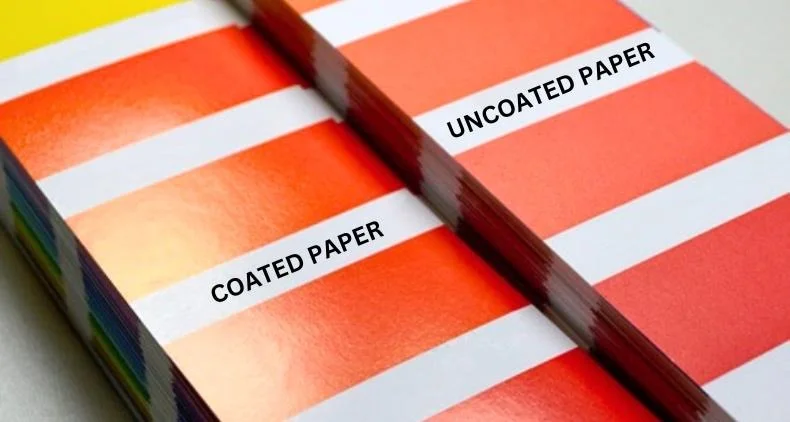
Coated paper provides a smoother surface, while uncoated paper offers a more natural tactile character.
For commercial printing and lightweight paper products, the most useful distinctions include coated, uncoated, offset, silk, matt, gloss, recycled and speciality papers. In addition, paper grades can differ within the same category. Consequently, buyers should compare the complete specification rather than selecting material from its name alone.
Paper Types at a Glance
Use this quick comparison to identify the most relevant paper family before reviewing the detailed explanations below.
| PAPER TYPE | SURFACE | MAIN ADVANTAGE | TYPICAL APPLICATIONS |
|---|---|---|---|
| Uncoated | Natural | Tactile feel and writeability | Stationery, forms, books, natural-brand printing |
| Coated | Smooth | Sharp image and colour reproduction | Brochures, catalogues, marketing material |
| Silk / Matt | Low sheen | Balance between imagery and readability | Brochures, reports, catalogues |
| Gloss | High sheen | Vibrant visual presentation | Photography, promotional graphics |
| Recycled | Varies by grade | Recycled fibre content | Corporate, promotional and sustainable-brand printing |
| Speciality | Varies | Distinctive tactile or visual identity | Luxury stationery, invitations, premium branding |
Uncoated Paper
Uncoated paper has no conventional coating layer applied to its printing surface. As a result, it usually retains a more natural texture and can provide a tactile, less reflective appearance.
Because the surface can absorb more ink than many coated papers, printed colours may appear softer or less intensely saturated. However, that characteristic can become an advantage when the desired result feels natural, understated or tactile.
Uncoated stocks also work well where customers may need to write on the paper. Therefore, they commonly appear in stationery, forms, letterheads, notepads, envelopes and selected premium printed products.
Coated Paper
Coated paper has a treated surface designed to provide greater smoothness and controlled ink interaction. Consequently, it can produce crisp images, strong colour reproduction and a refined printed appearance.
Coated paper comes in several surface variants, including matt, silk and gloss. Therefore, “coated” does not describe one single appearance. Instead, it describes a family of papers with treated surfaces that can be manufactured for different visual effects.
Brochures, catalogues, marketing literature and image-heavy commercial printing often benefit from suitable coated stocks. However, the ideal choice still depends on the artwork, reading experience and required finish.
Silk and Matt Paper
Silk and matt papers sit between highly glossy surfaces and more natural uncoated stocks. Their reduced surface sheen can make long-form content comfortable to read while still providing strong image reproduction.
For that reason, they are particularly useful for brochures, catalogues, reports and marketing documents that combine photography with substantial amounts of text.
The exact surface and visual effect can vary between manufacturers and grades. Therefore, when a particular appearance matters, a physical sample or approved material specification provides a more reliable reference than the generic word “matt” or “silk”.
Gloss Paper
Gloss paper provides a highly smooth, reflective surface that can produce a vivid visual effect. Consequently, it can suit photographic content, promotional graphics and applications where strong colour impact is a priority.
However, high reflectivity can also affect readability under certain lighting conditions. Therefore, gloss is not automatically the premium choice for every application. The correct surface depends on the balance between imagery, text, viewing conditions and brand positioning.
Offset Paper
Offset paper is commonly associated with uncoated printing stocks designed for commercial and general-purpose printed communication. Its surface characteristics can support readable text and practical everyday printing.
It can therefore suit products such as letterheads, forms, books, notepads and other printed materials where a natural surface and dependable print performance are desirable.
However, “offset” describes a paper category and its common printing association rather than a universal quality level. Different offset grades can have different weights, whiteness, opacity and surface characteristics.
Recycled Paper
Recycled paper incorporates recovered fibre into the paper-making process. The percentage and source of recycled content can vary, so two products labelled recycled may not have identical characteristics.
Modern recycled papers can provide excellent commercial printing results. At the same time, some grades intentionally retain a natural or distinctive appearance that supports sustainability-focused branding.
Therefore, recycled content should be considered alongside print requirements, surface, appearance, intended use and end-of-life expectations rather than treated as the only sustainability measure.
Speciality and Premium Paper
Speciality paper covers a broad group of materials designed to create a distinctive visual or tactile experience. These may include textured, coloured, metallic-effect, pearlescent or other premium stocks.
These papers can help brands create differentiation without relying entirely on additional finishing. For example, a textured stock can introduce tactile identity before any foil, embossing or lamination is applied.
However, speciality paper can require more careful production planning. Texture, absorbency, surface variation and fibre characteristics can affect printing and finishing. Therefore, material selection should happen before the final production specification is approved.
Which Paper Type Should You Choose?
Need Sharp Images?
A suitable coated stock can provide a smooth surface and controlled ink behaviour.
Need a Natural Feel?
An appropriate uncoated stock can provide texture, readability and a more tactile character.
Need Strong Visual Impact?
Gloss or another suitable smooth surface may enhance photographic and promotional artwork.
Need a Sustainability Focus?
Consider recycled content, fibre sourcing, coatings and the complete end-of-life pathway.
Paper Grade Is More Than a Paper Name
One of the most common material-selection mistakes is assuming that a paper name completely describes the product. In reality, a grade can combine several characteristics, including GSM, caliper, fibre composition, whiteness, opacity, surface, coating and intended application.
Therefore, “200 GSM coated paper” already communicates more useful information than simply saying “premium paper”. Likewise, a purchasing specification should identify the characteristics that genuinely matter for the finished product.
This approach becomes especially important when ordering commercial printing or branded paper products in quantity. A paper sample may look appropriate, yet its production behaviour, folding response or finishing compatibility may require further consideration.
Paper Selection Formula
Paper type + GSM + surface + fibre + application + finishing requirements
Together, these factors create a much more useful material specification than a paper category alone.
Where Kraft Paper Fits
Kraft paper deserves separate consideration because it has distinctive applications in bags, retail presentation and branded paper products. However, it should not be confused with every kraft-based board used for structural packaging.
For this reason, this guide only introduces kraft paper as one paper category. A dedicated Kraft Paper Guide can provide deeper information about kraft grades, fibre sources, printing, bags, sustainability, coatings and application-specific selection.
For heavier kraft board used in structural packaging, see the Kraft Board Material Guide.
Choosing Paper for a Real Product?
If you are selecting paper for a brochure, catalogue, paper bag, branded retail bag, stationery product or another printed item, the best material depends on more than the paper category. Quantity, dimensions, artwork, handling, finishing and budget can all change the most suitable specification.
Next, we examine paper GSM from 80 to 200 GSM and explain what different weights can mean for commercial printing, paper bags and other lightweight printed products. For a more technical treatment of GSM and packaging card, explore the Packaging Card GSM Guide.
Paper GSM and Weight: 80–200 GSM Explained
Paper GSM is one of the first specifications buyers encounter when choosing paper material for printing, bags, stationery and other commercial products. GSM means grams per square metre, commonly written as g/m². In simple terms, it describes the mass of a sheet based on its area. ISO 536:2019 provides the international method for determining the grammage of paper and board. :contentReference[oaicite:0]{index=0}
However, GSM does not tell you everything about a paper. A 120 GSM sheet and another 120 GSM sheet can feel and perform differently because density, caliper, fibre structure, coating, surface and manufacturing specification also matter. Therefore, GSM is best treated as a starting point for material selection, not as a complete definition of quality.
Paper GSM at a Glance: 80 to 200 GSM
This quick reference shows how common paper weights can relate to different commercial applications. Actual suitability depends on the complete paper specification and finished-product construction.
80 GSM
Lightweight
Leaflets
Office printing
100 GSM
Everyday print
Forms
Light documents
120 GSM
Premium leaflets
Letterheads
General marketing
150 GSM
Brochures
Flyers
Quality marketing
170–180 GSM
Premium print
Heavier brochures
Selected bags
200 GSM
Substantial feel
Premium print
Selected paper products
What Does GSM Mean in Paper Material?
GSM means grams per square metre. It expresses the mass of paper over a standard area, rather than simply measuring how thick the sheet feels. Consequently, a higher GSM generally means more material by area, but it does not automatically mean greater thickness, stiffness or strength.
For example, a dense 150 GSM paper can feel quite different from a more bulky 150 GSM paper. Likewise, coatings can alter the surface and visual character without changing the fundamental meaning of GSM. Therefore, buyers should avoid statements such as “200 GSM is always thicker and stronger than 150 GSM” unless the complete paper specifications support that conclusion.
ISO separately recognises thickness, density and specific volume as measurable paper properties under ISO 534:2011. That distinction is important because grammage and thickness are related, but they are not the same measurement. :contentReference[oaicite:1]{index=1}
Key rule: GSM tells you the paper’s area weight. It does not independently tell you its thickness, density, stiffness, durability, print quality or suitability for a particular product.
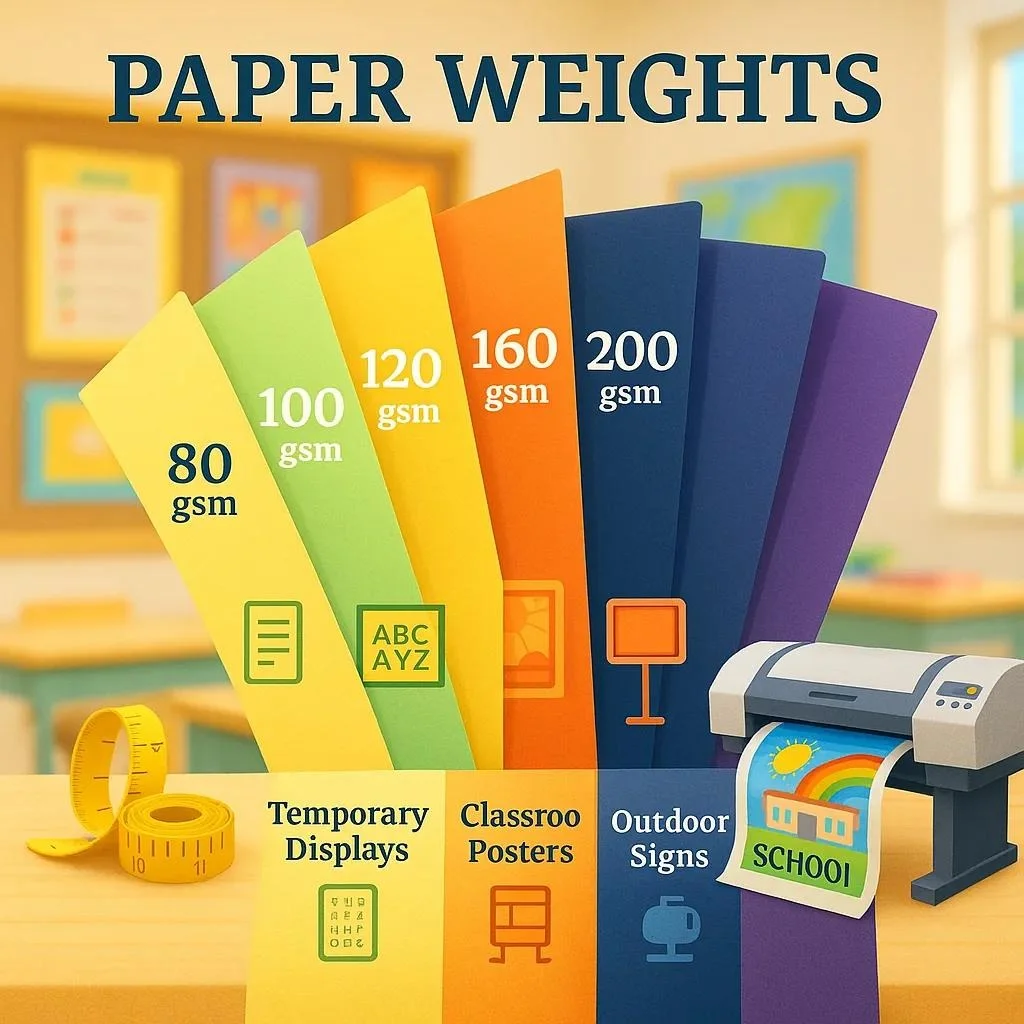
Different GSM levels provide different levels of paper weight and handling.
80 GSM Paper: Lightweight Paper Material
80 GSM paper sits towards the lightweight end of the range covered by this guide. It is commonly associated with everyday documents, office printing, lightweight leaflets and other applications where keeping material usage and finished weight relatively low matters.
Because it is lightweight, 80 GSM can provide an economical solution for high-volume printed communication. It can also work well where multiple sheets are assembled together and the individual sheet does not need substantial rigidity.
However, it is not automatically the right choice for premium marketing or demanding bag applications. A lightweight sheet may not provide the visual substance, opacity or handling characteristics required by a particular product. Therefore, the application should determine whether 80 GSM provides enough performance.
100 GSM Paper: Everyday Commercial Printing Stock
100 GSM paper provides a modest step up from very lightweight stocks. It can offer a more substantial feel while remaining relatively light and flexible.
This makes it useful for a range of everyday printed products. Depending on the grade, it can suit documents, forms, promotional sheets, internal communications and selected marketing applications.
Nevertheless, 100 GSM does not automatically provide a premium finish. Surface, whiteness, opacity and coating can significantly influence the final appearance. Therefore, two 100 GSM papers may produce noticeably different results.
120 GSM Paper: A Popular Premium Printing Weight
120 GSM paper often provides a useful balance between flexibility, substance and print presentation. Consequently, it can suit letterheads, premium leaflets, inserts, brochures and other commercial printing applications.
For businesses, this range can be particularly useful when a printed product needs to feel more substantial than standard office paper without becoming unnecessarily heavy. It can therefore provide a practical middle ground between economy and premium presentation.
However, the correct 120 GSM stock still depends on surface and application. For example, a coated 120 GSM paper can create a different visual result from an uncoated 120 GSM stock.
150 GSM Paper: Commercial Brochures, Flyers and Marketing Material
150 GSM paper provides noticeably more substance than lightweight printing stocks. As a result, it is commonly considered for brochures, flyers, promotional literature and other printed products where a more substantial sheet is desirable.
At this point, the paper can support a stronger premium impression while remaining flexible enough for many commercial applications. Furthermore, a suitable coated surface can provide strong image reproduction, while an uncoated grade can offer a more natural tactile character.
Therefore, 150 GSM is often a useful choice when the product needs to balance print quality, handling, appearance and cost.
170–180 GSM Paper: Premium Paper Material for Selected Applications
170 to 180 GSM paper moves further towards a substantial premium feel. It can suit higher-end brochures, promotional materials, covers for selected products and certain paper-based packaging applications.
For branded paper bags, however, GSM alone should never determine the specification. Bag construction, dimensions, handle design, folds, creases, printing, surface treatment and the expected load all influence material selection.
Consequently, a suitable 170 or 180 GSM stock may perform well in one bag construction but not necessarily in another. A professional specification should consider the entire finished structure.
200 GSM Paper: Heavy Paper Material for Premium Products
200 GSM paper sits at the upper end of the range covered by this guide. It can provide a noticeably more substantial feel and can suit premium printed products where greater visual weight is desirable.
It can be considered for selected brochures, promotional materials, covers and certain paper-product constructions. However, it is important to recognise that 200 GSM remains paper rather than automatically becoming structural board.
Therefore, when the finished product needs genuine structural rigidity, the specification may need to move into paperboard or another packaging substrate rather than simply increasing paper GSM.
80 GSM vs 100 vs 120 vs 150 vs 180 vs 200 GSM
| GSM | Relative feel | Typical role | Strengths | Watch point |
|---|---|---|---|---|
| 80 GSM | Light | Documents, lightweight print | Economical and flexible | Less substantial feel |
| 100 GSM | Light–medium | Everyday commercial print | Good balance for routine use | May not feel premium enough |
| 120 GSM | Medium | Marketing and stationery | Balance of substance and flexibility | Specification still matters |
| 150 GSM | Medium–substantial | Brochures and flyers | Premium commercial presentation | Higher material weight |
| 170–180 GSM | Substantial | Premium print and selected bags | Strong premium feel | Needs application-specific assessment |
| 200 GSM | Heavy paper | Premium printed products | Substantial presentation | Not automatically structural board |
Does Higher GSM Mean Thicker Paper?
Not necessarily. Higher GSM means greater mass per square metre, but thickness depends partly on the density and structure of the sheet. ISO 534 specifically treats thickness, density and specific volume as separate measurable properties. :contentReference[oaicite:2]{index=2}
For example, two sheets with the same grammage can have different calipers because their fibre structure and density differ. Therefore, when thickness matters, ask for the relevant technical specification rather than assuming it from GSM alone.
This distinction is particularly important for folding, creasing, binding and bag construction. A paper that looks ideal on a GSM chart may behave differently during production.
Does Higher GSM Mean Stronger Paper?
Higher GSM does not automatically mean stronger paper. Strength can depend on fibre characteristics, fibre bonding, density, moisture, manufacturing conditions and the particular test property being considered.
For this reason, professional material selection should distinguish between weight, thickness, stiffness, tensile strength, tear resistance and other performance properties. ISO’s paper and board standards include separate methods for properties such as thickness and tensile behaviour, which reinforces why GSM should not be used as a universal strength measurement. :contentReference[oaicite:3]{index=3}
The Professional Specification Check
If a supplier asks only for “150 GSM paper”, the specification may still be incomplete. Depending on the product, you may also need to identify the paper type, surface, colour, fibre composition, thickness, printing requirements and finishing requirements.
What GSM Is Best for Paper Bags?
There is no single GSM that is universally best for paper bags. The correct material depends on bag dimensions, construction, handle type, intended load, printing coverage, surface treatment and expected handling.
A lightweight promotional bag may have very different requirements from a luxury retail bag. Similarly, a food-related paper bag may require a different material and compliance assessment from a general retail carrier.
Therefore, do not select bag paper solely because a particular GSM appears “strong”. Instead, provide the finished bag dimensions, construction, intended use and approximate load so the material can be assessed as part of the complete specification.
For examples of different bag constructions, explore Personalised Bags, Brown Paper Bags, Die-Cut Handle Bags and Flat Handle Bags.
How to Choose Paper GSM for Commercial Printing
For brochures, catalogues, booklets, flyers and stationery, start with the desired reading and handling experience. Next, consider the amount of imagery, required opacity, folding or binding, finishing and budget. Finally, compare suitable paper grades rather than choosing GSM in isolation.
Choose Lighter GSM
When low weight, flexibility and economical high-volume production are priorities.
Choose Mid-Range GSM
When you need a balance between flexibility, print presentation and material substance.
Choose Higher GSM
When a more substantial paper feel supports the product’s positioning and construction.
Request a Specification
When the product has demanding folding, bag, finishing, handling or presentation requirements.
Paper GSM, Printing and Finishing: Why the Combination Matters
GSM becomes even more important when combined with printing and finishing decisions. A particular paper weight may respond differently depending on whether it is coated or uncoated, folded, creased, laminated or decorated with a premium finish.
For example, a luxury printed bag may combine a suitable paper substrate with high-quality printing, lamination and decorative finishing. In contrast, a natural paper product may deliberately use an uncoated surface and minimal finishing.
Therefore, material should be selected before the final production specification is locked, particularly when the finished product requires several processes.
For detailed information about paper and card weight across packaging applications, see the Packaging Card GSM Guide. For broader information about paper, printing and packaging decisions, explore the Printing & Packaging Guide.
Technical Reference: Paper Grammage and Thickness
For technical specifications, international standards distinguish between grammage and other paper properties. ISO 536:2019 specifies a method for determining grammage, while ISO 534:2011 addresses thickness, density and specific volume. :contentReference[oaicite:4]{index=4}
View ISO 536:2019 — Determination of Grammage | View ISO 534:2011 — Thickness, Density and Specific Volume
Not Sure Which Paper GSM You Need?
Tell us what you are producing, the finished size, quantity, printing requirements and desired finish. We can then assess the paper specification against the actual product rather than recommending GSM in isolation.
In the next section, we move beyond GSM and examine paper material thickness, caliper, density and strength. That distinction is essential when you need to understand why two papers with the same GSM can behave differently during printing, folding, finishing or bag production.
Paper Material Thickness, Caliper and Strength
Paper material thickness, caliper and strength are closely related to GSM, yet they are not interchangeable measurements. This distinction matters when you are choosing paper for brochures, catalogues, bags, stationery, folders or premium printed products. A higher GSM can indicate more mass per square metre; however, it does not by itself tell you exactly how thick, stiff or strong the finished sheet will be.
Therefore, professional paper specification looks beyond a single number. GSM tells you about grammage, caliper tells you about thickness, density describes how much material occupies a given volume, while strength and stiffness describe how the sheet responds to force. Together, these properties give a much clearer picture of how paper will behave during printing, folding, converting, handling and everyday use.
Paper Material Properties at a Glance
Before selecting a paper stock, understand what each specification actually tells you.
GSM
What it measures:
Mass per square metre.
Caliper
What it measures:
Sheet thickness.
Density
What it indicates:
How compact the material is.
Strength
What it indicates:
Resistance to particular forces.
Stiffness
What it indicates:
Resistance to bending.
What Is Paper Caliper?
Paper caliper is the measured thickness of a sheet. Unlike GSM, which measures mass per unit area, caliper describes the physical thickness of the material. Manufacturers and printers may express caliper using different units depending on the specification system and market.
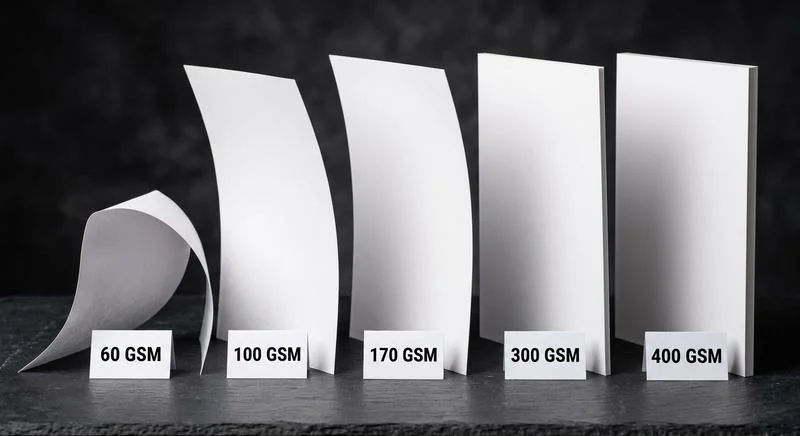
GSM and physical paper thickness are related but are not identical measurements.
This distinction becomes particularly useful when the finished product has a dimensional or mechanical requirement. For example, thickness can influence folding behaviour, binding, stacking, packaging construction and the perceived substance of a printed piece.
However, caliper should still not be treated as a direct measurement of strength. A thicker sheet can feel more substantial, yet fibre structure, bonding and other material characteristics can determine how it actually performs under stress.
Simple distinction: GSM answers “How much does the paper weigh per square metre?” Caliper answers “How thick is the sheet?”
GSM vs Caliper: What Is the Difference?
| Property | GSM | Caliper | Why it matters |
|---|---|---|---|
| Measures | Mass per area | Physical thickness | Defines different aspects of the sheet |
| Units | g/m² | Depends on measurement system | Both require a clear specification |
| Determines thickness? | Not directly | Yes | Important for dimensional planning |
| Determines strength? | No | No | Specific strength tests are required |
| Useful for purchasing? | Yes | Yes, when relevant | Together they create a better material specification |
Paper Material Density and Bulk
Paper density describes how compact the material is, while bulk relates to the volume occupied by a given amount of paper. Consequently, two papers with the same GSM can have different thicknesses because their structures and densities differ.
This explains why one paper can feel relatively thick and soft while another paper with the same grammage can feel denser and more compact. Neither result is automatically better. Instead, each may suit a different application.
For example, a catalogue may benefit from a particular combination of bulk, opacity and flexibility, while a premium business card may require a different material structure. Therefore, the finished product should determine which characteristics receive priority.
Paper Strength Is Not the Same as GSM
Paper strength refers to the material’s resistance to particular forms of stress. Depending on the application and testing method, relevant properties can include tensile strength, tear resistance, folding endurance and other mechanical characteristics.
Consequently, simply increasing GSM does not guarantee the required performance. Fibre quality, fibre bonding, orientation, moisture and manufacturing conditions can all influence how a paper responds to force.
This distinction becomes particularly important for paper bags. A bag must withstand its intended handling and load while also maintaining its shape and appearance. Therefore, bag paper should be assessed alongside construction, dimensions, handles, folds and the expected contents.
Tensile Performance
Relevant when paper must resist pulling forces rather than simply support its own weight.
Tear Resistance
Important when the finished product may experience concentrated tearing forces.
Folding Endurance
Relevant for products that repeatedly fold or experience creasing during use.
Stiffness
Important when the sheet needs to resist bending and maintain a particular form.
Paper Material Stiffness and Flexibility
Stiffness describes how strongly a material resists bending. It can contribute significantly to the perceived quality of a printed product. However, maximum stiffness is not always desirable.
A brochure, for example, needs to open and turn comfortably. Conversely, a presentation folder may benefit from greater rigidity. Similarly, a paper bag needs enough structure to hold its intended shape while retaining sufficient flexibility around folds, creases and handles.
Therefore, the ideal paper material balances stiffness with flexibility according to the product’s construction.
How Paper Structure Affects Folding and Creasing
Paper material must often pass through mechanical processes after printing. These can include folding, creasing, trimming, binding and bag conversion. Consequently, the material’s thickness, fibre orientation and structure can influence production behaviour.
When a printed product contains several folds, a suitable paper specification can help achieve clean and consistent results. However, simply choosing a higher GSM can make some constructions more difficult to fold or crease effectively.
Therefore, paper selection should happen alongside structural planning. If a product has a complex folding or packaging construction, the printer or packaging specialist should review the material before production begins.
Paper Thickness, Lamination and Surface Finishing
Finishing can also alter the final feel and construction of a printed paper product. Lamination adds a surface layer, while other decorative processes can change tactile and visual characteristics. Consequently, the finished product can feel substantially different from the original unprocessed sheet.
This is particularly relevant for luxury branded paper bags, premium brochures and presentation products. A suitable substrate creates the foundation, while printing and finishing build the final appearance.
However, not every paper stock suits every finishing process. Therefore, the substrate should be checked for compatibility before a premium specification is confirmed.
For detailed information about specialist finishes, see the Packaging Luxury Finishes Guide.
Which Paper Property Matters Most?
| Application | Priority | Why | Do not judge by |
|---|---|---|---|
| Brochure | Surface + GSM + folding | Needs good print presentation and comfortable handling | GSM alone |
| Catalogue | Opacity + surface + bulk | Multiple pages need balanced weight and readability | Thickness alone |
| Paper Bag | Strength + construction + GSM | The finished bag must handle its intended load | High GSM alone |
| Business Card | Caliper + stiffness + surface | Tactile substance strongly affects perception | Weight alone |
| Folder | Stiffness + creasing + caliper | Needs controlled folding and structural behaviour | GSM alone |
Why Two Papers with the Same GSM Can Feel Different
This is one of the most important points in paper material selection. Imagine two stocks that are both specified at 150 GSM. Their grammage may be identical, yet one could have a different caliper, density, surface texture or fibre structure.
As a result, one may feel more substantial, another may feel smoother, and a third may provide a more natural tactile response. Therefore, a GSM comparison is useful, but it cannot replace a complete material comparison.
A Better Paper Specification
Weight
Thickness
Feel & print
Performance
Real-world use
Better purchasing question: “Which complete paper specification is appropriate for my product?” rather than simply “Which GSM should I buy?”
Paper Material Specification for a Commercial Order
When requesting a quotation, providing only a GSM can leave important questions unanswered. Instead, give the supplier as much application information as possible. Include the product type, finished dimensions, quantity, artwork requirements, desired surface, intended use and any required finishing.
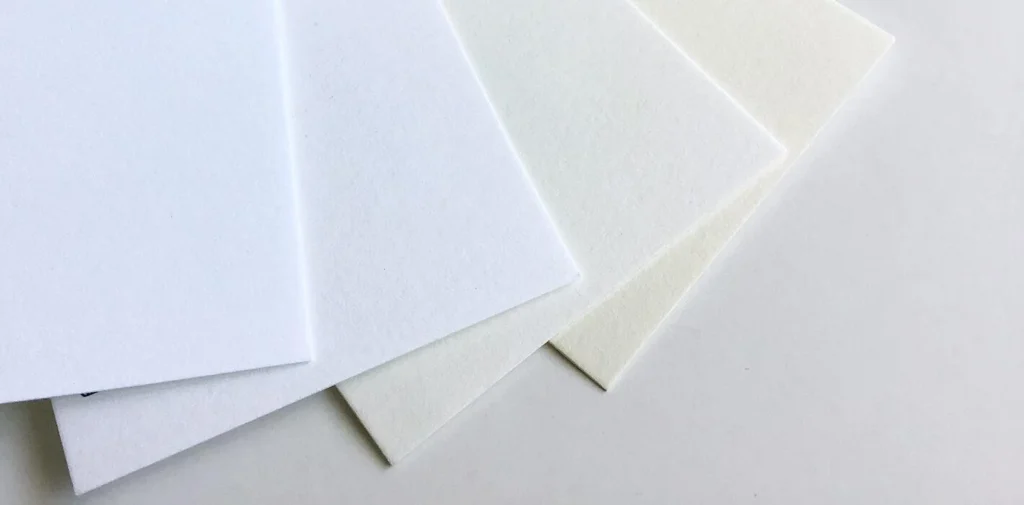
Paper stocks can vary in weight, thickness, surface and tactile character.
For paper bags, also provide the bag construction, handle type and expected contents. For brochures and catalogues, provide the page count, finished size, colour requirements, binding method and desired feel.
That information allows the material to be selected as part of the complete production specification. As a result, you are more likely to receive a recommendation that balances appearance, performance and cost.
Need the Right Paper Specification?
If you know your product but are unsure whether you need 120, 150, 180 or 200 GSM, do not guess from the number alone. Share your application and production requirements so the complete paper specification can be assessed.
Technical Reference for Paper Thickness and Strength
International paper standards distinguish between grammage, thickness and mechanical properties. ISO 534 covers thickness, density and specific volume, while separate testing methods address properties such as tensile behaviour. Therefore, a technical paper specification should use the measurement relevant to the performance requirement.
ISO 534 — Paper and board thickness, density and specific volume
GSM, caliper and strength therefore work together rather than competing with one another. Once these distinctions are clear, you can make a much more informed decision about paper for commercial printing, bags and premium printed products. Next, we examine coated and uncoated paper material and compare how their surfaces affect print quality, colour, tactile feel, readability and finishing.
Coated and Uncoated Paper Material: Surface, Printing and Applications
Coated and uncoated paper material can produce very different results even when the GSM is identical. The key difference is the treatment of the paper surface. Coated paper has a coating layer designed to modify surface characteristics and ink interaction, while uncoated paper retains a more natural paper surface.
As a result, the choice affects more than appearance. It can influence colour reproduction, image sharpness, tactile feel, readability, writing ability, finishing options and the overall perception of a printed product. Therefore, the right paper material depends on what the finished product needs to communicate and how it will be used.
Coated vs Uncoated Paper: One-Look Comparison
Use this comparison first, then explore the detailed material guidance below.
What Is Coated Paper Material?
Coated paper material has a surface treatment that changes the way the sheet interacts with ink and light. The coating can create a smoother surface, which helps support detailed printed imagery and controlled colour reproduction.
Coated papers are available with different surface appearances. For example, matt, silk and gloss coatings can produce noticeably different visual and tactile results. Consequently, “coated paper” should not be treated as one single finish.
For commercial printing, this flexibility makes coated paper particularly useful when the artwork contains photography, gradients, product imagery or strong brand colours. However, the final result still depends on the paper grade, printing process, ink system and artwork.
What Is Uncoated Paper Material?
Uncoated paper material does not have the conventional coating layer used on coated stocks. Therefore, the surface generally retains more of its natural paper character.
Because the surface behaves differently with ink, colours can appear less intense or more subdued than they would on a suitable coated stock. However, that softer appearance can create a premium, authentic or environmentally conscious brand aesthetic.
Uncoated paper can also be particularly useful where people need to write on the printed surface. Consequently, it remains a popular choice for stationery, forms, letterheads, notepads and selected corporate materials.
Coated Paper Types: Matt, Silk and Gloss
Coated paper comes in several surface options. The most commercially recognised choices include matt, silk and gloss. Although they belong to the same broad coated-paper family, each creates a different balance between visual impact, reflectivity and tactile experience.
Matt Coated Paper
Provides a restrained, low-sheen appearance. It can work particularly well for premium brochures, reports and sophisticated brand communication.
Silk Coated Paper
Offers a balance between image reproduction and reduced surface glare. It is a practical option for brochures and catalogues containing both images and substantial text.
Gloss Coated Paper
Provides a highly reflective surface that can create strong visual impact, particularly for photographic and promotional artwork.
Matt Paper Material for Premium Printing
Matt coated paper can provide a sophisticated visual presentation without the strong reflections associated with high-gloss surfaces. Therefore, it often suits brands that want their printed material to feel refined rather than highly promotional.
It can work well for brochures, catalogues, reports, corporate literature and premium marketing material. Furthermore, its reduced sheen can help create a comfortable reading experience when the product contains substantial text.
However, matt does not mean that the paper is uncoated. This distinction is important. A matt-coated sheet remains a coated paper material, even though its surface has a low-sheen appearance.
Silk Paper Material for Brochures and Catalogues
Silk paper material offers a useful middle ground. It can provide strong colour and image reproduction while reducing the high reflectivity associated with gloss paper.
Consequently, silk is often considered for brochures, catalogues, reports and marketing documents that combine photography with longer sections of text. It provides a polished appearance while maintaining a relatively restrained visual character.
For businesses producing substantial marketing literature, silk can therefore provide a strong balance between presentation, readability and commercial practicality.
Gloss Paper Material for High-Impact Printing
Gloss paper material has a highly smooth and reflective surface. It can make colours appear vivid and can enhance the visual impact of photographic artwork.
For promotional pieces where visual impact is the priority, this can be advantageous. However, reflections can become distracting under certain lighting conditions. Therefore, gloss should be selected because it suits the intended viewing environment and design—not simply because it appears more luxurious.
Uncoated Paper Material for Stationery and Natural Branding
Uncoated paper material can create a more tactile and approachable identity. The natural surface can work particularly well for brands that want their printed communication to feel authentic, understated or craft-led.
It is also practical for products where users may write on the paper. Consequently, uncoated stocks are commonly considered for letterheads, notepads, forms, envelopes and office stationery.
For businesses requiring coordinated stationery, relevant products include Letterhead Printing, Custom Envelopes, Personalised Notepads and Business Cards.
Coated or Uncoated Paper? Choose by Application
| Product | Often considered | Why | Important consideration |
|---|---|---|---|
| Brochure | Silk / matt coated | Good balance of imagery and text | Reading experience |
| Catalogue | Silk / matt coated | Detailed product imagery | Page count and binding |
| Photo-led flyer | Gloss / silk | Strong colour and image impact | Reflectivity |
| Letterhead | Uncoated | Natural feel and writing suitability | Brand colour reproduction |
| Notepad | Uncoated | Practical writing surface | Opacity and ink bleed |
| Luxury retail bag | Application-specific paper + finishing | Combines material feel with branding | Construction, handles and finishing compatibility |
Coated Paper and Colour Reproduction
One reason coated paper is widely used in commercial printing is its smooth surface. A suitable coated stock can provide controlled ink behaviour and strong reproduction of fine artwork.
That advantage becomes especially relevant when a design contains product photography, detailed illustrations, gradients or multiple brand colours. However, paper alone does not determine colour accuracy. The printing process, ink, colour management, artwork and finishing can all influence the final result.
Therefore, colour-critical projects should be assessed as a complete production system rather than by paper choice alone.
Uncoated Paper and Ink Absorption
Because uncoated paper has a different surface structure, ink can interact with the fibres differently from a coated stock. Consequently, printed colours may appear softer, and fine details can have a different visual character.
That is not necessarily a disadvantage. In fact, brands seeking a natural or tactile aesthetic may prefer this result. However, artwork should be prepared with the selected paper in mind, particularly when exact colour appearance is important.
Can You Write on Coated Paper?
Sometimes, but it depends on the coating and writing instrument. A highly coated or glossy surface can be less suitable for ordinary handwriting because the ink may not behave in the same way as it does on an absorbent uncoated surface.
Therefore, if customers need to write on the product, an appropriate uncoated stock—or a specifically selected writable coated stock—should be considered.
This is especially relevant for forms, appointment cards, note sheets, stationery and other interactive printed products.
Can You Print on Uncoated Paper?
Yes. Uncoated paper is widely used for commercial printing. It can produce excellent results when the artwork and printing specification are matched to the material.
However, colours and images can appear different from those produced on coated paper. Therefore, proofing or physical samples become particularly valuable when the exact tactile and visual result matters.
Paper Material Decision Guide
Choose Coated
When image detail, smoothness and strong colour presentation are priorities.
Choose Uncoated
When tactile feel, writing ability and natural presentation matter most.
Choose Matt
When you want a refined low-sheen appearance with strong readability.
Choose Gloss
When vivid imagery and high visual impact are more important than low reflectivity.
Coated and Uncoated Paper for Luxury Paper Bags
For premium paper bags, the surface decision becomes part of the brand experience. A smooth coated surface can create a polished retail appearance, while an uncoated or specially textured stock can create a more natural and tactile identity.
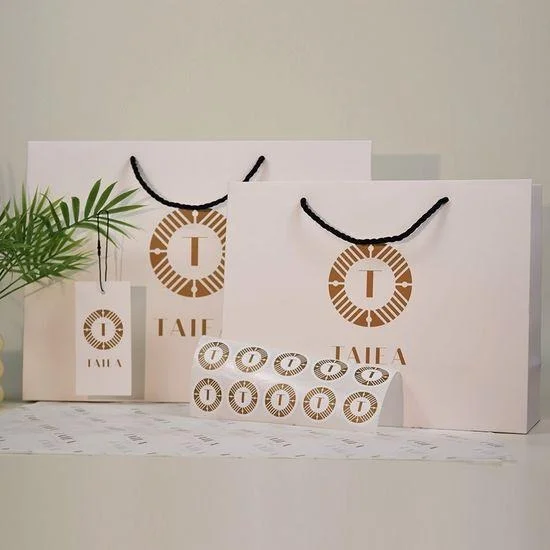
Paper material can be converted into branded retail, promotional and luxury paper bags.
However, the material surface is only one part of the specification. Bag dimensions, construction, handle type, paper weight, printing coverage, lamination and decorative finishes also affect the final result.
For example, a luxury retail bag may combine a suitable paper substrate with lamination and metallic or embossed branding. Therefore, material selection should happen before the finishing specification is finalised.
Explore Personalised Bags, Luxury Ribbon Bags and Paper Gift Bags to compare different finished product applications.
Coated and Uncoated Paper for Brochures and Catalogues
Brochures and catalogues usually need to balance image quality with reading comfort. Therefore, silk or matt coated paper can be useful where the document contains both photography and substantial text.
Uncoated paper can instead create a more tactile and understated result. This can work particularly well for brands that prioritise natural materials, writing interaction or a less glossy visual identity.

Paper material supports professional brochures, booklets and marketing literature.
The correct choice also depends on page count and binding. A catalogue containing many pages can require a different weight and surface strategy from a short premium brochure.
For production examples, see Brochure Printing, Catalog Printing and Booklet Printing.
The Premium Paper Specification Checklist
Before approving a paper material, check these points together:
Required weight
Coated or uncoated
Matt, silk, gloss or natural
How the product will be used
Artwork and colour requirements
Lamination and decorative effects
Paper Material Selection Should Start with the Finished Product
The best paper material is not determined by surface type alone. Instead, begin with the finished product and work backwards. Ask how it will be handled, whether customers will write on it, whether photography needs to dominate, whether the surface should feel natural or luxurious, and whether additional finishing will be applied.
Then compare the appropriate paper grades against those requirements. This approach reduces unnecessary specification changes and helps ensure that the final material supports both the design and commercial objective.
For a broader understanding of packaging substrates, use the Packaging Materials Guide. For structural packaging materials, the specialist Folding Carton Material Guide provides more detailed information about board rather than lightweight printing paper.
Technical Reference for Paper and Board
Paper and board properties are assessed through specific technical measurements rather than a single general quality score. The International Organization for Standardization (ISO) publishes standards covering characteristics such as grammage and thickness. Therefore, material specifications should identify the properties relevant to the intended application.
ISO 536 — Paper and board: Determination of grammage | ISO 534 — Paper and board: Thickness, density and specific volume
Need Help Choosing the Right Paper Material?
Tell us what you are producing, including the finished size, quantity, intended use, printing requirements and preferred appearance. We can help you compare suitable paper specifications before production.
Once the paper surface has been selected, the next question is often sustainability. The following section examines recycled paper material, virgin fibre, responsible sourcing and sustainable paper choices, while keeping the focus on what these claims actually mean for commercial printing and packaging.
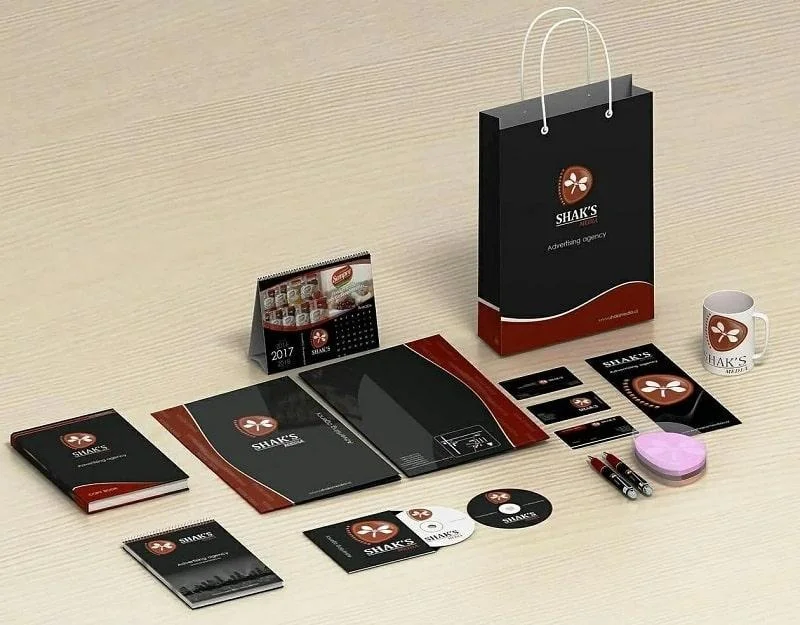
Paper remains an important material for professional business stationery and printed communication.
Recycled and Sustainable Paper Material: Fibre, Sourcing and Environmental Choices
Recycled and sustainable paper material is increasingly important for brands choosing printed bags, brochures, catalogues, stationery and other paper products. However, sustainability is more complicated than simply selecting a paper labelled “recycled” or “eco-friendly”. The material’s fibre source, recycled content, forestry certification, manufacturing process, coatings, inks, durability and end-of-life pathway can all influence the overall environmental profile.
Therefore, the most responsible approach is to compare the complete paper specification against the product’s actual requirements. A material that lasts longer, avoids unnecessary replacement and uses an appropriate amount of fibre may provide a more practical solution than choosing a sustainability claim without examining the wider specification.
Sustainable Paper Material at a Glance
Different sustainability attributes answer different questions. They should therefore be considered separately.
Recycled Fibre
Concerns the use of recovered fibre in the paper.
Virgin Fibre
Fresh fibre can provide particular performance and quality characteristics.
Responsible Sourcing
Addresses how forest-based fibre is sourced and managed.
Certification
Provides a framework for verified sourcing or recycled-content claims.
End of Life
Considers whether the finished product can enter an appropriate recovery stream.
What Is Recycled Paper Material?
Recycled paper material contains fibre recovered from previously used paper products. That recovered material can be processed and incorporated into new paper products, depending on the manufacturer’s specification and the intended grade.
However, “recycled paper” does not necessarily mean that every fibre in the sheet is recycled. The proportion and type of recovered fibre can vary. Therefore, when recycled content is commercially important, request the specific recycled-content information rather than relying on a generic description.
Recycled paper can be available in different surfaces, colours and weights. Consequently, businesses do not necessarily have to sacrifice professional presentation simply because they want to increase recycled content.
Virgin Fibre and Recycled Fibre Paper: What Is the Difference?
Virgin fibre paper uses newly produced paper fibres, while recycled paper incorporates recovered fibre. Both can have legitimate roles in commercial printing and packaging.
Virgin fibre can provide particular strength, consistency, brightness or performance characteristics, depending on the grade. Recycled fibre, meanwhile, can help incorporate recovered material into a new paper product.
Therefore, choosing between virgin and recycled fibre should depend on the product’s performance requirements as well as the brand’s sustainability objectives. A blanket rule that one option is always better for every application oversimplifies the material decision.
| Factor | Recycled Fibre Paper | Virgin Fibre Paper | What to assess |
|---|---|---|---|
| Fibre source | Recovered paper fibre | New fibre | Supplier specification |
| Performance | Varies by grade | Varies by grade | Actual product requirements |
| Appearance | Can range from natural to highly refined | Can range from natural to highly refined | Brand and design requirements |
| Print suitability | Depends on grade and surface | Depends on grade and surface | Artwork and printing method |
| Best decision method | Assess recycled content and performance | Assess sourcing and performance | Compare the complete specification |
What Does FSC-Certified Paper Material Mean?
FSC certification relates to responsible forest management and supply-chain controls. The Forest Stewardship Council provides certification systems designed to verify that forest-based materials meet defined requirements and that certified material can be traced through relevant supply chains.
For businesses purchasing printed paper products, this distinction is useful because a sustainability claim should ideally be supported by a recognised certification or documented material specification. Therefore, if FSC-certified paper is required, the project should identify the relevant certification and chain-of-custody requirements before production.
For official information about FSC standards, certification and responsible forestry, consult the Forest Stewardship Council.
Recycled Paper vs FSC-Certified Paper
Recycled paper and FSC-certified paper are not interchangeable terms. They address different aspects of the material. Recycled content concerns recovered fibre, whereas FSC certification concerns responsible sourcing and the relevant certified supply chain.
Consequently, a paper can be recycled without being FSC-certified, and a certified paper can contain virgin fibre from responsibly managed sources. Some products may also combine recycled content with appropriate certification.
Recycled vs FSC: One-Look Comparison
Recycled Paper
Focus: recovered fibre content.
Ask: What percentage and type of recycled content does the specification contain?
FSC-Certified Paper
Focus: responsible forest-based sourcing and certified supply chains.
Ask: What certification and chain-of-custody requirements apply?
What Makes Paper Material Sustainable?
There is no single characteristic that makes every paper product sustainable. Instead, sustainability can involve several connected factors, including fibre sourcing, recycled content, material efficiency, product lifespan, manufacturing, coatings, printing processes and end-of-life recovery.
For example, using an unnecessarily heavy paper can increase material consumption without improving the finished product. Conversely, selecting a suitable specification that performs well for its intended purpose can avoid premature replacement.
Therefore, sustainable paper selection should begin with the question: “What is the minimum appropriate material specification that delivers the required performance and presentation?”
Paper Material Efficiency and Responsible GSM Selection
GSM has a direct relationship with the amount of paper used per unit area. Therefore, reducing unnecessary GSM can reduce material consumption and finished-product weight. However, the lowest GSM is not automatically the most sustainable option.
If a lighter sheet fails during normal use, requires replacement or cannot deliver the required product performance, the initial material saving may not achieve the intended result. Consequently, right-sizing the material is generally more useful than simply choosing the lowest possible GSM.
Avoid Over-Specifying
Do not select a heavier paper simply because a higher GSM sounds more premium.
Avoid Under-Specifying
Do not reduce GSM so far that the product loses necessary performance.
Specify for Purpose
Choose the lightest appropriate specification that reliably fulfils the application.
Recycled Paper Material for Printed Bags
Recycled paper material for bags can support brands that want a paper-based retail presentation with a sustainability-focused message. However, the bag still needs to meet practical requirements such as dimensions, handle construction, printing quality and expected load.
Consequently, the bag’s recycled content should be assessed alongside its complete construction. A material that looks sustainable but does not perform adequately for the intended contents may not be the best commercial solution.
For businesses comparing paper bag options, explore Brown Paper Bags, Flat Handle Bags and Personalised Bags.
Recycled Paper Material for Brochures, Catalogues and Stationery
Recycled paper can also work effectively for commercial printing. Brochures, catalogues, booklets, letterheads, flyers and office materials can use recycled stocks where the selected grade meets the project’s appearance and performance requirements.
Furthermore, recycled paper can support a brand story when its material appearance complements the visual identity. A natural surface, for instance, can reinforce a sustainability-led design more effectively than adding environmental messaging alone.
However, recycled content should not be treated as a substitute for good design. The finished product still needs appropriate typography, imagery, colour management and print production.
Can Recycled Paper Be Luxury Paper Material?
Yes. Recycled paper does not automatically mean low-grade or visually basic. Modern paper ranges can combine recycled fibre with refined surfaces, suitable colour reproduction and premium finishing.
Consequently, sustainability and luxury presentation do not have to be opposites. A premium product can use an appropriate recycled substrate while adding carefully selected finishing techniques to strengthen the brand experience.
For luxury paper products, the final specification should consider the interaction between recycled content, surface, GSM, printing, lamination and decorative finishing.
See the Packaging Luxury Finishes Guide for deeper information about premium finishing choices.
Paper Coatings, Lamination and Recyclability
Paper-based products can contain additional coatings, laminates or treatments that affect their appearance and performance. Therefore, the sustainability profile of a finished paper product cannot always be determined from the base paper alone.
For example, a paper bag with a decorative surface treatment may have different recovery considerations from an untreated paper bag. Likewise, a printed product with additional layers should be assessed according to the relevant local recycling infrastructure and material composition.
Therefore, avoid broad claims such as “all paper is recyclable” or “paper is automatically sustainable”. The actual finished construction and local recovery system matter.
Paper Material and Food Packaging Considerations
When paper is intended for direct or indirect food-related applications, sustainability is only one part of the material decision. The paper, inks, coatings, adhesives and overall construction may need to meet application-specific requirements.
Therefore, food bags should not be specified solely by GSM or recycled content. The intended food contact, barrier requirements, printing process and applicable regulatory requirements must also be considered.
For food-related paper products, request a specification that addresses the actual intended use rather than assuming that a general-purpose paper is automatically suitable.
How to Avoid Greenwashing in Paper Material Claims
Greenwashing can occur when environmental claims sound stronger than the evidence supporting them. Therefore, businesses should use specific, verifiable descriptions instead of vague statements such as “100% eco-friendly” or “completely sustainable”.
A stronger specification identifies measurable characteristics. For example, it may identify recycled content, a recognised certification, a particular fibre source or an applicable manufacturing claim.
Weak Claim vs Strong Specification
| Instead of saying… | Prefer… |
|---|---|
| “Eco-friendly paper” | A defined paper specification with documented environmental attributes |
| “100% sustainable” | Specific, evidence-based sustainability information |
| “Recyclable paper” | A description that considers the complete finished construction and relevant recycling route |
| “Green packaging” | A clear description of fibre, certification, material and relevant environmental characteristics |
How to Choose Sustainable Paper Material for Your Brand
A practical selection process can keep sustainability decisions clear. First, define what the product must do. Next, identify the minimum suitable GSM, surface and performance requirements. Then assess recycled content, sourcing and certification options. Finally, review printing, finishing and end-of-life considerations.
01
Define the product
02
Select appropriate GSM
03
Assess fibre source
04
Check certification
05
Review finishing
06
Confirm end-of-life considerations
Choosing Sustainable Paper Material Without Sacrificing Print Quality
Sustainability does not require a business to accept poor printing. Instead, the paper grade should be matched to the required visual result. Recycled stocks are available in a range of surfaces and weights, so the project can still prioritise colour, readability and brand presentation.
However, colour expectations should be communicated clearly. Some recycled or natural-looking stocks can intentionally produce a different visual result from bright white coated paper. Therefore, a physical proof can be valuable when colour and tactile appearance are commercially important.
Responsible Paper Material Purchasing for UK Businesses
UK businesses often need to communicate environmental information accurately to customers, procurement teams and retailers. Consequently, purchasing documentation should identify the actual material specification and any relevant certification rather than relying solely on marketing terminology.
Where a client requests sustainable paper, clarify whether they mean recycled content, FSC certification, a particular fibre source, plastic-free construction, recyclability or another defined requirement. This simple clarification can prevent the wrong material from being quoted.
For broader information about packaging substrates, see the Packaging Materials Guide. For specialist structural packaging, the Corrugated Material Guide and Rigid Board Material Guide cover materials outside the lightweight paper range of this guide.
Authoritative Sustainability References
Environmental claims should be based on defined specifications and credible standards rather than generic descriptions. The Forest Stewardship Council provides information on responsible forest management and certification. For UK waste and resource guidance, WRAP provides information on resource efficiency, waste and circular-economy topics.
Where a project requires certified or recycled paper, the exact requirement should be confirmed with the paper supplier before production.
Looking for Sustainable Paper Printing?
Tell us whether you need recycled paper, certified sourcing, a natural appearance or another specific sustainability requirement. We can then match the material decision with your product, printing and finishing requirements.
Once the fibre and sustainability requirements are clear, the next decision is how the paper will be used and printed. The following section focuses on paper material for bags and commercial printed products, including paper bags, brochures, catalogues, booklets, stationery and branded products, while keeping specialist kraft-paper information within its dedicated guide.
Paper Material FAQs: GSM, Printing, Sustainability and Product Selection
This final paper material FAQ section answers the practical questions buyers commonly ask before selecting paper for bags, brochures, catalogues, booklets, stationery and other printed products. It also brings together the key decisions covered throughout this guide, so you can quickly identify the right specification before requesting a quotation.
Paper Material FAQ — Quick Answers
Need more strength?
Consider GSM, fibre structure and the product’s construction together.
Need better imagery?
A suitable coated paper can support detailed image reproduction.
Need writing ability?
Uncoated paper is generally a strong starting point.
Need sustainable paper?
Define recycled content, certification or sourcing requirements precisely.
What Is Paper Material?
Paper material is a sheet-based material made primarily from cellulose fibres that can be formed, dried and finished for printing, writing, packaging and other applications. Its final characteristics depend on fibre type, manufacturing, grammage, thickness, surface treatment and intended use.
Therefore, paper is not one universal material. Different paper grades can behave very differently even when they have similar GSM. The correct choice depends on what the finished product needs to achieve.
What Is the Difference Between Paper GSM and Thickness?
GSM means grams per square metre and describes the mass of paper over a defined area. Thickness, meanwhile, describes the physical caliper of the sheet.
Consequently, two papers with the same GSM can have different thicknesses because their fibre structure, density and manufacturing characteristics differ. For a precise specification, therefore, do not use GSM and thickness as interchangeable terms.
For a deeper explanation of GSM selection for packaging and printed products, see the Packaging Card GSM Guide.
What GSM Paper Is Best for Bags?
There is no single best paper GSM for bags. The appropriate specification depends on bag dimensions, construction, contents, handle type, printing coverage, expected handling and required appearance.
A smaller lightweight bag may require a different paper specification from a large retail carrier bag. Likewise, a premium branded bag with handles and luxury finishing may require a different construction from a simple promotional paper bag.
Therefore, choose the bag specification as a complete system rather than selecting GSM in isolation.
Is 80 GSM Paper Suitable for Printing?
Yes. 80 GSM paper can be suitable for lightweight printed products such as certain office documents, inserts and other applications where a lighter sheet meets the required performance.
However, it may not provide the same opacity, stiffness or premium feel as a heavier stock. Therefore, the correct GSM depends on the intended product rather than the number alone.
Is 100 GSM Paper Suitable for Commercial Printing?
100 GSM paper can be suitable for many commercial printing applications. It can provide a useful balance between lightweight handling and a more substantial feel than very light paper.
Its suitability still depends on the product. For example, a document, flyer and branded paper product can have very different requirements even when they use the same GSM.
Is 120 GSM Paper Good for Brochures?
120 GSM paper can be suitable for brochures where a relatively lightweight and flexible sheet is preferred. However, brochures vary considerably in page count, folding requirements, image coverage and desired premium feel.
Therefore, 120 GSM should be treated as one possible specification rather than a universal brochure standard. A higher or lower weight may provide a better result depending on the project.
Is 150 GSM Paper Good for Premium Printing?
150 GSM paper can create a more substantial feel than lighter stocks and can work well for selected brochures, flyers, covers, inserts and other premium printed products.
However, premium quality does not come from GSM alone. Surface, colour reproduction, finishing, folding and overall design also contribute to the final perception.
Is 200 GSM Paper Card or Paper?
200 GSM sits towards the heavier end of the paper range and can begin to feel more like lightweight card depending on the specific grade and manufacturing characteristics.
However, GSM alone does not define whether a material should be classified commercially as paper or board. Thickness, construction and supplier specification also matter.
What Is the Best Paper Material for Brochures?
The best paper material for brochures depends on the balance between text, imagery, tactile feel, durability and budget. Coated matt or silk stocks can work particularly well when a brochure contains both photography and substantial text.
Uncoated paper can instead provide a natural tactile experience and may suit brands that want a less glossy presentation.
For production options, see Brochure Printing.
What Is the Best Paper Material for Catalogues?
For catalogues, the material should support the required image reproduction while remaining practical for the total page count and binding method. Silk or matt coated paper can provide a useful balance between imagery and readability.
However, catalogue specifications vary significantly. A short luxury catalogue may require a different stock from a large multi-page product catalogue.
Explore Catalog Printing for the commercial application.
What Is the Best Paper Material for Business Cards?
Business cards normally require a more substantial specification than ordinary office paper because they need to feel durable and professional during handling.
However, the final choice depends on thickness, surface, printing, lamination and finishing. Therefore, businesses should select the complete business-card specification rather than focusing only on GSM.
See Business Cards for the relevant product application.
What Is the Best Paper Material for Letterheads?
Uncoated paper is often a practical choice for letterheads because users may need to write on the surface or print additional information. It also provides a natural tactile character that suits corporate stationery.
Nevertheless, the final specification should account for the printer, colour requirements, writing needs and brand identity.
For the finished product, see Custom Letterhead Printing.
What Is the Difference Between Coated and Uncoated Paper?
Coated paper has a surface treatment that can improve smoothness and support strong image and colour reproduction. Uncoated paper retains a more natural surface and often provides better suitability for writing.
| Requirement | Often suitable | Reason |
|---|---|---|
| Detailed photography | Coated paper | Smooth surface can support detailed image reproduction |
| Natural tactile feel | Uncoated paper | Retains a more natural paper character |
| Writing surface | Uncoated paper | Generally more suitable for handwriting |
| High visual impact | Gloss or suitable coated paper | Can provide vivid image presentation |
Is Recycled Paper Material Good Quality?
Yes. Recycled paper can provide high-quality commercial printing when the selected grade matches the application.
Modern recycled stocks can offer different weights, surfaces and print characteristics. Therefore, recycled content should not automatically be interpreted as lower quality.
The important point is to select the correct specification for the intended product and to communicate any colour, tactile or performance expectations before production.
Is FSC Paper the Same as Recycled Paper?
No. FSC certification and recycled content describe different characteristics.
Recycled paper focuses on recovered fibre, whereas FSC certification concerns responsible forest-based sourcing and certified supply chains. Consequently, one should not be used as a substitute for the other.
For official information, consult the Forest Stewardship Council.
Is Paper Material More Sustainable Than Plastic?
It is not accurate to decide sustainability solely by comparing the words “paper” and “plastic”. The environmental profile depends on the material specification, manufacturing, product lifespan, weight, transport, reuse and end-of-life pathway.
Paper can provide important advantages in suitable applications, particularly where responsible fibre sourcing and appropriate recovery infrastructure exist. However, the finished product should still be assessed as a whole.
For UK resource and waste guidance, the Waste and Resources Action Programme (WRAP) provides useful independent information.
Can Paper Material Be Laminated?
Yes. Paper products can use laminations or other surface treatments where the application requires additional protection or a particular visual effect.
However, adding a layer changes the finished construction. Therefore, if recyclability or a particular sustainability specification matters, the complete finished product should be assessed rather than the base paper alone.
For a detailed explanation of laminations, embossing, foiling and other premium treatments, see the Packaging Luxury Finishes Guide.
Can Paper Bags Have Luxury Finishes?
Yes. Paper bags can combine suitable paper material with premium printing and decorative finishes. Depending on the construction, these can include lamination, foil effects, embossing and other branded treatments.
However, the substrate must be compatible with the intended finishing process. Therefore, finishing should be considered during material specification rather than added as an afterthought.
Explore Personalised Bags and Luxury Ribbon Bags for premium paper-bag applications.
What Paper Material Is Best for Food Bags?
The best paper material for food bags depends on the food type, intended contact, required barrier performance, construction and printing requirements.
Food-related paper products require more careful specification than ordinary promotional bags. Therefore, do not select material solely by GSM, colour or appearance. The intended application and relevant compliance requirements must guide the specification.
What Paper Material Is Best for Retail Bags?
Retail bags need to balance strength, appearance, handling and branding. Therefore, the best material depends on bag size, contents, handle construction, expected load and desired finish.
A luxury retail bag may prioritise tactile quality and decorative finishing, while a promotional bag may prioritise cost efficiency and high-volume production.
What Paper Material Is Best for Eco-Friendly Bags?
There is no single “eco-friendly paper” specification suitable for every bag. Instead, identify the sustainability attribute that matters: recycled content, responsible sourcing, certification, material efficiency or another defined requirement.
Then match that attribute with the required bag performance. This approach creates a more credible specification than relying on a generic environmental label.
Can Paper Material Be Used for Premium Branding?
Absolutely. Paper can support premium branding through the combination of appropriate material, printing quality, construction and finishing.
In fact, a premium result often comes from contrast: a carefully selected paper surface combined with restrained colour, precise typography and one or two well-chosen finishes can create a stronger result than excessive decoration.
How Do I Choose the Right Paper Material?
Use this simple sequence:
1. Product
What are you making?
2. Use
How will customers use it?
3. GSM
What weight is appropriate?
4. Surface
Coated or uncoated?
5. Finish
What treatment is required?
6. Sustainability
What environmental specification applies?
Then request a quotation using the complete specification. This reduces ambiguity and allows the manufacturer to recommend a material that supports the actual application rather than simply quoting a generic paper grade.
Where Can I Learn More About Packaging Paper and Board Materials?
This guide focuses specifically on the paper-material range used for printed products and paper-based applications. For deeper information about related substrates, use the relevant specialist guides:
- Printing & Packaging Guide — broader printing and packaging fundamentals.
- Packaging Card GSM Guide — detailed GSM and board-weight information.
- Packaging Materials Guide — wider packaging-material selection.
- Folding Carton Material Guide — folding-carton board and structural packaging.
- Kraft Board Material Guide — specialist kraft material information.
- Corrugated Material Guide — corrugated board and shipping applications.
- Rigid Board Material Guide — rigid-board packaging.
- Packaging Design Guide — design and specification considerations.
- Packaging Styles Guide — packaging construction and style options.
- Printing Methods Guide — commercial printing processes.
- Printing Dieline Guide — artwork and structural dielines.
Which Paper Products Can I Order from Sky Print and Enterprise?
Paper material can be converted into a wide range of commercial printed products. Depending on the specification, applications include paper bags, retail bags, branded bags, brochures, booklets, catalogues, business cards, flyers, leaflets, envelopes, letterheads, presentation folders, notepads and other office essentials.
Relevant product categories include Personalised Bags, Brown Paper Bags, Die-Cut Handle Bags, Flat Handle Bags, Booklet Printing, Catalog Printing, Custom Envelopes and Presentation Folders.
Ready to Choose Your Paper Material?
Send us your product type, finished size, quantity, artwork requirements and preferred paper characteristics. If you are unsure about the material, we can assess the application and help you specify the appropriate paper before production.
Paper Material Guide — Key takeaway: The right paper is not simply the heaviest, cheapest, whitest, most recycled or most luxurious option. Instead, it is the material that provides the required performance, appearance, printability, tactile quality, sustainability characteristics and commercial value for the finished product.