
Packaging Card GSM Guide is a complete resource for understanding paper weight, board specifications and material selection for professional packaging projects. From luxury retail boxes and cosmetic packaging to food cartons, shipping boxes and branded product packaging, GSM plays an essential role in determining strength, appearance, print performance and overall packaging quality.When businesses develop custom packaging, they often focus first on artwork, colours, branding and box style. However, the material specification behind the design is equally important. A beautifully printed box will not deliver the expected customer experience if the board is too weak, too flexible or unsuitable for the product inside. Therefore, understanding GSM helps businesses make better packaging decisions before production begins.
This Packaging Card GSM Guide explains everything you need to know about paper and board weight, including how GSM works, how manufacturers select suitable materials, how GSM differs from thickness and which specifications work best for different industries. Furthermore, this guide provides practical recommendations, comparison tables and real packaging examples to help you choose materials with confidence.
Whether you are launching a new product, improving existing packaging or comparing packaging quotations, this guide will help you understand the technical information behind professional packaging production.
📖 Table of Contents
Jump directly to any section of this Packaging Card GSM Guide.
Why Understanding Packaging Card GSM Is Important
Packaging materials directly influence how customers perceive a product. A rigid luxury box creates a different impression compared with a lightweight carton, even when both designs use identical artwork. Therefore, selecting the correct GSM allows businesses to achieve the right balance between protection, presentation and production cost.
For example, a premium skincare brand may require a higher GSM board to support luxury finishes such as foil stamping, embossing and soft-touch lamination. On the other hand, a takeaway food business may prioritise lightweight but durable packaging that protects products while remaining cost-effective for high-volume production.
Consequently, GSM selection depends on several factors, including:
- Product weight and dimensions.
- Required packaging strength.
- Printing and finishing requirements.
- Transportation and storage conditions.
- Brand positioning and customer expectations.
- Production quantity and budget considerations.
Professional packaging manufacturers evaluate all these factors before recommending a suitable board specification. Therefore, the highest GSM is not always the best option. The correct GSM is the one that provides the required performance while maintaining manufacturing efficiency.
What Makes GSM Different From Other Packaging Specifications?
Many packaging buyers confuse GSM with thickness because both measurements influence how a material feels. However, they describe different characteristics. GSM measures the weight of the material, whereas thickness measures the physical depth of the board.
For instance, two boards can have the same GSM but different thickness levels because manufacturers may use different fibres, coatings or construction methods. Similarly, a thicker board does not always provide better performance if the material composition is unsuitable for the application.
| Specification | Meaning | Why It Matters |
|---|---|---|
| GSM | Weight of paper or board per square metre | Helps compare material grades |
| Thickness | Physical measurement of board depth | Influences rigidity and folding behaviour |
| Material Type | Fibre and board construction | Affects strength, appearance and print quality |
Packaging Manufacturer Insight
Experienced packaging manufacturers do not select board GSM based only on thickness or appearance. Instead, they consider the complete packaging journey, including design, printing, finishing, assembly, transportation and customer handling. This approach ensures the final packaging solution performs effectively while delivering the desired brand experience.
How GSM Influences Packaging Quality
The selected GSM affects several important packaging characteristics. A suitable board weight improves structural stability, creates a better printing surface and allows packaging to maintain its shape during handling. Additionally, the correct material specification helps manufacturers achieve consistent production results.
For example, premium products such as
perfume boxes,
serum boxes
and
jewellery packaging
usually require boards that provide excellent rigidity and a smooth surface for premium printing.
Similarly, products requiring additional protection, such as
shipping boxes
and
subscription boxes,
depend on carefully selected materials that can withstand transportation and repeated handling.
What Is Card GSM in Packaging?
GSM means grams per square metre and represents the weight of paper, card or board based on an area of one square metre. Packaging manufacturers, printers and designers use GSM as a standard measurement because it provides a consistent way to compare different material grades before production begins.
For example, if one square metre of packaging board weighs 350 grams, the material specification is 350 GSM. Similarly, a 500 GSM board weighs 500 grams per square metre. A higher GSM usually indicates a heavier material; however, it does not automatically mean the packaging will always perform better.
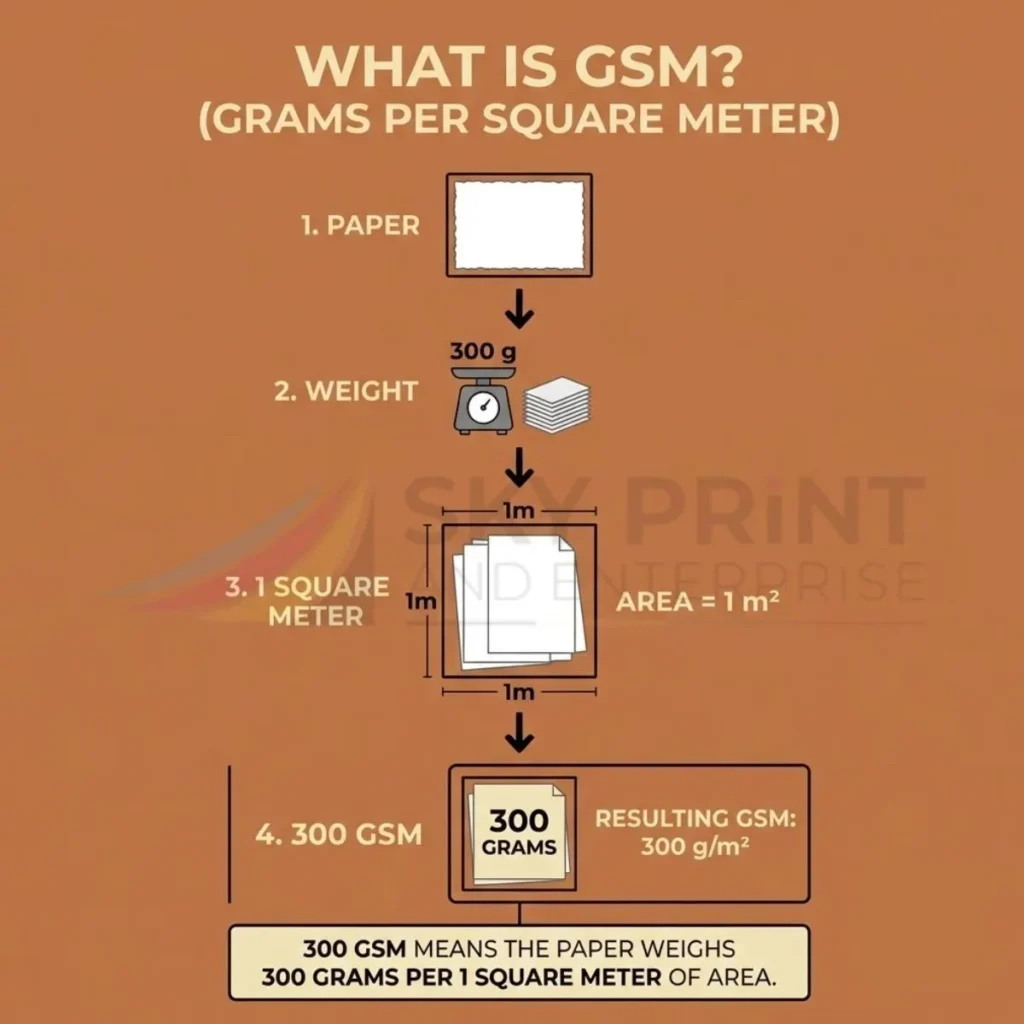
Understand what GSM means and why it is important when choosing paper and packaging materials.
The final performance of packaging depends on several additional factors, including fibre quality, board construction, coating, manufacturing process and intended application. Therefore, professional packaging suppliers consider GSM as one part of a wider material evaluation process rather than the only deciding factor.
This is particularly important because packaging serves different purposes across industries. A cosmetic brand may require a smooth board surface for premium printing, while a food manufacturer may need a material that provides strength, reliability and suitable product protection. Consequently, the ideal GSM depends on the specific requirements of each packaging project.
How Is GSM Measured?
Manufacturers calculate GSM by measuring the weight of a material sample with an area of one square metre. The measurement is internationally recognised and allows packaging companies to communicate material specifications accurately with customers, printers and suppliers.
For instance, a packaging manufacturer may recommend a 300 GSM folding carton board for a retail product because it provides a balance between print quality, folding performance and structural strength. A heavier 400 GSM board may be selected when the product requires additional rigidity or a more premium feel.
However, GSM should always be evaluated alongside the packaging design. A well-designed box made from the correct material can often outperform a poorly designed box made from a heavier board. Therefore, structural engineering, die-line design and material selection work together to create successful packaging.
Simple GSM Example:
- 250 GSM = Lightweight packaging board suitable for smaller products.
- 300 GSM = Popular choice for many folding cartons and retail boxes.
- 350–400 GSM = Premium packaging with increased rigidity.
- 500+ GSM = Heavy-duty applications and speciality packaging.
Common Packaging Card GSM Ranges Explained
Different packaging applications require different GSM levels. While there is no universal GSM specification that works for every product, manufacturers commonly use certain ranges depending on the packaging style, product weight and expected customer experience.
| GSM Range | Typical Application | Characteristics |
|---|---|---|
| 150–250 GSM | Sleeves, inserts, lightweight packaging | Flexible and economical |
| 250–350 GSM | Retail cartons, food boxes, cosmetic packaging | Good balance of strength and print quality |
| 350–500 GSM | Premium boxes, luxury packaging, gift packaging | Higher rigidity and premium feel |
| 500+ GSM | Heavy packaging, rigid structures, speciality products | Strong and highly durable |
Packaging Card GSM Examples by Product Type
Different products require different levels of protection and presentation. Therefore, manufacturers select GSM based on the product category rather than applying the same material specification to every box.
For example, premium confectionery packaging such as
Indian Mithai Boxes
often requires a strong board that maintains shape while supporting attractive printing and finishing. Similarly,
Honey Packaging
needs suitable strength because glass jars add significant weight to the packaging structure.
Food packaging such as
Burger Boxes,
Fish and Chip Boxes
and
Custom Pizza Boxes
requires materials that provide stability while supporting efficient production for larger quantities.
On the other hand, luxury products such as
Cufflink Boxes
and
Scarf Gift Boxes
often focus on premium presentation, where material selection contributes directly to the perceived value of the product.
Expert Packaging Advice
The best GSM choice is not always the heaviest option. Professional packaging design combines the right material weight, structural design and finishing techniques to create packaging that looks premium, performs reliably and remains cost-effective.
Understanding the difference between GSM and thickness is essential when selecting packaging materials. Although many buyers use these terms interchangeably, they describe two different characteristics of paper and board. GSM measures the weight of a material, while thickness measures the physical depth of that material. Therefore, a higher GSM does not always mean a thicker board, and a thicker board does not always provide better packaging performance.
When businesses order custom packaging, choosing the wrong specification can affect everything from printing quality and structural strength to transportation performance and customer perception. Consequently, professional packaging manufacturers analyse both GSM and thickness before recommending a material suitable for the product and packaging design.
This section of the Packaging GSM Guide explains the relationship between GSM and thickness, why the difference matters, and how manufacturers select the correct board specification for different packaging applications.
GSM vs Thickness: What Is the Difference?
GSM refers to the weight of paper or board measured in grams per square metre. Thickness, on the other hand, refers to how deep or thick the material physically measures, usually calculated in microns, millimetres or points depending on the industry.
For example, a 350 GSM folding carton board may feel similar in weight to another 350 GSM board, but both materials can have different thickness levels depending on their fibre structure, coating and manufacturing method. One board may feel stiffer because of its construction, while another may provide better print performance because of its smoother surface.
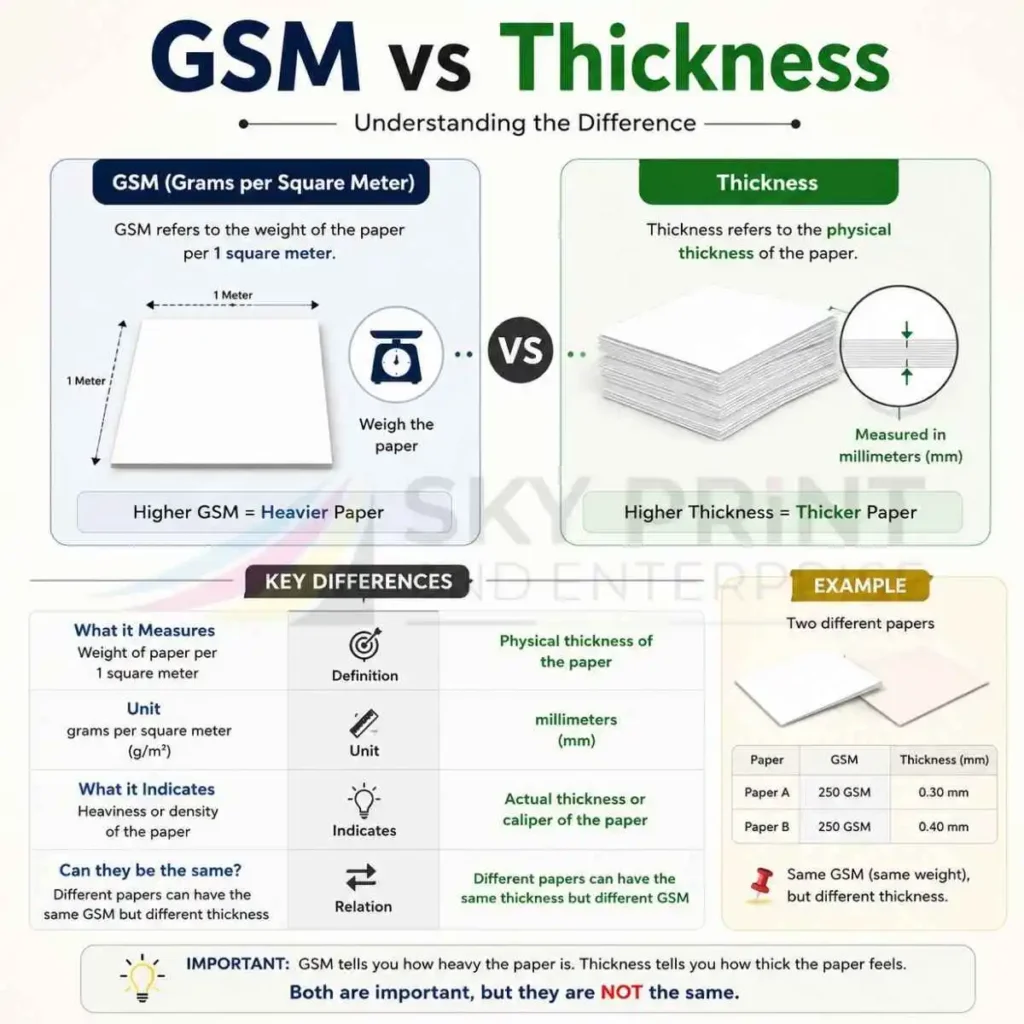
Learn the difference between GSM and material thickness when selecting packaging board.
Therefore, GSM alone cannot determine the complete quality or performance of packaging material. Manufacturers must consider multiple characteristics together, including:
- Board composition: Different fibres create different levels of stiffness and durability.
- Thickness: Affects rigidity, folding behaviour and product protection.
- Surface finish: Influences printing quality and premium appearance.
- Coating: Can improve durability, moisture resistance and visual appeal.
- Packaging structure: The box design itself affects overall strength.
As a result, experienced packaging suppliers never recommend material based on GSM alone. They evaluate the complete packaging requirement before selecting the most suitable board.
Why Higher GSM Does Not Always Mean Thicker Packaging
A common misunderstanding among packaging buyers is that increasing GSM automatically creates thicker and stronger packaging. However, this is not always true. The relationship between GSM and thickness depends heavily on the type of material being used.
For example, two different 400 GSM boards may have different thickness levels because one may contain denser fibres while another may contain a lighter construction with more volume. Similarly, coated boards may feel different from uncoated boards even when both have the same GSM specification.
This difference becomes particularly important when designing premium packaging. A luxury cosmetic box requires a combination of smooth printing, excellent colour reproduction and sufficient rigidity. Therefore, manufacturers often select a board that provides the correct balance between GSM, thickness and surface quality rather than simply choosing the heaviest option.
Important Packaging Rule:
The best packaging material is not necessarily the heaviest material. The best material is the one that provides the required strength, appearance, printing performance and cost efficiency for the specific application.
Card GSM and Thickness Comparison in Packaging
The following comparison explains how GSM and thickness influence packaging decisions.
| Factor | GSM | Thickness |
|---|---|---|
| Definition | Weight of material per square metre | Physical depth of material |
| Measured By | Grams per square metre | Microns, millimetres or points |
| Main Influence | Material weight and density | Rigidity and physical feel |
| Used For | Comparing material grades | Understanding board thickness |
Choosing the Right Balance Between GSM and Thickness
Successful packaging design requires a balance between material weight, thickness and structural requirements. A box that is too lightweight may fail during handling, while an unnecessarily heavy material can increase production costs and transportation expenses.
For example, premium products such as
perfume packaging,
serum boxes
and
essential oil storage boxes
often require carefully selected board specifications that support luxury finishes while maintaining structural integrity.
Similarly, food and transport packaging such as
pizza boxes,
fish and chip boxes
and
shipping boxes
require materials selected according to product weight, stacking requirements and delivery conditions.
Therefore, packaging professionals always evaluate the complete application before recommending a GSM and thickness combination. This approach creates packaging that performs reliably while delivering the desired brand experience.
Understanding the difference between GSM and microns helps businesses make better packaging material decisions. While GSM explains the weight of paper or board, microns explain the physical thickness of the material. Both measurements provide valuable information; however, they describe different characteristics and should not be used as replacements for each other.
Many packaging buyers compare materials only by GSM because it is a commonly used specification. However, thickness also affects how packaging feels, folds, stacks and protects products. Therefore, professional packaging manufacturers consider both GSM and micron measurements when selecting suitable materials for custom packaging projects.
This section explains how GSM and microns work together, why the difference matters and how manufacturers use these measurements when producing retail packaging, food boxes, luxury packaging and commercial printed products.
What Are Microns in Packaging?
A micron is a measurement used to describe the thickness of a material. One micron equals one thousandth of a millimetre. In packaging production, microns help manufacturers understand how thick a sheet of paper, card, film or board is.
For example, a packaging material measuring 400 microns has a thickness of 0.4 millimetres. A material measuring 600 microns has a thickness of 0.6 millimetres. Therefore, a higher micron value usually indicates a thicker material.
However, thickness alone does not determine packaging quality. A thick material may not always provide the best printing surface, folding performance or structural strength. Similarly, a thinner material with better fibre construction can sometimes perform better than a thicker alternative.
This is why packaging professionals evaluate micron measurements alongside GSM, board type and packaging structure before selecting materials.
Simple Explanation:
- GSM = How heavy the material is.
- Microns = How thick the material is.
- Material construction = How the packaging performs.
Relationship Between GSM and Microns
Although GSM and microns measure different properties, they are closely related. Generally, heavier materials tend to have greater thickness, but the relationship is not always exact. The final thickness depends on the density, fibre composition and manufacturing process of the board.
For example, two different boards may both have a specification of 350 GSM, but one may measure 450 microns while another measures 500 microns. The difference occurs because the boards may use different fibres, coatings or production techniques.
This is particularly important in packaging because the same GSM value can create different results depending on the material selected. A luxury cosmetic box, for example, requires a smooth surface for high-quality printing and finishing, while a transport box requires durability and impact resistance.
Therefore, packaging manufacturers look beyond the GSM number and analyse the complete material specification before recommending the right option.
Approximate GSM to Micron Comparison Chart
The following table provides a general guide showing how common packaging materials may compare. Actual measurements can vary depending on board type, manufacturer and material construction.
| Approximate GSM | Approximate Thickness | Common Uses |
|---|---|---|
| 250 GSM | Approximately 300–350 microns | Light packaging sleeves and cartons |
| 300 GSM | Approximately 350–450 microns | Retail boxes and folding cartons |
| 350 GSM | Approximately 400–500 microns | Premium product packaging |
| 400 GSM+ | 500+ microns | Luxury packaging and stronger cartons |
Why Packaging Manufacturers Use Both Card GSM and Microns
Professional packaging production requires more than selecting a paper weight. Manufacturers need to understand how materials will behave during printing, cutting, folding, gluing and transportation. Therefore, GSM and micron measurements work together to provide a clearer picture of material performance.
For example, a premium
perfume box
may require a carefully selected folding board that offers excellent print quality and enough thickness to maintain a premium feel. Similarly,
custom box sleeves
often require a material that combines flexibility with sufficient thickness for a professional appearance.
On the other hand, stronger applications such as
shipping boxes
and
subscription boxes
depend more heavily on structural performance, stacking strength and protection during delivery.
Consequently, the most successful packaging solutions come from selecting the correct combination of GSM, thickness, material type and box structure.
Expert Packaging Advice
When comparing packaging quotations, always check the complete material specification rather than comparing GSM alone. Two suppliers may quote the same GSM but use different boards, which can create noticeable differences in quality, strength and final appearance.
Understanding the difference between GSM and caliper helps packaging buyers and designers evaluate materials more accurately. While GSM explains the weight of paper or board, caliper measures the thickness of the material. Both measurements provide valuable technical information, but they help answer different questions during packaging development.
When selecting packaging materials, businesses often compare GSM values between suppliers. However, two boards with identical GSM can have different caliper measurements because manufacturers may use different fibres, coatings and production methods. Therefore, understanding caliper allows businesses to make more informed decisions about packaging strength, appearance and performance.
This section explains what caliper means, how it differs from GSM and why professional packaging manufacturers consider both measurements when creating reliable packaging solutions.
What Is Caliper in Packaging?
Caliper refers to the thickness of a paper or board material. Packaging manufacturers usually measure caliper in microns, thousandths of an inch (points) or millimetres. It provides information about the physical depth of the material and helps manufacturers understand how a board will behave during production.
For example, a folding carton board with a higher caliper will usually feel thicker and provide increased rigidity compared with a lower-caliper board. However, thickness alone does not determine packaging quality because the material composition and structural design also influence performance.
Caliper becomes especially important when packaging needs to maintain its shape during handling. Retail packaging displayed on shelves, premium gift boxes and product presentation boxes often require a specific thickness level to achieve the desired appearance.
Manufacturers also consider caliper during the converting process. The thickness of a board affects cutting, creasing and folding performance. Therefore, selecting a suitable caliper helps prevent issues such as cracking, inaccurate folds or weak structural areas.
Difference Between GSM and Caliper
Although GSM and caliper are related, they measure completely different properties. GSM focuses on material weight, while caliper focuses on material thickness. Understanding this difference prevents businesses from choosing packaging materials based on incomplete information.
| Measurement | What It Measures | Packaging Importance |
|---|---|---|
| GSM | Weight of material per square metre | Helps compare paper and board grades |
| Caliper | Physical thickness of material | Influences rigidity and appearance |
| Thickness | Depth measurement of the board | Affects folding and structural behaviour |
For example, a 350 GSM board may have a different caliper compared with another 350 GSM board from a different manufacturer. The difference may come from fibre density, coating or board construction. Consequently, packaging suppliers evaluate the complete specification rather than relying on one measurement.
Why Caliper Matters for Packaging Design
Caliper influences how packaging feels in the customer’s hands. A thicker board often creates a perception of quality and durability, which is particularly important for luxury products. Therefore, brands selling premium items often select materials with carefully controlled thickness levels to support their positioning.
For example, cosmetic and beauty brands producing
perfume boxes,
serum boxes
and
essential oil packaging
often require boards with a smooth surface, consistent caliper and excellent printing characteristics.
Similarly, retail products such as
printed foldable boxes
and
custom box sleeves
need materials that maintain shape while allowing accurate folding and professional finishing.
On the other hand, heavier applications such as shipping and subscription packaging depend on different performance requirements. These products require materials that withstand pressure, stacking and transportation conditions.
Expert Packaging Recommendation
When comparing packaging materials, always review GSM and caliper together. GSM explains the material weight, while caliper explains the physical thickness. A professional packaging manufacturer uses both measurements to recommend materials that deliver the right balance of appearance, strength and production performance.
Understanding GSM vs PT (point) helps businesses compare packaging materials accurately, especially when working with international suppliers. While GSM measures the weight of paper or board, PT measures thickness. Both specifications describe different aspects of packaging material, and manufacturers often use them together when selecting boards for commercial production.
The term “point” is commonly used in the printing and packaging industries, particularly in North America. However, UK and European suppliers more commonly use GSM, microns and millimetres when describing paper and board specifications. Therefore, understanding these different terms helps businesses avoid confusion when comparing packaging quotations from different markets.
This section explains what PT means, how it compares with GSM and why understanding point thickness can help businesses select the correct packaging material.
What Does PT Mean in Packaging?
PT, also called point or points, is a measurement used to describe the thickness of paper, card and board materials. One point equals one thousandth of an inch. Therefore, a 10 PT board has a thickness of 0.010 inches.
In simple terms, PT tells manufacturers how thick a material physically is, similar to how microns describe thickness. However, the terminology differs depending on the region and industry. Packaging suppliers in the United States commonly use points, while UK and European suppliers usually refer to microns or millimetres.
For example:
- 10 PT = approximately 0.010 inches thickness.
- 15 PT = approximately 0.015 inches thickness.
- 20 PT = approximately 0.020 inches thickness.
A higher PT value generally indicates a thicker board. However, similar to GSM and microns, thickness alone does not determine the overall packaging performance. Fibre quality, board construction and design also influence strength and durability.
GSM vs PT: Understanding the Difference
Furthermore, GSM and PT measure completely different characteristics. GSM focuses on material weight, whereas PT focuses on thickness. Therefore, comparing the two measurements directly is not always possible because they answer different technical questions.
| Measurement | Meaning | Common Usage |
|---|---|---|
| GSM | Weight of material per square metre | UK, Europe and global printing industries |
| PT (Point) | Thickness measurement in thousandths of an inch | Mostly North American printing industries |
| Microns | Thickness measurement in thousandths of a millimetre | UK and international packaging specifications |
For example, a supplier in the USA may describe a board as 18 PT, while a UK supplier may describe a similar material by its micron thickness or GSM value. Understanding these differences makes international packaging communication much easier.
Why PT Matters for Packaging Buyers
PT measurement becomes useful when businesses need to compare packaging materials from suppliers using different technical standards. Instead of focusing on one number, buyers can understand how thick a board actually is and whether it suits their packaging requirements.
For premium packaging applications, thickness contributes to the customer’s perception of quality. A luxury box with a substantial feel creates a stronger brand impression than a lightweight alternative. Therefore, businesses producing premium products often consider board thickness alongside printing quality and finishing options.
For example, luxury products such as:
often require carefully selected board thickness to achieve a premium appearance and reliable structure.
Similarly, food and retail packaging requires the right balance between thickness and practicality. Products such as:
need materials that provide durability while remaining efficient for high-volume manufacturing.
Expert Packaging Advice
When comparing packaging specifications from different countries, always confirm whether the supplier is referring to GSM, PT, microns or another measurement. Clear communication prevents material misunderstandings and ensures the final packaging meets your expectations for quality, strength and appearance.
Complete Packaging Card GSM Chart
One of the most common questions asked by businesses is, “Which GSM should I choose?” Unfortunately, there is no single answer because every packaging project has different requirements. The correct GSM depends on several factors, including product weight, packaging style, printing requirements, storage conditions, transportation, finishing techniques and customer expectations.
For example, a lightweight cosmetic carton requires a completely different board specification from a corrugated shipping box carrying several kilograms of products. Likewise, a luxury gift box focuses on presentation and rigidity, whereas takeaway food packaging prioritises functionality, food safety and production efficiency.
Professional packaging manufacturers evaluate all of these factors before recommending a board grade. Rather than selecting the heaviest material available, they choose the GSM that provides sufficient strength while keeping production efficient and cost-effective.
Packaging Card GSM Guide : Recommended Packaging GSM Chart
The following chart provides general guidance for common packaging applications. Actual material recommendations may vary depending on the board grade, structural design and finishing requirements. Therefore, treat these values as a practical starting point rather than fixed manufacturing standards.
| Packaging Application | Recommended GSM | Typical Material | Reason |
|---|---|---|---|
| Product Sleeves | 200–300 GSM | Folding Box Board | Lightweight and economical |
| Retail Folding Cartons | 250–350 GSM | SBS / FBB | Excellent printing and folding |
| Luxury Product Boxes | 350–400 GSM | Premium Folding Board | Premium appearance |
| Food Packaging | 250–350 GSM | Food-grade Board | Strength with efficient production |
| Rigid Gift Boxes | Greyboard + Wrapped Paper | Rigid Board | Maximum rigidity |
| Shipping Cartons | Corrugated Board | E-Flute / B-Flute | Product protection |
Although this chart provides useful guidance, every packaging project should be evaluated individually. Product dimensions, weight, storage conditions and branding objectives all influence the final material specification.
Packaging Card GSM Guide for Folding Cartons
Folding cartons are among the most widely used packaging formats because they combine attractive printing with efficient manufacturing. Businesses across the cosmetics, healthcare, electronics, confectionery and retail sectors rely on folding cartons to protect products while presenting a professional appearance.
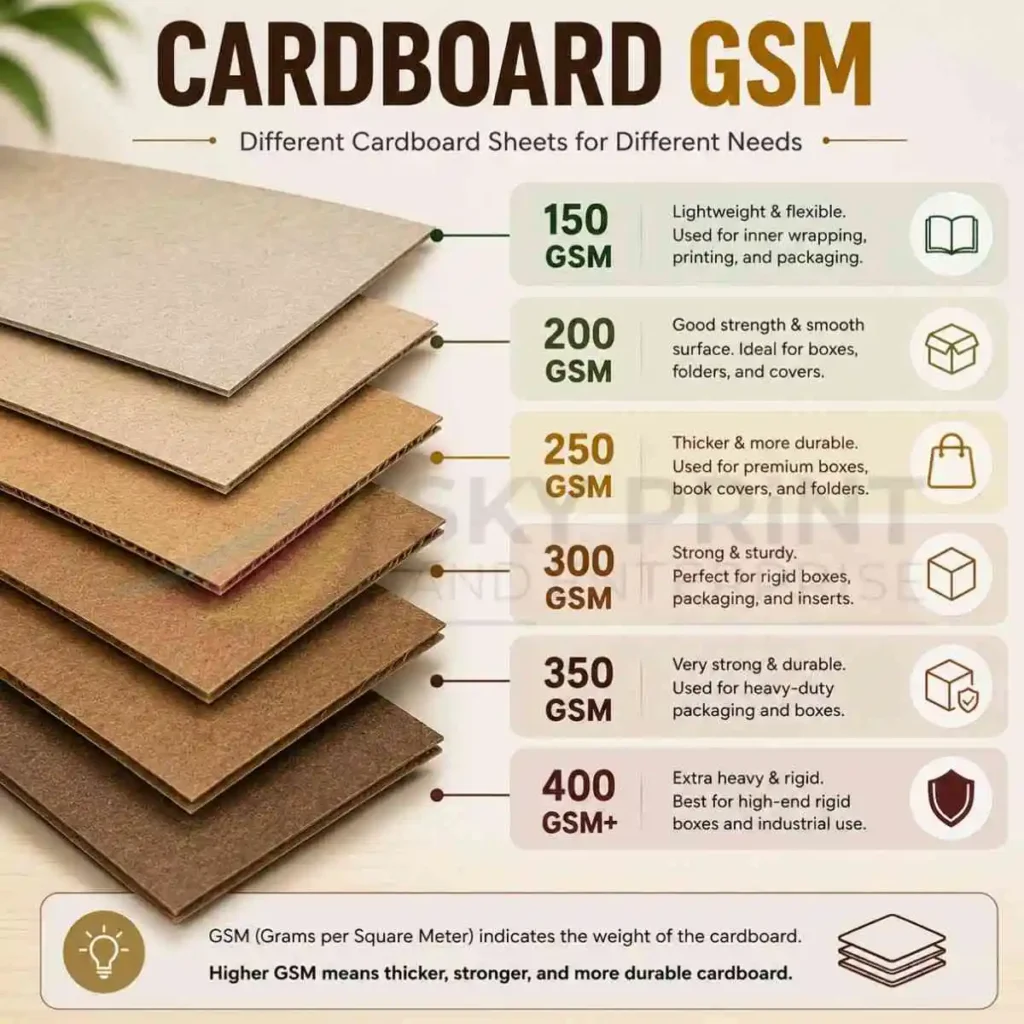
A quick reference chart explaining the most commonly used paper and card GSM for packaging and printing applications.
Most folding cartons use board between 250 and 350 GSM. This range usually provides sufficient rigidity without making the box difficult to fold or assemble. However, luxury products often benefit from heavier board because the additional stiffness enhances the customer’s perception of quality.
Products such as
Perfume Boxes,
Serum Boxes,
Comb Boxes
and
Bra Packaging Boxes
commonly use premium folding boards because they support vibrant printing, foil stamping, embossing and other decorative finishes.
Choosing a heavier GSM than necessary may increase production costs without providing meaningful benefits. Therefore, packaging manufacturers usually recommend the lightest board capable of delivering the required structural performance.
Packaging Card GSM Guide for Food Packaging
Food packaging requires careful material selection because it must balance durability, hygiene, print quality and production efficiency. Unlike luxury retail packaging, food boxes often prioritise functional performance while maintaining attractive branding.
Many takeaway and fast-food products perform well with board between 250 and 350 GSM. Nevertheless, the ideal specification depends on factors such as moisture exposure, serving temperature, grease resistance and the weight of the food.
For example,
- Burger Boxes require materials that remain stable during handling.
- Fish and Chip Boxes often use suitable food-grade boards designed for hot food applications.
- Pizza Boxes rely more heavily on corrugated construction than GSM alone because insulation and structural strength are equally important.
- Honey Packaging frequently requires stronger materials to support the additional weight of filled glass jars.
Therefore, manufacturers evaluate the complete packaging application before selecting the most suitable board grade. They also consider food-contact requirements, storage conditions and transportation to ensure the finished packaging performs consistently throughout the supply chain.
Manufacturer Recommendation
Do not choose packaging materials by GSM alone. Always compare the board grade, material composition, structural design and intended application. Two packaging boxes with identical GSM values can perform very differently because the fibre quality, coating and construction determine how the material behaves during printing, folding and transportation.
Packaging Card GSM Guide: How Manufacturers Choose the Right GSM
Selecting the correct GSM is one of the most important decisions during packaging development. Although many businesses ask for a specific GSM at the quotation stage, experienced manufacturers rarely choose materials based on weight alone. Instead, they evaluate the complete packaging project, including the product, box structure, finishing requirements, storage conditions and transportation needs before recommending the most suitable material.
Every packaging project has unique requirements. A lightweight cosmetic product, for example, does not require the same board specification as a heavy glass jar or an e-commerce shipping box. Consequently, manufacturers combine technical knowledge with practical production experience to select materials that provide the best balance between appearance, durability and cost.
Choosing an unnecessarily heavy board can increase production costs and shipping expenses, while selecting material that is too light may reduce product protection and damage brand perception. Therefore, successful packaging always starts with understanding the application rather than simply choosing a higher GSM.
Key Factors That Influence GSM Selection
Professional packaging manufacturers review several technical factors before recommending a board specification. Each factor contributes to the performance of the finished packaging and helps ensure the product remains protected throughout production, transportation and retail display.
| Factor | Why It Matters | Impact on GSM |
|---|---|---|
| Product Weight | Heavier products require stronger packaging. | May require higher GSM or stronger board construction. |
| Box Style | Structural design affects overall strength. | Some box styles achieve strength without increasing GSM. |
| Printing & Finishing | Foil, embossing and Spot UV require stable surfaces. | Premium finishes often benefit from heavier boards. |
| Transport Conditions | Shipping and stacking increase stress on packaging. | May require corrugated board instead of heavier carton board. |
| Brand Positioning | Luxury brands expect premium presentation. | Higher-quality materials improve perceived value. |
Manufacturers also consider humidity, storage time, handling frequency and the assembly process. As a result, they recommend materials that perform consistently throughout the entire product journey rather than focusing on a single technical measurement.
How Material Type Changes GSM Recommendations
The type of material often influences GSM recommendations more than many buyers realise. In this Packaging Card GSM Guide, it is important to understand that different packaging boards provide different levels of stiffness, print quality, and durability, even when they have similar GSM values. Therefore, manufacturers evaluate the board grade before confirming the final specification.
For example, folding carton board used for premium retail packaging performs differently from kraft board or corrugated board. Likewise, rigid box construction relies primarily on thick greyboard rather than standard folding carton GSM values.
If you would like to understand how different materials affect packaging performance, these guides provide more detailed information:
Cardboard Packaging Material Guide
Kraft Packaging Material Guide
Corrugated Cardboard Material Guide
Rigid Box Material Guide
Understanding the characteristics of each material helps businesses compare quotations more effectively and choose packaging that delivers the required balance between performance, sustainability and budget.
Real-World Packaging Card GSM Examples
Looking at practical packaging examples makes it easier to understand how manufacturers apply GSM recommendations in real projects. Rather than following a single standard, they adjust the specification according to product weight, packaging purpose and customer expectations.
| Packaging Product | Typical Recommendation | Reason |
|---|---|---|
| Indian Mithai Boxes | Medium to heavy folding board | Supports product weight and premium printing. |
| Tights Boxes | Light to medium board | Protects lightweight apparel while remaining economical. |
| Dog Toy Boxes | Medium folding board | Provides durability for retail display. |
| Date Boxes | Food-grade folding board | Supports food presentation and handling. |
| Shipping Boxes | Corrugated construction | Prioritises protection over GSM alone. |
These examples demonstrate why manufacturers rarely recommend the same GSM for every project. Instead, they select materials according to the packaging’s functional requirements and the customer’s branding objectives.
Expert Tip
If you receive two packaging quotations with different GSM specifications, don’t assume the heavier material is automatically the better option. Compare the board grade, structural design, finishing process and intended application before making a decision. An experienced packaging manufacturer will always recommend the most suitable material for your product rather than simply the highest GSM available.
Best GSM for Different Packaging Products
One of the greatest advantages of understanding a Packaging GSM Guide is the ability to choose materials that match the product instead of relying on guesswork. Different products place different demands on packaging. Some require excellent print quality, others need additional rigidity, while shipping cartons prioritise strength during transportation. Therefore, professional manufacturers recommend GSM according to the product’s size, weight, intended use and structural design.
Although businesses often ask for the “best GSM”, experienced packaging specialists understand that no universal GSM exists. The correct choice depends on how the packaging will be manufactured, handled, displayed and delivered. Selecting an appropriate board improves durability, controls production costs and creates a better customer experience.
The examples below illustrate how different packaging applications typically require different material specifications. These recommendations serve as practical guidance rather than fixed manufacturing rules because board construction, coatings and structural engineering also influence the final performance.
Recommended Card GSM for Cosmetic and Beauty Packaging
Cosmetic packaging combines product protection with premium branding. Customers often judge quality before opening the box, so the material must provide a smooth printing surface, accurate folding, and a high-end appearance. As explained in this Packaging Card GSM Guide, manufacturers generally select premium folding boards that support decorative finishes such as foil stamping, embossing, and Spot UV.
Packaging products such as
Perfume Boxes,
Serum Boxes
and
Essential Oil Boxes
often benefit from premium carton boards because these materials deliver excellent print reproduction while maintaining a professional appearance throughout the supply chain.
Manufacturers balance GSM with board stiffness and finishing requirements to ensure the packaging feels luxurious without becoming unnecessarily heavy.
Recommended Card GSM for Retail Packaging
Retail packaging must protect products while attracting customers on the shelf. Consequently, manufacturers choose board grades that deliver both structural reliability and excellent print quality. The packaging should maintain its shape during storage, transportation and retail display without increasing production costs unnecessarily.
Examples include:
Each product has different structural requirements. Therefore, manufacturers evaluate the product dimensions, weight and retail environment before recommending the most appropriate board specification.
Recommended GSM for E-commerce Packaging
E-commerce packaging experiences more handling than traditional retail packaging. Products pass through warehouses, courier networks and customer deliveries before reaching their destination. Consequently, structural strength often becomes more important than paper weight alone.
Applications such as
Shipping Boxes
and
Subscription Boxes
typically rely on corrugated board construction rather than increasing the GSM of folding cartons. This approach provides better protection while remaining cost-effective for transportation.
Professional manufacturers therefore consider flute type, board composition, compression strength and packaging design alongside GSM to create durable e-commerce packaging.
Professional Recommendation – Packaging Card GSM Guide
The best Packaging Card GSM Guide always considers the product first and the GSM second. Material quality, structural engineering and manufacturing experience have a greater influence on packaging performance than GSM alone. Choosing the right combination produces packaging that protects products, enhances branding and delivers long-term value.
Best Card GSM for Different Packaging Products
One of the greatest advantages of understanding a Packaging GSM Guide is the ability to choose materials that match the product instead of relying on guesswork. Different products place different demands on packaging. Some require excellent print quality, others need additional rigidity, while shipping cartons prioritise strength during transportation. Therefore, professional manufacturers recommend GSM according to the product’s size, weight, intended use and structural design.
Although businesses often ask for the “best GSM”, experienced packaging specialists understand that no universal GSM exists. The correct choice depends on how the packaging will be manufactured, handled, displayed and delivered. Selecting an appropriate board improves durability, controls production costs and creates a better customer experience.
The examples below illustrate how different packaging applications typically require different material specifications. These recommendations serve as practical guidance rather than fixed manufacturing rules because board construction, coatings and structural engineering also influence the final performance.
Recommended Card GSM for Cosmetic and Beauty Packaging
Cosmetic packaging combines product protection with premium branding. Customers often judge quality before opening the box, so the material must provide a smooth printing surface, accurate folding and a high-end appearance. Manufacturers generally select premium folding boards that support decorative finishes such as foil stamping, embossing and Spot UV.
Packaging products such as
Perfume Boxes,
Serum Boxes
and
Essential Oil Boxes
often benefit from premium carton boards because these materials deliver excellent print reproduction while maintaining a professional appearance throughout the supply chain.
Manufacturers balance GSM with board stiffness and finishing requirements to ensure the packaging feels luxurious without becoming unnecessarily heavy.
Recommended GSM for Retail Packaging
Retail packaging must protect products while attracting customers on the shelf. Consequently, manufacturers choose board grades that deliver both structural reliability and excellent print quality. The packaging should maintain its shape during storage, transportation and retail display without increasing production costs unnecessarily.
Examples include:
Each product has different structural requirements. Therefore, manufacturers evaluate the product dimensions, weight and retail environment before recommending the most appropriate board specification.
Recommended GSM for E-commerce Packaging
E-commerce packaging experiences more handling than traditional retail packaging. Products pass through warehouses, courier networks and customer deliveries before reaching their destination. Consequently, structural strength often becomes more important than paper weight alone.
Applications such as
Shipping Boxes
and
Subscription Boxes
typically rely on corrugated board construction rather than increasing the GSM of folding cartons. This approach provides better protection while remaining cost-effective for transportation.
Professional manufacturers therefore consider flute type, board composition, compression strength and packaging design alongside GSM to create durable e-commerce packaging.
Professional Recommendation
The best Packaging GSM Guide always considers the product first and the GSM second. Material quality, structural engineering and manufacturing experience have a greater influence on packaging performance than GSM alone. Choosing the right combination produces packaging that protects products, enhances branding and delivers long-term value.
Packaging Card GSM Guide for Commercial Printing and Specialty Packaging
A complete Packaging GSM Guide covers more than standard cartons and shipping boxes. Many businesses also require packaging for promotional products, gift items, subscription services and specialty retail products. These applications often combine premium printing with structural performance, so manufacturers carefully balance GSM, board quality and finishing techniques to achieve the desired result.
Commercial printing places additional demands on packaging materials because every print process interacts differently with paperboard. Foil stamping, embossing, debossing, soft-touch lamination and Spot UV all perform better when the board has the correct surface characteristics and sufficient rigidity. Therefore, selecting the right GSM becomes part of a much broader material selection process.
Instead of choosing the heaviest board available, professional packaging manufacturers recommend materials that deliver excellent print quality while maintaining production efficiency and controlling overall costs.
Packaging Card GSM Guide for Luxury Packaging
Luxury packaging focuses on presentation as much as protection. Customers immediately notice how a box feels, opens and reflects the quality of the brand. Consequently, luxury packaging requires carefully selected materials that combine structural stability with premium printing performance.
Products such as
Bracelet Boxes,
Custom Cufflink Boxes,
Scarf Gift Boxes
and premium
Perfume Boxes
often use carefully selected carton board or rigid board systems that support decorative finishes without compromising durability.
Luxury packaging also requires consistent colour reproduction, accurate folding, and clean die-cutting. Therefore, manufacturers assess the entire production process rather than specifying GSM alone. This Packaging Card GSM Guide highlights why a well-designed luxury package combines the correct board grade, professional finishing, and precise structural engineering to create a memorable customer experience.
Packaging Card GSM Guide for Food and Gift Packaging
Food and gift packaging covers a wide range of products, each with unique performance requirements. Some products require attractive presentation for retail shelves, while others prioritise protection during transport or long-term storage. Consequently, manufacturers recommend different board grades according to the intended application.
Examples include:
- Indian Mithai Boxes for premium confectionery presentation.
- Date Boxes for retail food packaging.
- Honey Packaging for heavier glass containers.
- Custom Printed Box Sleeves for branding and promotional packaging.
Although these packaging products serve different industries, manufacturers follow the same principle: select the lightest material that delivers the required strength, appearance and print quality. This approach reduces waste, improves production efficiency and supports more sustainable packaging solutions.
Common Mistakes When Choosing Packaging Card GSM
Many businesses assume that increasing GSM automatically improves packaging quality. However, this assumption can lead to unnecessary production costs without meaningful performance improvements. In this Packaging Card GSM Guide, we explain how professional packaging manufacturers evaluate board weight, thickness, strength, and application before recommending the right specification.
The most common mistakes include:
- Choosing packaging materials based only on GSM.
- Ignoring the type and quality of the paperboard.
- Comparing quotations without checking the complete material specification.
- Selecting thicker materials when better structural design would achieve the same result.
- Overlooking transportation, storage and stacking requirements.
- Not considering premium finishing requirements during material selection.
Avoiding these mistakes helps businesses improve packaging performance while controlling manufacturing costs. As a result, packaging remains attractive, functional and commercially efficient throughout the product lifecycle.
Expert Manufacturer Insight
The most successful packaging projects begin with understanding the product rather than selecting a GSM value. Experienced packaging manufacturers analyse the product weight, structural requirements, printing process, finishing options and transportation conditions before recommending the most appropriate material. This approach produces packaging that performs consistently while supporting both branding and commercial objectives.
Packaging Card GSM Guide FAQs
Many businesses have similar questions when choosing packaging materials. This section answers the most common questions about paper weight, cardboard thickness and packaging board selection. Understanding these answers makes it easier to compare quotations, communicate with packaging manufacturers and select materials that suit your products.
Common Packaging GSM Questions – Packaging Card GSM Guide
What does Card GSM mean in packaging?
GSM stands for grams per square metre. It measures the weight of paper or board used to manufacture packaging. A higher GSM generally indicates a heavier material, although it does not automatically mean stronger or thicker packaging.
Does a higher GSM always mean better packaging?
No. A higher GSM simply means the material weighs more per square metre. Packaging quality also depends on fibre composition, board grade, structural design, coatings and manufacturing quality. A well-designed package using the correct board often performs better than an unnecessarily heavy alternative.
What GSM is best for folding cartons?
Many folding cartons use materials between 250 and 350 GSM. However, the ideal specification depends on product weight, box size, printing requirements and finishing techniques.
Which packaging materials use GSM measurements?
GSM commonly applies to folding box board, solid bleached board, kraft board, paperboard and many speciality papers. Corrugated packaging also uses GSM when describing liner papers, although flute construction plays an equally important role.
Can two materials have the same GSM but different thickness?
Yes. Different fibre densities and manufacturing processes can produce materials with identical GSM values but different thicknesses. Therefore, manufacturers often compare GSM together with caliper or micron measurements.
How does GSM affect print quality?
The printing result depends more on the board surface and coating than GSM alone. Nevertheless, heavier premium boards often provide greater stability during printing and finishing.
Does GSM affect shipping costs?
Yes. Heavier packaging materials may increase overall shipping weight, particularly for high-volume orders. Consequently, manufacturers usually recommend the lightest material that still provides adequate protection.
Is corrugated board measured only by GSM?
No. Corrugated packaging also considers flute profile, liner weight, board construction and compression strength. These characteristics influence performance more than GSM alone.
How do manufacturers recommend the correct GSM?
Manufacturers evaluate product dimensions, weight, structural design, transportation requirements, storage conditions, branding objectives and finishing processes before selecting the most suitable material.
Should I specify GSM when requesting a quotation?
You can provide a preferred GSM if you have previous packaging experience. However, allowing the manufacturer to recommend the specification often produces better results because they can match the material to your product and packaging design.
Expert Buying Advice Before Ordering Packaging – Packaging Card GSM Guide
Before approving any packaging quotation, request a complete material specification rather than comparing GSM alone. Ask which board grade will be used, whether the material is suitable for your product, what finishing options are available and whether the packaging has been designed for transportation as well as presentation.
If sustainability is important, discuss recycled content, recyclable materials and environmentally responsible production methods with your packaging supplier. Many modern materials provide excellent performance while supporting environmental objectives.
Finally, remember that packaging represents your brand. A carefully engineered package creates a positive first impression, protects the product and improves the overall customer experience. Working with an experienced manufacturer helps ensure every element of the packaging contributes to those goals.
Key Takeaway
The best packaging material is not necessarily the one with the highest GSM. Successful packaging combines the correct board grade, appropriate thickness, intelligent structural design and high-quality manufacturing to create packaging that protects products, strengthens branding and delivers long-term value.
Packaging Card GSM Guide: Final Thoughts
Choosing the correct packaging material involves much more than selecting a higher GSM. As this Packaging Card GSM Guide has demonstrated, successful packaging depends on understanding how GSM, board quality, thickness, structural engineering and manufacturing processes work together. Every packaging project has unique requirements, so the ideal solution always depends on the product, the brand and the intended use.
Whether you are producing retail cartons, luxury gift boxes, food packaging, e-commerce boxes or commercial printed packaging, selecting the appropriate material improves product protection, enhances customer experience and supports long-term business growth. Working with an experienced packaging manufacturer ensures that every element—from material selection to finishing—contributes to a high-quality finished product.
Rather than comparing quotations by GSM alone, compare the complete material specification, board grade, construction method and manufacturing expertise. This approach helps you achieve better packaging performance, greater value and more consistent production results.
Continue Learning with Our Packaging Guides
Expand your packaging knowledge by exploring our specialist guides covering materials, packaging design and manufacturing.
Industry Resources
For additional information about paper, board, sustainability and packaging standards, you may find these industry organisations helpful:
- FEFCO – European Federation of Corrugated Board Manufacturers
- CITPA – International Confederation of Paper & Board Converters
- WRAP UK – Sustainable Packaging Guidance
- ISO International Standards
These organisations publish technical guidance, sustainability information and industry best practices that complement the information provided in this Packaging GSM Guide.
Need Expert Packaging Advice?
Whether you need folding cartons, luxury rigid boxes, food packaging, retail packaging or shipping boxes, our packaging specialists can recommend the most suitable material, board grade and GSM for your project.