
Welcome to the Custom Printing & Packaging Guide, your complete resource for custom packaging, commercial printing, packaging materials, luxury box finishes, structural design and manufacturing. Whether you are launching a new product, improving your existing packaging or exploring commercial printing solutions, this comprehensive guide explains every stage of the packaging process to help businesses make informed decisions.
Sky Print and Enterprise • Printing & Packaging Resources
Printing & Packaging Guide
Welcome to the ultimate Printing & Packaging Guide, your trusted resource for learning everything about custom packaging, commercial printing, packaging materials, luxury finishes, box styles, artwork preparation, printing methods, sustainable packaging and much more. Whether you are launching a new product, developing premium retail packaging or improving your brand presentation, this guide will help you make informed decisions with confidence.
Created by the packaging specialists at Sky Print and Enterprise, this knowledge hub combines practical industry expertise with easy-to-understand explanations. As a result, businesses, designers, marketers, retailers and manufacturers can all benefit from reliable information in one convenient place.
Welcome to the Printing & Packaging Guide
The Printing & Packaging Knowledge Hub has been created to serve as a complete educational resource for anyone involved in custom packaging and commercial printing. Instead of searching through multiple websites for answers, you can explore expertly written guides covering every stage of the packaging journey, from selecting the right board material to choosing luxury finishes that enhance your brand.
Moreover, packaging has become far more than simply protecting a product. Today, it influences purchasing decisions, communicates brand values, improves customer experience and supports sustainability goals. Consequently, understanding packaging fundamentals is essential for businesses of every size.
Throughout this hub, you will discover detailed guidance on packaging design, cardboard grades, GSM selection, printing methods, box construction, dielines, artwork preparation, manufacturing techniques, quality control, sustainability and much more. Furthermore, each topic has been carefully organised so you can continue learning through dedicated in-depth guides as they are published.
Whether you manufacture cosmetics, food products, apparel, electronics, jewellery or luxury gifts, this hub has been designed to provide practical knowledge that helps you choose packaging solutions with greater confidence.
Why This Packaging Guide Matters for Your Business
Successful packaging combines engineering, branding, printing technology and consumer psychology. Therefore, every decision—from the thickness of the board to the choice of finishing—can influence product protection, production costs and customer perception.
Unfortunately, much of the information available online is either incomplete or overly technical. By contrast, this packaging knowledge hub explains complex packaging concepts in a practical way while maintaining professional accuracy. Consequently, you can confidently compare materials, understand manufacturing processes and select solutions that align with your objectives.
In addition, every guide is written with real commercial applications in mind. Rather than focusing solely on theory, we explain how packaging decisions affect retail presentation, logistics, sustainability, printing quality and long-term brand value.
Complete Packaging Guide for Businesses
Choosing the right packaging is one of the most important decisions a business can make. However, packaging is far more than a printed box. Instead, it combines structural engineering, material selection, printing technology, finishing techniques and manufacturing processes into one complete solution. Consequently, businesses that understand each stage usually produce packaging that protects products, strengthens their brand and improves customer satisfaction.
Throughout this Packaging Guide, you will learn how packaging is designed, manufactured and printed. Furthermore, every chapter explains a different stage of the production journey. Therefore, whether you are developing retail packaging, luxury presentation boxes or e-commerce mailer boxes, this guide will help you make informed decisions before production begins.
In addition, we explain how board grades, box styles, artwork preparation, dielines, printing methods and luxury finishes influence both cost and quality. As a result, you can confidently choose packaging that performs well while remaining commercially viable.
Explore Our Printing & Packaging Guide
This packaging guide is continually expanding. The following expert guides will help you explore every aspect of printing and packaging in greater detail.
| Guide | What You’ll Discover |
|---|---|
| Complete Packaging Design Guide | Learn how effective packaging design strengthens branding, improves shelf appeal and creates memorable customer experiences. |
| Packaging Materials Guide | Understand the differences between kraft board, SBS, corrugated board, rigid board and specialty materials. |
| Packaging Card GSM Guide | Compare paperboard thicknesses, recommended applications and industry standards for different packaging products. |
| Luxury Packaging Finishes Guide | Explore foil stamping, embossing, debossing, Spot UV, soft-touch lamination and many other premium finishes. |
| Printing Methods Guide | Discover digital, lithographic, flexographic and offset printing techniques used across the packaging industry. |
| Complete Box Styles Guide | Learn about tuck boxes, mailer boxes, rigid boxes, crash-lock boxes, sleeves and many more packaging styles. |
| Printing Dieline Guide | Find parts of dieline, types of dielines, preparation, new tends, how printing dieline techniques used across the packaging industry. |
| Printing Artwork Guide Guide | Understand, artwork, packaging artwork, artwork design preparation, not to do mistakes and complete other detail. |
Need Professional Packaging Advice?
Choosing the right packaging can significantly improve product protection, brand perception and customer satisfaction. If you need tailored guidance or a bespoke quotation, our specialists are here to help.
Printing & Packaging Guide: Packaging Design Guide
Exceptional packaging begins with thoughtful design. While attractive graphics certainly capture attention, successful packaging also protects products, communicates brand identity and enhances the customer’s overall experience. Therefore, effective packaging design balances creativity with functionality, ensuring every box looks impressive while performing its intended purpose.
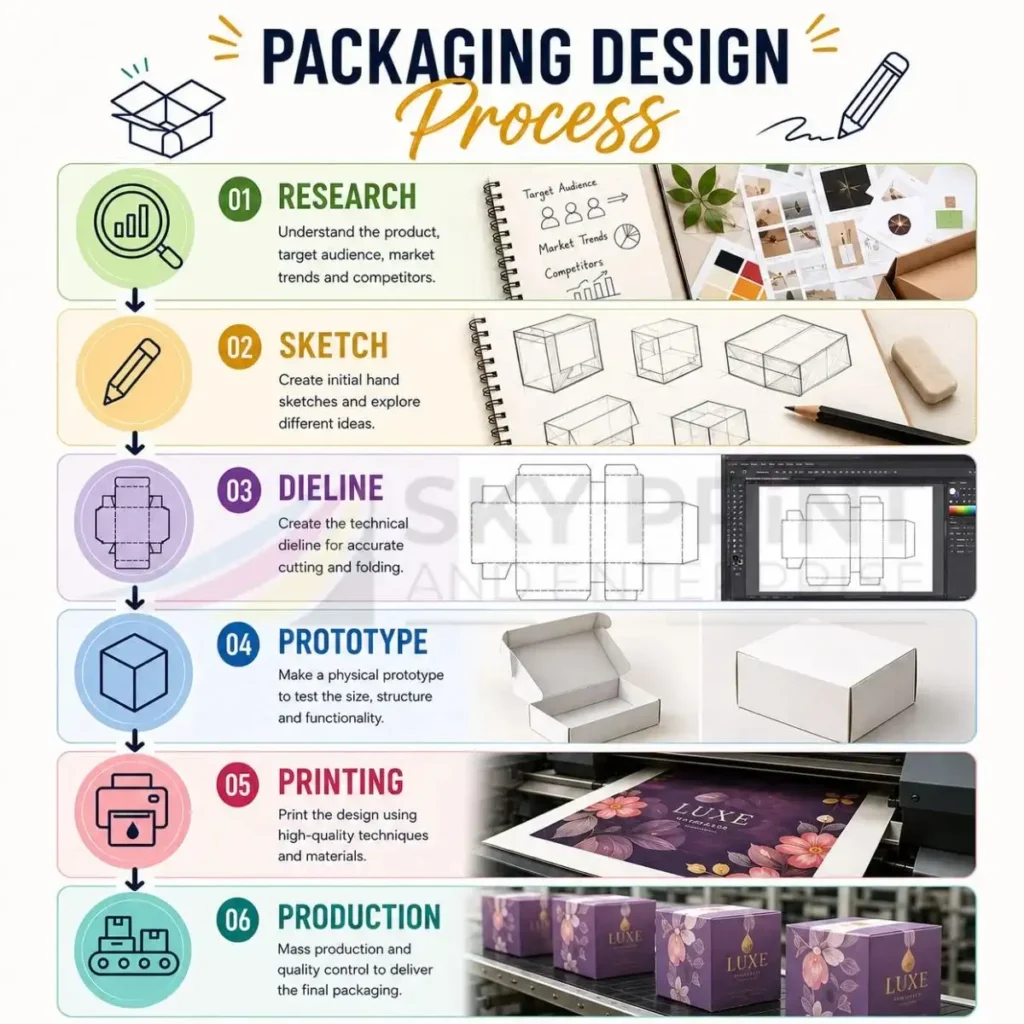
packaging design process
Moreover, modern consumers judge a product long before they open it. Colours, typography, finishes, structure and materials all influence purchasing decisions. Consequently, investing in professional packaging design can strengthen brand recognition, improve customer confidence and encourage repeat purchases.
Furthermore, when developing custom packaging, designers should consider several essential elements:
- Brand consistency and logo placement.
- Clear product information.
- Readable typography.
- Appropriate colour combinations.
- Structural strength.
- Efficient product protection.
- Sustainability objectives.
- Retail shelf impact.
- Premium unboxing experience.
Expert Tip – Packaging Guide
Great packaging tells your brand story before customers even see the product itself. Therefore, every design decision—from the opening mechanism to the finishing effects—should reinforce your brand identity while improving usability.
Additionally, businesses looking for bespoke retail solutions can explore our
Custom Printed Cardboard Boxes,
Luxury Rigid Boxes,
Custom Gift Boxes and
Custom Mailer Boxes, each manufactured to combine durability with premium presentation.
Most importantly, our Complete Packaging Design Guide will explore colour psychology, branding strategies, typography, layout planning, consumer behaviour, artwork preparation and practical design techniques in much greater detail.
Printing & Packaging Guide: Packaging Materials Guide
Selecting suitable packaging materials is one of the most important decisions during product development. Different materials provide different levels of strength, print quality, sustainability and cost efficiency. Consequently, understanding their characteristics helps businesses choose packaging that performs effectively throughout storage, transport and retail display.
Today, cardboard packaging remains one of the most versatile and environmentally responsible packaging solutions available. Nevertheless, not every board grade suits every application. Luxury products often require rigid board, whereas lightweight retail cartons may perform perfectly with folding boxboard or kraft card.
| Material | Typical Uses | Key Benefits |
|---|---|---|
| Kraft Board | Eco packaging | Natural appearance, recyclable and durable |
| SBS Board | Cosmetics & pharmaceuticals | Bright white surface with excellent print quality |
| Corrugated Board | Shipping cartons | Outstanding strength and protection |
| Greyboard | Rigid boxes | Exceptional rigidity and premium feel |
| Duplex Board | Retail cartons | Cost-effective with good printability |
Depending on your industry, different packaging materials offer distinct advantages. Food businesses often prioritise food-safe board, while luxury brands typically select rigid board with decorative papers and premium finishes. Likewise, e-commerce companies generally choose folding carton packaging material because it provides excellent style and printing options, however corrugated material provide superior safes transit.
Moreover, explore our specialist packaging collections including
Custom Kraft Boxes,
Corrugated Boxes,
Rigid Boxes,
Printed Paper Bags and our
Packaging Materials Service.
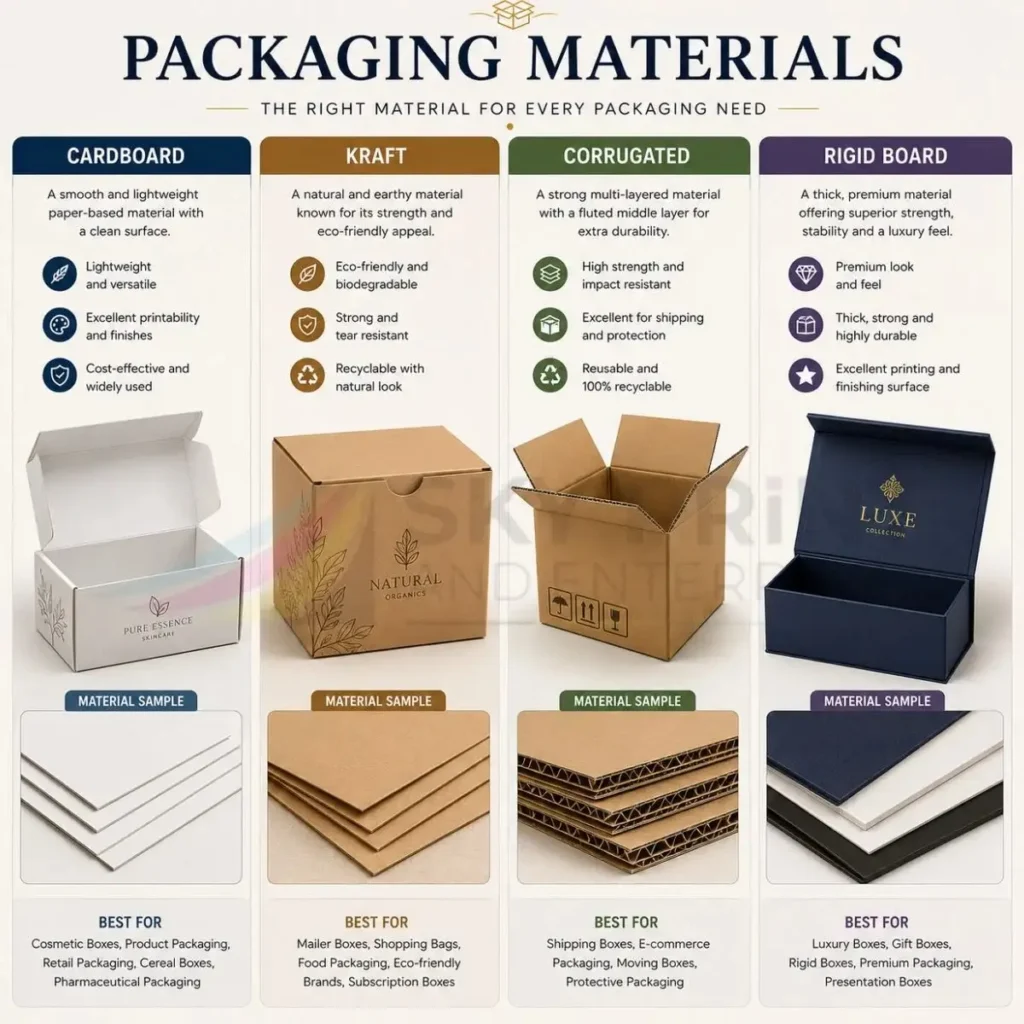
Custom packaging materials UK
Packaging Card GSM Guide -Packaging Guide
Understanding packaging card GSM is essential when specifying custom packaging. GSM stands for grams per square metre, representing the weight of paperboard. Although GSM does not directly measure thickness, it provides a useful indication of strength and suitability for different packaging applications.
Most importantly, as GSM increases, packaging generally becomes stronger and more rigid. However, choosing the highest GSM is not always the best option. Instead, businesses should balance product protection, manufacturing efficiency, shipping costs and premium appearance.
| GSM | Common Applications | Strength |
|---|---|---|
| 250–300gsm | Lightweight cartons | Good |
| 350–400gsm | Retail packaging | Very Good |
| 450–600gsm | Premium cartons | Excellent |
| 800gsm+ | Luxury rigid packaging | Outstanding |
For example, cosmetic cartons frequently use 350–400gsm SBS board because it provides excellent print quality while maintaining structural integrity. Conversely, premium gift boxes usually incorporate thick greyboard wrapped with printed paper to create a luxurious appearance.
However, if you manufacture products for retail, food, cosmetics or gifting, our specialists can recommend the ideal board specification based on your product weight, transportation requirements and branding objectives. Additionally, our Packaging Card GSM Guide will provide comprehensive comparisons, conversion charts and expert recommendations for every board grade.
Build Packaging That Performs Beautifully – Packaging Guide
Whether you require sustainable kraft packaging, luxury rigid boxes, durable corrugated shipping cartons or high-quality retail packaging, our team can help you select the right material, GSM and structural design for your project.
Continue reading the next section to discover the printing methods, luxury finishes and box styles that transform ordinary packaging into memorable brand experiences.
Custom Packaging Guide for Modern Businesses
Today, custom packaging has become a powerful marketing tool rather than simply a protective container. Therefore, businesses increasingly invest in packaging that improves customer experience, strengthens brand recognition and supports sustainable manufacturing. Moreover, advances in printing technology now allow companies to create highly customised packaging for both short and large production runs.
Consequently, understanding packaging materials, structural design and commercial printing methods enables businesses to reduce waste, improve efficiency and deliver a more memorable customer experience.
Packaging Guide – Printing Methods Guide
Selecting the right printing method is just as important as choosing the correct packaging material. Different printing technologies produce different levels of colour accuracy, image sharpness, production speed and overall cost. Therefore, understanding how each process works allows businesses to achieve the ideal balance between quality, efficiency and budget.
Moreover, modern printing has evolved considerably over the last decade. Today, businesses can choose from digital printing for short runs, lithographic offset printing for premium retail packaging, flexographic printing for corrugated cartons and labels, as well as specialised UV and screen printing for decorative applications. Consequently, every packaging project should begin by selecting the printing process that best matches the product requirements.
Why Choosing the Right Printing Method Matters
The printing process directly affects colour consistency, brand presentation, production time, finishing compatibility and manufacturing costs. Moreover, selecting the correct technology helps reduce waste while ensuring your packaging meets professional retail standards.
Most Common Printing Methods Used in Packaging – Packaging Guide
| Printing Method | Best For | Advantages |
|---|---|---|
| Offset Lithographic Printing | Retail cartons, luxury packaging | Outstanding colour quality, economical for large volumes. |
| Digital Printing | Short runs, prototypes, personalised packaging | Fast turnaround with no printing plates required. |
| Flexographic Printing | Corrugated boxes, labels and flexible packaging | High-speed production with excellent durability. |
| Screen Printing | Special effects and promotional packaging | Excellent ink coverage on specialist materials. |
| UV Printing | Luxury packaging and premium branding | Instant curing with vibrant colours and exceptional finish. |
Offset Lithographic Printing
Offset lithographic printing remains the preferred choice for premium folding cartons and luxury retail packaging because it delivers outstanding colour accuracy and sharp image reproduction. Furthermore, it supports complex artwork, fine typography and high-resolution photography. As production volumes increase, offset printing becomes increasingly cost-effective, making it ideal for medium and large manufacturing runs.
Digital Printing
Digital printing has transformed short-run packaging production. Since it requires no printing plates, businesses can produce prototypes, personalised packaging and seasonal campaigns much more quickly. Additionally, digital technology allows brands to test new packaging concepts before committing to large production quantities.
Flexographic Printing
Flexographic printing is widely used for corrugated packaging, shipping cartons, paper bags and labels. It combines high production speeds with durable inks, making it particularly suitable for industrial and e-commerce packaging applications.
Screen & UV Printing
For luxury packaging, screen printing and UV printing provide decorative possibilities that standard printing methods cannot always achieve. They produce vibrant colours, raised textures and premium visual effects that enhance the perceived value of the finished packaging.
Professional Printing Services
Alongside custom packaging, Sky Print and Enterprise also manufactures high-quality commercial printed products including
Commercial Printing Services,
Booklet Printing,
Catalogue Printing,
Leaflet Printing,
Custom Envelopes,
Letterhead Printing and
Presentation Folders.
Using consistent print quality across both packaging and marketing materials helps businesses create a stronger and more recognisable brand identity.
Expert Advice – Packaging Guide
There is no single printing method that suits every packaging project. Instead, the best option depends on production quantity, artwork complexity, material selection, turnaround time and budget. Our Complete Printing Methods Guide will compare every commercial printing technology in greater detail, including colour management, Pantone matching, CMYK printing, speciality inks and production recommendations for different industries.
Packaging Guide – Luxury Packaging Finishes Guide
Luxury packaging is more than an attractive outer box—it creates a memorable first impression that reflects the quality of your brand. While structural design protects the product, premium finishing techniques elevate packaging into an experience that customers remember long after the purchase. Consequently, many luxury brands invest in decorative finishes that communicate craftsmanship, exclusivity and attention to detail.
Whether you manufacture cosmetics, jewellery, premium food products, fashion accessories or corporate gifts, the right finishing combination can significantly improve perceived value. Furthermore, luxury finishes help products stand out on crowded retail shelves while reinforcing a premium brand image across every customer touchpoint.
Why Luxury Finishes Matter – Packaging Guide
Consumers often associate premium finishes with premium products. Therefore, adding high-quality finishing effects can increase perceived product value, strengthen brand recognition and create a memorable unboxing experience without changing the product itself.
Most Popular Luxury Packaging Finishes – Packaging Guide
| Finish | Appearance | Best Used For |
|---|---|---|
| Matt Lamination | Smooth, elegant finish | Luxury retail and cosmetic packaging |
| Gloss Lamination | High shine | Food packaging and vibrant graphics |
| Soft-Touch Lamination | Velvety texture | Premium brands and presentation boxes |
| Foil Stamping | Metallic highlights | Luxury logos and premium branding |
| Embossing & Debossing | Raised or recessed texture | High-end packaging and invitations |
| Spot UV | Gloss highlights | Logos, graphics and product names |
| Anti-Scratch Lamination | Durable matte surface | Frequently handled retail packaging |
Foil Stamping
Foil stamping remains one of the most recognised luxury finishing techniques. Available in gold, silver, rose gold, copper, holographic and many custom colours, foil instantly attracts attention while creating a sophisticated appearance. Moreover, foil is often combined with embossing to give logos and brand names additional depth.
Embossing & Debossing
Embossing raises selected artwork above the surface of the packaging, whereas debossing presses the design into the material. Both techniques create a tactile experience that customers naturally interact with. Consequently, these finishes are commonly used for luxury gift boxes, jewellery packaging and premium corporate presentation boxes.
Spot UV Coating
Spot UV applies a high-gloss coating to selected design elements while leaving the remaining surface matte. This contrast immediately draws attention to important branding elements such as logos, illustrations or product names. Additionally, raised Spot UV adds texture, creating an even more premium visual effect.
Soft-Touch & Anti-Scratch Lamination
Soft-touch lamination provides a luxurious velvet-like feel that customers immediately notice when holding the packaging. Anti-scratch lamination offers a similar premium appearance while improving resistance to fingerprints and surface marks. Therefore, both finishes are excellent choices for luxury retail packaging that requires durability as well as elegance.
Popular Finish Combinations – Packaging Guide
- Matt Lamination + Gold Foil + Embossed Logo
- Soft-Touch Lamination + Spot UV
- Matt Lamination + Raised Spot UV
- Gloss Lamination + Silver Foil
- Embossing + Foil Stamping
- Textured Paper + Blind Debossing
- Anti-Scratch Lamination + Copper Foil
Combining finishes often produces a far stronger visual impact than relying on a single decorative effect.
Luxury Packaging Solutions
If you’re planning premium packaging, explore our bespoke
Luxury Rigid Boxes,
Gift Boxes,
Jewellery Packaging,
Cosmetic Packaging,
Luxury Paper Bags and
Custom Printed Cardboard Boxes.
Our packaging specialists can recommend the most suitable finishing techniques based on your brand identity, product type and production budget.
Complete Luxury Packaging Finishes Guide
This section introduces the most popular decorative finishes used throughout the packaging industry. However, our dedicated Luxury Packaging Finishes Guide will explore every finishing process in far greater detail, including foil colours, varnishes, coatings, textured papers, metallic inks, speciality effects, production techniques, costs, artwork preparation and recommendations for different industries.
Whether you’re creating premium cosmetic packaging, luxury gift boxes, jewellery packaging or high-end retail cartons, the correct finishing combination can transform standard packaging into an exceptional brand experience.
Complete Box Styles Guide -Packaging Guide
Every successful packaging project begins with selecting the correct box style. Although artwork, materials and luxury finishes play an important role, the structural design of the box ultimately determines how well the product is protected, displayed and experienced by customers. Consequently, choosing the wrong box style can increase manufacturing costs, reduce protection during transport and negatively affect the overall customer experience.
Overall, the purpose of this Complete Box Styles Guide is to help businesses understand the most popular packaging structures used across the retail, e-commerce and luxury packaging industries. Furthermore, each style offers different advantages depending on the product, budget and intended use. Therefore, understanding these differences allows brands to make informed packaging decisions while improving both functionality and visual appeal.
Why Box Style Selection Matters – Packaging Guide
- Protects products during storage and transportation.
- Creates an engaging customer unboxing experience.
- Improves shelf presentation in retail environments.
- Supports efficient packing and shipping.
- Reduces material waste and production costs.
- Strengthens overall brand perception.
- Allows luxury finishes to perform more effectively.
Popular Packaging Box Styles – Packaging Guide
| Box Style | Best For | Difficulty |
|---|---|---|
| Straight Tuck End | Retail products | Easy |
| Reverse Tuck End | Cosmetics | Easy |
| Auto Lock Bottom | Heavy products | Medium |
| Mailer Box | E-commerce | Medium |
| Rigid Box | Luxury packaging | Advanced |
| Sleeve Box | Premium presentation | Medium |
| Window Box | Food & Retail | Medium |
Straight Tuck End (STE)
The Straight Tuck End is one of the most widely used folding carton designs within the packaging industry. Both top and bottom flaps fold in the same direction, creating a clean appearance that is particularly suitable for premium retail products. Moreover, this style offers excellent print coverage because the front panel remains uninterrupted by visible locking tabs.
Moreover, straight tuck boxes are frequently used for cosmetics, skincare products, pharmaceuticals, electronics, confectionery and many other lightweight retail products.
Reverse Tuck End (RTE)
Reverse Tuck End boxes remain one of the most economical packaging styles because the top and bottom flaps fold in opposite directions. Consequently, they reduce board waste during production while remaining easy to assemble. This style is especially popular for cosmetic cartons, health products and consumer goods requiring quick manual packing.
Auto Lock Bottom Boxes
Products with greater weight require stronger structural support. Therefore, Auto Lock Bottom boxes automatically lock into position during assembly, providing exceptional strength without requiring additional tape. These boxes are commonly used for bottled products, candles, glass containers and premium food packaging.
Explore Our Packaging Solutions
Looking for professionally manufactured custom boxes? Explore our extensive collection including
and our complete
Mailer Boxes
Mailer boxes have become increasingly popular with subscription services, direct-to-consumer brands and e-commerce retailers. Unlike standard folding cartons, mailer boxes feature interlocking flaps that create additional strength without requiring adhesive. As a result, they protect products during shipping while also delivering an impressive unboxing experience.
Furthermore, mailer boxes provide a large printable surface for branding, promotional messages and product information. Businesses often combine them with tissue paper, custom inserts and branded stickers to enhance customer satisfaction.
Rigid Boxes
Rigid boxes represent the highest level of premium packaging. Manufactured using thick greyboard wrapped with decorative paper, these boxes cannot be folded flat and therefore provide outstanding structural integrity. Luxury brands frequently choose rigid packaging for jewellery, watches, electronics, cosmetics, perfumes and corporate gifts because it communicates quality before customers even open the box.
Additionally, rigid boxes pair exceptionally well with decorative finishes such as foil stamping, embossing, magnetic closures, ribbon pulls and soft-touch lamination, making them the preferred choice for premium product presentation.
Sleeve Boxes
Sleeve boxes consist of two separate components: an inner tray that securely holds the product and an outer sleeve that slides over the tray. Although this design appears simple, it creates an elegant presentation that immediately enhances the perceived value of a product. Consequently, sleeve boxes are widely used for premium chocolates, cosmetics, electronics, promotional products and luxury gift packaging.
Moreover, sleeve boxes provide excellent branding opportunities because both the tray and sleeve can feature different colours, finishes and printed artwork. Many luxury brands also combine sleeve packaging with foil stamping, embossing or Spot UV to create a sophisticated unboxing experience.
Drawer (Slide-Out) Boxes
Drawer boxes, sometimes called slide-out boxes, operate similarly to a drawer opening from a cabinet. The rigid outer shell remains fixed while the inner tray slides smoothly outward using either a thumb notch or decorative ribbon pull. Therefore, this packaging style creates a premium opening experience that customers associate with luxury products.
Luxury cosmetics, watches, jewellery, electronics, mobile accessories and corporate gift sets frequently use drawer boxes because they combine excellent product protection with an unforgettable presentation. Additionally, EVA foam, cardboard inserts or moulded pulp inserts can be incorporated to hold products securely during transportation.
Magnetic Closure Boxes
Among all premium packaging solutions, magnetic closure boxes are considered one of the most luxurious. Hidden magnets inside the lid create a smooth closing mechanism while maintaining a clean exterior appearance. Consequently, these boxes are often selected for high-value retail products where presentation is just as important as protection.
In addition, luxury apparel brands, jewellery manufacturers, technology companies and premium gift retailers frequently choose magnetic rigid boxes because they create an exceptional first impression. Furthermore, decorative finishes such as soft-touch lamination, gold foil and embossed logos complement this structure perfectly.
Popular Luxury Box Styles – Packaging Guide
- Magnetic Closure Boxes
- Drawer Boxes
- Book Style Boxes
- Rigid Shoulder Boxes
- Two-Piece Lift-Off Lid Boxes
- Sleeve & Tray Boxes
Furthermore, these packaging styles are commonly enhanced with premium decorative finishes to create an exceptional customer experience.
Window Boxes
Window boxes include a transparent film or open die-cut section that allows customers to view the product before making a purchase. As a result, they improve consumer confidence while increasing shelf appeal. Food packaging, bakery products, confectionery, candles and cosmetics frequently use window packaging because product visibility supports purchasing decisions.
Additionally, if you require this style, explore our
Custom Window Boxes,
which can be manufactured in various sizes with recyclable window materials.
Display & Counter Display Boxes
Retail display boxes are specifically designed to present products directly on shop shelves or checkout counters. Unlike standard packaging, display boxes combine transportation and merchandising into one structure. Therefore, retailers can quickly place products on display without unpacking individual cartons.
Display packaging is particularly suitable for confectionery, cosmetics, stationery, promotional products and impulse-purchase items. Furthermore, vibrant printing and bold branding help maximise product visibility within busy retail environments.
Corrugated Shipping Boxes
When product protection becomes the highest priority, corrugated shipping boxes remain the preferred solution. Their fluted construction absorbs impact during transportation while providing excellent stacking strength. Consequently, e-commerce retailers and manufacturers rely on corrugated packaging for shipping products safely across the UK and internationally.
In addition, learn more about our
Corrugated Packaging Boxes,
manufactured for strength, durability and sustainable shipping.
How to Choose the Right Box Style – Packaging Guide
Selecting the correct packaging style depends upon several practical considerations. Although appearance remains important, businesses should first evaluate the product’s weight, dimensions, transportation requirements and target audience. Afterwards, decorative finishes and branding elements can be incorporated to create a complete packaging solution.
| Requirement | Recommended Box Style |
|---|---|
| Luxury Presentation | Rigid or Magnetic Closure Box |
| Retail Shelf Display | Straight or Reverse Tuck End Box |
| E-commerce Shipping | Mailer or Corrugated Box |
| Heavy Products | Auto Lock Bottom Box |
| Product Visibility | Window Box |
| Premium Gifts | Drawer or Sleeve Box |
Packaging Solutions for Every Industry
Sky Print and Enterprise manufactures bespoke packaging for a wide range of industries, including
Cosmetics,
Food Packaging,
Apparel,
Electronics,
Gift Packaging,
Jewellery and
Retail Packaging.
Our design specialists help businesses select the most appropriate box style, board grade, printing method and luxury finishes to create packaging that protects products while strengthening brand identity.
Complete Box Styles Guide
This section introduces the most widely used packaging structures. However, our dedicated Complete Box Styles Guide will explore more than 30 box styles with structural illustrations, dielines, assembly methods, manufacturing recommendations, cost comparisons, industry applications and expert advice to help you select the ideal packaging solution for any product.
Continue reading this Printing & Packaging Knowledge Hub to learn about artwork preparation, packaging dielines, dimensions and manufacturing processes that transform great ideas into exceptional packaging.
Packaging Artwork Preparation Guide – Packaging Guide
Designing attractive packaging is only the first step towards producing a high-quality printed box. Equally important is preparing the artwork correctly before it reaches the printing press. Even the most creative design can result in blurred images, incorrect colours, missing text or costly production delays if the artwork is not supplied in the correct format. Therefore, understanding artwork preparation is essential for designers, marketing teams and businesses ordering custom packaging.
Overall, this Packaging Artwork Preparation Guide explains the essential technical requirements for creating professional print-ready artwork. Moreover, by following these best practices, you can minimise production errors, reduce approval times and ensure your finished packaging looks exactly as intended.
Why Correct Artwork Preparation Matters – Packaging Guide
- Produces sharper, higher-quality printing.
- Prevents text or logos from being trimmed.
- Maintains accurate brand colours.
- Reduces manufacturing delays.
- Avoids costly artwork corrections.
- Improves print consistency across multiple production runs.
- Ensures packaging meets professional printing standards.
Essential Elements of Print-Ready Artwork – Packaging Guide
Professional packaging artwork consists of far more than attractive graphics. Every file should include bleed, trim lines, safe areas, correctly embedded images, vector logos and production-ready colour settings. Consequently, designers should always prepare artwork according to commercial printing standards rather than screen display requirements.
| Artwork Element | Recommendation |
|---|---|
| Colour Mode | CMYK |
| Resolution | 300 DPI |
| Bleed | 3 mm minimum |
| Safe Area | Keep important content inside trim area |
| Fonts | Convert to outlines or embed correctly |
| Preferred File Format | PDF/X, AI or EPS |
Understanding Bleed, Trim Line and Safe Area
One of the most common mistakes in packaging artwork is misunderstanding bleed and safe areas. Bleed is the extra printed area extending beyond the finished trim size. During production, sheets are trimmed using industrial cutting equipment, and a small movement can occur. Therefore, extending background colours and images into the bleed prevents unwanted white edges from appearing.
Likewise, important information such as logos, product names, nutritional details and barcodes should remain inside the safe area. This precaution ensures that no critical design elements are accidentally removed during trimming.
Quick Tip
Always request the final dieline before beginning artwork. Designing without the correct dieline can lead to misplaced folds, cut lines and glue flaps, resulting in expensive revisions later in the production process.
CMYK vs RGB
Digital screens display colours using RGB (Red, Green and Blue), whereas commercial printing presses reproduce colours using CMYK (Cyan, Magenta, Yellow and Black). Consequently, artwork designed entirely in RGB may appear brighter on screen than in the final printed packaging.
Furthermore, to achieve consistent colour reproduction, packaging artwork should always be created in CMYK from the beginning of the design process. Furthermore, businesses with established brand colours may also specify Pantone colours to achieve greater colour consistency across multiple print runs.
| Colour System | Primary Use |
|---|---|
| RGB | Digital screens and websites |
| CMYK | Commercial printing |
| Pantone (PMS) | Brand colour consistency |
Image Resolution
High-resolution images are essential for professional packaging. Although low-resolution graphics may appear acceptable on a computer monitor, they often become blurred or pixelated when printed. Therefore, all photographs and raster images should normally be supplied at a minimum resolution of 300 DPI at their final print size.
However, vector graphics such as logos and icons should be created in Adobe Illustrator or another vector application whenever possible. Unlike raster images, vector artwork can be enlarged without losing quality, making it ideal for commercial printing.
Professional Printing & Artwork Support
If you require assistance preparing artwork for commercial printing, our team can help with artwork checking, print file optimisation and packaging production. We also manufacture
Booklets,
Catalogues,
Custom Envelopes,
Presentation Folders and a wide range of
Commercial Printing Services.
Proper artwork preparation is one of the simplest ways to achieve exceptional print quality while reducing production delays and unnecessary costs.
Fonts, Typography and Text Readability
Typography is one of the most overlooked aspects of packaging artwork. Nevertheless, it has a significant influence on readability, brand recognition and the overall appearance of your packaging. Customers should be able to identify the product name, brand, instructions and important information quickly, whether they are browsing on a retail shelf or opening an online order.
Furthermore, for commercial printing, fonts should either be converted to outlines or embedded correctly within the artwork file before submission. Otherwise, missing fonts may be substituted automatically during production, altering the layout and affecting the finished packaging. Furthermore, avoid using excessively thin typefaces for small text because they may lose clarity when printed.
Typography Best Practices
- Use clear, readable fonts for product information.
- Maintain consistent typography throughout the packaging.
- Convert fonts to outlines before exporting artwork.
- Avoid placing small text over complex backgrounds.
- Ensure adequate contrast between text and background colours.
- Use a logical hierarchy for headings, subheadings and body text.
Barcodes, QR Codes and Variable Data
Modern packaging often includes barcodes, QR codes, serial numbers or batch information. These elements must remain sharp and unobstructed to ensure they scan correctly throughout the supply chain. Therefore, barcodes should never be stretched, distorted or positioned across folds, glue flaps or cut lines.
Similarly, QR codes should be generated at a suitable resolution and tested before production begins. Many businesses now use QR codes to direct customers to user guides, promotional campaigns, product authentication pages or sustainability information.
Legal and Regulatory Information – Packaging Guide
Depending on the product and market, packaging may need to include mandatory information such as ingredients, nutritional values, safety warnings, recycling symbols, country of origin, manufacturer details or compliance marks. Consequently, artwork should always be reviewed carefully before approval to ensure all legal requirements have been met.
Most importantly, for food, cosmetics and pharmaceutical packaging, regulations may vary between industries and export markets. Therefore, confirming compliance before printing can prevent expensive reprints and unnecessary delays.
Common Packaging Artwork Mistakes – Packaging Guide
Even experienced designers occasionally overlook technical details that affect the final printed result. Fortunately, most problems can be avoided by carrying out a thorough pre-flight check before submitting artwork.
| Common Mistake | Possible Result |
|---|---|
| Artwork supplied in RGB | Unexpected colour shifts after printing. |
| Missing bleed | White edges after trimming. |
| Low-resolution images | Blurry or pixelated printing. |
| Fonts not outlined | Text substitution and layout changes. |
| Logos placed too close to trim lines | Important artwork may be cut off. |
| Incorrect dieline used | Artwork misalignment and production delays. |
Packaging Artwork Pre-Flight Checklist
Before approving artwork for production, review every file carefully. A systematic quality check helps avoid unnecessary delays while ensuring consistent print quality across every production run.
Final Artwork Checklist – Packaging Guide
- ✓ Correct dieline used.
- ✓ 3 mm bleed included.
- ✓ Safe area respected.
- ✓ Artwork created in CMYK.
- ✓ Images supplied at 300 DPI.
- ✓ Fonts converted to outlines.
- ✓ Barcodes tested.
- ✓ QR codes verified.
- ✓ Legal information checked.
- ✓ PDF exported using print-ready settings.
Artwork Approval Process
Once artwork has been submitted, manufacturers typically carry out a pre-production inspection before sending a digital proof or press proof for approval. At this stage, every element should be reviewed carefully, including colours, spelling, dimensions, positioning and finishing instructions. After approval, production usually begins immediately, making late amendments significantly more expensive.
For this reason, businesses should appoint a single decision-maker to review proofs thoroughly before giving final approval. A structured approval process reduces the risk of errors while ensuring every production run meets brand standards.
Need Help Preparing Packaging Artwork?
Whether you’re designing your first folding carton or managing a nationwide packaging project, our experienced team can review your artwork before production begins. We provide guidance on dielines, bleed, colour management, luxury finishes and print specifications to help ensure professional results.
Explore our Commercial Printing Services, browse our range of Custom Printed Packaging, or Request a Free Quote to discuss your next project with our packaging specialists.
Our future Complete Packaging Artwork Guide will cover Adobe Illustrator setup, InDesign workflows, PDF/X standards, Pantone colour management, overprinting, trapping, spot colours, white ink preparation, varnish layers and professional pre-press techniques in even greater detail.
Packaging Dielines & Structural Engineering Guide – Packaging Guide
Every custom packaging box begins long before artwork is printed or materials are selected. Behind every professionally manufactured carton is a carefully engineered structural layout known as a packaging dieline. Although customers only see the finished box, the dieline determines how the packaging folds, locks, protects the product and performs throughout manufacturing, shipping and retail display. Consequently, structural engineering is one of the most important stages in packaging development.
Whether you are producing a simple tuck-end carton, a luxury rigid gift box or a heavy-duty corrugated shipping box, the packaging structure must be designed with precision. A well-engineered dieline reduces production waste, improves assembly efficiency and ensures the finished packaging performs exactly as intended. Therefore, businesses should always consider structural design alongside branding and aesthetics rather than treating it as a separate stage.
What Is a Packaging Dieline?
A packaging dieline is a technical drawing that shows the exact shape of a box before it is cut, folded and glued. It includes every cut line, fold line, glue flap, locking tab and panel required to manufacture the finished package accurately.
Understanding the Main Components of a Dieline
Although dielines may appear complex initially, they are made up of several standard elements used throughout the packaging industry. Each line serves a specific manufacturing purpose and must be positioned accurately to ensure reliable production.
| Dieline Element | Purpose |
|---|---|
| Cut Line | Shows where the sheet will be cut. |
| Crease Line | Creates accurate folding points. |
| Glue Flap | Provides an area for box assembly. |
| Locking Tabs | Secure the box without additional fasteners. |
| Perforation | Allows controlled tearing or opening. |
| Window Cut-Out | Creates visibility for the packaged product. |
Why Structural Engineering Is So Important
Effective structural engineering does far more than determine the appearance of a package. It directly affects manufacturing efficiency, shipping performance, customer experience and production costs. Consequently, experienced packaging engineers evaluate numerous factors before approving a structural design.
- Product dimensions and weight.
- Material strength and board grade.
- Stacking requirements during transport.
- Protection against compression and impact.
- Ease of assembly on production lines.
- Retail shelf presentation.
- Unboxing experience.
- Storage efficiency.
- Shipping costs.
- Sustainability objectives.
For example, a luxury perfume box requires a completely different structural approach from an e-commerce mailer or a bakery carton. Therefore, every packaging solution should be engineered specifically for its intended application rather than using a generic template.
The Packaging Engineering Process
Professional packaging manufacturers follow a structured engineering workflow to ensure every box performs reliably during production and throughout its lifecycle. Although individual projects vary, most custom packaging developments follow the same sequence.
| Stage | Description |
|---|---|
| Product Assessment | Measure dimensions, weight and protection needs. |
| Structural Design | Develop CAD dieline. |
| Prototype Production | Create physical sample. |
| Customer Approval | Review fit, appearance and usability. |
| Production Optimisation | Prepare tooling and manufacturing. |
| Mass Production | Manufacture and quality inspection. |
Engineering Meets Manufacturing
At Sky Print and Enterprise, structural engineering forms the foundation of every custom packaging project. Whether manufacturing Rigid Boxes, Corrugated Boxes, Tuck Boxes or Mailer Boxes, our engineering team develops packaging that combines structural integrity with premium presentation.
A precisely engineered dieline not only improves manufacturing efficiency but also reduces waste, protects products and creates a better customer experience.
CAD Packaging Design & Structural Development
Modern packaging engineering begins with Computer-Aided Design (CAD). Instead of drawing packaging manually, structural designers create highly accurate digital dielines using specialist packaging software. This allows every panel, fold, locking tab and glue flap to be engineered with precision before any material is cut. Consequently, CAD design reduces development time while improving manufacturing accuracy.
CAD software also enables engineers to visualise how a flat sheet transforms into a finished package. Furthermore, structural adjustments can be made within minutes, allowing multiple design options to be evaluated before tooling is manufactured. This flexibility is particularly valuable for businesses developing new products or refining existing packaging.
Packaging Prototypes and White Samples
Before full-scale production begins, manufacturers usually produce a prototype, often referred to as a white sample or plain sample. This prototype is created without printed graphics, allowing the structural design to be evaluated independently from the artwork.
Furthermore, testing a prototype provides an opportunity to confirm that the product fits correctly, the box opens and closes smoothly, inserts hold the product securely and assembly can be completed efficiently. Moreover, identifying structural issues during prototyping is significantly less expensive than discovering them after production has started.
Benefits of Prototype Approval
- Confirms product fit and dimensions.
- Tests opening and closing mechanisms.
- Verifies structural strength.
- Allows design improvements before production.
- Reduces manufacturing risk.
- Minimises expensive production changes.
- Improves customer confidence before mass production.
Packaging Inserts and Internal Protection – Packaging Guide
Many products require additional protection inside the outer box. Packaging inserts help prevent movement during transport while improving product presentation when customers open the package. Depending on the application, inserts may be manufactured from cardboard, corrugated board, moulded pulp, EVA foam or other protective materials.
Moreover, luxury packaging often incorporates precision-cut inserts that display products neatly while reinforcing a premium appearance. Similarly, fragile products benefit from custom-engineered inserts that distribute impact forces more evenly throughout the package.
| Insert Type | Typical Application | Advantages |
|---|---|---|
| Cardboard Insert | Retail packaging | Economical and recyclable. |
| Corrugated Insert | Heavy products | Excellent structural strength. |
| Foam Insert | Electronics and luxury goods | Superior cushioning and presentation. |
| Moulded Pulp Insert | Eco-friendly packaging | Sustainable and protective. |
Glue Systems and Locking Mechanisms
Not every packaging box requires adhesive during assembly. Many folding cartons include self-locking tabs, crash-lock bottoms or interlocking closures that improve packing speed while maintaining structural strength. Conversely, rigid boxes and certain premium packaging styles require carefully controlled adhesive application to achieve precise alignment and a flawless finish.
Selecting the correct locking mechanism depends upon the product weight, manufacturing process and intended customer experience. Therefore, structural engineers consider both performance and production efficiency during the design stage.
Structural Performance Testing
Professional packaging should perform reliably throughout storage, transportation and retail handling. Consequently, structural designs are frequently evaluated using a combination of physical testing and engineering calculations before mass production begins.
- Compression testing.
- Drop testing.
- Stacking performance evaluation.
- Transit simulation.
- Moisture resistance assessment.
- Assembly efficiency testing.
Above all, these evaluations help ensure the packaging protects the product while maintaining its appearance from the production line to the final customer.
Common Structural Design Mistakes
Even minor engineering errors can affect packaging performance. Fortunately, many issues can be avoided through careful planning, prototyping and quality assurance.
| Issue | Potential Impact |
|---|---|
| Incorrect product dimensions | Poor product fit. |
| Weak locking tabs | Package opening during transport. |
| Insufficient board strength | Box collapse under load. |
| Poor insert design | Product movement and damage. |
| Ignoring shipping conditions | Reduced package performance. |
Structural Engineering Checklist
- ✓ Product dimensions verified.
- ✓ Board grade selected.
- ✓ Dieline approved.
- ✓ Prototype tested.
- ✓ Inserts confirmed.
- ✓ Locking mechanism evaluated.
- ✓ Manufacturing tolerances checked.
- ✓ Transit performance reviewed.
- ✓ Artwork aligned with dieline.
- ✓ Production approval completed.
Need a Custom Packaging Structure?
Whether you need a simple folding carton or a fully engineered luxury presentation box, our structural design specialists can develop packaging that balances strength, efficiency and premium presentation. From concept development and CAD engineering to prototyping and full-scale manufacturing, we help businesses create packaging tailored to their products and brand objectives.
Explore our Boxes by Style, Rigid Boxes, Corrugated Boxes or Request a Free Quote to discuss your next packaging project.
Our Complete Packaging Dieline Guide include downloadable structural examples, FEFCO box styles, CAD terminology, engineering calculations, manufacturing tolerances, glue patterns, locking systems and practical case studies for different industries.
Packaging Dimensions & Measurement Guide – Packaging Guide
Accurate measurements are fundamental to successful packaging design and manufacturing. Even the highest-quality materials, premium printing and luxury finishes cannot compensate for incorrect dimensions. If a box is too small, the product may not fit safely. Conversely, if the box is unnecessarily large, businesses waste material, increase shipping costs and reduce storage efficiency. Therefore, understanding how packaging dimensions are measured is essential before ordering custom packaging.
Whether you require folding cartons, rigid boxes, corrugated shipping cartons or retail packaging, manufacturers calculate every dieline from the finished dimensions of the package. Consequently, providing precise measurements helps reduce development time, avoid production errors and ensure the finished packaging performs as expected.
Why Accurate Measurements Matter – Packaging Guide
- Ensures products fit securely inside the packaging.
- Improves product protection during storage and transport.
- Reduces material waste and manufacturing costs.
- Prevents delays caused by incorrect sampling.
- Supports efficient palletisation and shipping.
- Creates a better customer unboxing experience.
- Allows structural engineers to optimise the packaging design.
The Standard Order of Packaging Dimensions
Across the global packaging industry, dimensions are almost always written in the same order:
Length × Width × Height (L × W × H)
Always confirm whether the dimensions refer to the internal size or the external size of the finished box.
Although this format appears straightforward, confusion often arises because different people measure from different orientations. Therefore, it is important to use consistent terminology throughout the design and manufacturing process.
| Dimension | Description |
|---|---|
| Length (L) | The longest opening dimension of the box. |
| Width (W) | The shorter opening dimension. |
| Height (H) | Distance from the base to the top of the box. |
Internal Dimensions vs External Dimensions
One of the most common misunderstandings when ordering packaging is the difference between internal and external measurements. Internal dimensions describe the usable space inside the finished box, whereas external dimensions include the thickness of the board and any structural components. Consequently, manufacturers generally request internal dimensions because these determine whether the product fits correctly.
| Measurement Type | Best Used For |
|---|---|
| Internal Dimensions | Designing packaging around the product. |
| External Dimensions | Shipping, warehousing and logistics. |
How to Measure a Product for Custom Packaging
Before requesting a quotation, carefully measure the product itself rather than estimating the box size. Ideally, measurements should be taken using digital callipers or an accurate steel ruler. Additionally, consider any accessories, instruction manuals, protective inserts or internal packaging that will be placed inside the finished box.
- Measure the longest side of the product.
- Measure the shorter side.
- Measure the overall height.
- Add clearance for inserts or protective padding.
- Confirm whether the product requires a tight or loose fit.
- Provide measurements in millimetres whenever possible.
Expert Recommendation
Avoid designing packaging directly around theoretical product dimensions. Instead, always measure a physical production sample. Manufacturing tolerances, product coatings, labels and protective wrapping can all affect the final dimensions.
Allowing Space for Inserts and Protective Packaging
Many products require additional internal protection. Foam inserts, cardboard dividers, moulded pulp trays or paper cushioning all occupy valuable space inside the package. Therefore, these components should be considered during the initial design stage rather than added afterwards.
Luxury packaging often incorporates precision-engineered inserts that securely position the product while enhancing the customer experience. Likewise, e-commerce packaging frequently requires additional protective materials to minimise movement during transportation.
Need Help Choosing the Correct Box Size?
Whether you require retail cartons, luxury rigid boxes, corrugated shipping cartons or bespoke presentation packaging, our team can recommend the most appropriate dimensions, board grade and structural design for your products.
Browse our Boxes by Style, Rigid Boxes, Corrugated Packaging or Request a Free Quote for expert guidance.
Packaging Tolerances and Manufacturing Accuracy
Although packaging manufacturers work to extremely high standards, every manufacturing process includes acceptable tolerances. These slight variations occur during printing, die-cutting, creasing, folding and gluing. Consequently, structural engineers always design packaging with realistic production tolerances rather than expecting every box to measure exactly the same.
Furthermore, the acceptable tolerance depends on several factors, including the packaging material, board thickness, box size, production equipment and finishing techniques. Therefore, businesses should avoid designing packaging with zero clearance, particularly when products fit tightly inside inserts or presentation boxes.
Why Tolerances Matter – Packaging Guide
- Prevent products from fitting too tightly.
- Improve assembly speed.
- Reduce manufacturing waste.
- Increase production consistency.
- Avoid damage during transportation.
- Improve customer satisfaction.
Packaging Size Standards
Most custom packaging is manufactured in millimetres because this provides the greatest level of accuracy. Nevertheless, businesses operating internationally may also use centimetres or inches depending on their market. Therefore, it is important to specify the unit of measurement whenever requesting quotations or approving technical drawings.
| Unit | Typical Use |
|---|---|
| Millimetres (mm) | Packaging manufacturing standard. |
| Centimetres (cm) | General product measurements. |
| Inches (in) | North American specifications. |
Choosing the Right Clearance
A package should never fit so tightly that the product becomes difficult to insert or remove. Equally, excessive empty space allows movement during transportation, increasing the risk of damage. Consequently, packaging engineers calculate an appropriate clearance based on the product dimensions, packaging material and any protective inserts used inside the box.
In addition, fragile products such as glass bottles, cosmetics and electronics generally require additional clearance to accommodate cushioning materials. Conversely, luxury presentation boxes often use precision-cut inserts to minimise movement while maintaining an elegant appearance.
Packaging Dimensions for Shipping
Shipping packaging requires a different approach from retail packaging. While retail cartons prioritise shelf appearance and branding, shipping cartons must withstand stacking, handling and transportation. Therefore, engineers often optimise external dimensions to maximise pallet efficiency, reduce courier costs and minimise unused shipping space.
Meanwhile, businesses shipping products through fulfilment centres should also consider dimensional weight calculations, pallet layouts and warehouse storage requirements during the packaging design process.
Common Measuring Mistakes – Packaging Guide
- Using external dimensions instead of internal dimensions.
- Forgetting to include product accessories.
- Ignoring insert thickness.
- Measuring from the wrong orientation.
- Using estimated rather than actual product dimensions.
- Supplying dimensions in mixed units.
- Not considering manufacturing tolerances.
- Leaving insufficient clearance for assembly.
Frequently Asked Questions About Packaging Dimensions – Packaging Guide
Should I measure the product or the existing box?
Always measure the product itself whenever possible. Existing packaging may contain unnecessary empty space or additional protective materials that are not required for your new packaging design.
Do manufacturers need internal or external dimensions?
In most cases, manufacturers prefer internal dimensions because these determine how well the product fits inside the finished packaging. External dimensions are then calculated during the engineering stage.
How much extra space should I leave?
The required clearance depends on the product, board thickness, inserts and transportation requirements. Packaging engineers normally recommend the appropriate tolerance after reviewing the product specification.
Get Expert Help with Custom Packaging Dimensions
Choosing the correct dimensions is one of the most important decisions in packaging development. Our experienced packaging specialists can help you determine the ideal internal dimensions, structural design and board specification to ensure your packaging protects the product while presenting your brand professionally.
Explore our Retail Packaging,
Food Packaging,
Electronic Packaging,
Cosmetic Packaging or Request a Quote for tailored recommendations.
Our future Complete Packaging Dimensions Guide will include industry size charts, FEFCO sizing references, dimensional weight calculations, pallet optimisation techniques and downloadable measuring templates for different packaging styles.
Packaging Materials Guide: Choosing the Right Material for Every Product
The success of any packaging project depends not only on its design but also on selecting the most suitable material. Even an outstanding structural design cannot perform effectively if the wrong board or paper is used. Consequently, understanding packaging materials is one of the most important steps when developing custom packaging for retail, e-commerce, food, cosmetics, electronics or luxury products.
Moreover, every packaging material offers different levels of strength, print quality, sustainability, moisture resistance and cost. Therefore, manufacturers evaluate several factors before recommending a board grade, including the product weight, transportation method, storage conditions, printing requirements and customer expectations.
This comprehensive Packaging Materials Guide explains the most widely used materials in commercial printing and packaging manufacturing. Whether you are designing folding cartons, rigid boxes, corrugated packaging or luxury presentation boxes, choosing the correct substrate ensures excellent print quality, reliable protection and efficient production.
Why Material Selection Is So Important
- Protects products throughout storage and transportation.
- Improves print quality and colour reproduction.
- Supports luxury finishes such as foil stamping and embossing.
- Determines the structural strength of the package.
- Influences production costs and manufacturing efficiency.
- Supports sustainability and recycling objectives.
- Enhances the customer’s overall unboxing experience.
Paperboard vs Cardboard – What’s the Difference?
Many people use the terms paperboard and cardboard interchangeably. However, within the packaging industry they describe different materials with distinct applications.
Paperboard is a smooth, high-quality material primarily used for folding cartons and premium printed packaging. It offers excellent printability, making it ideal for cosmetics, pharmaceuticals, food products and retail packaging.
However, cardboard generally refers to heavier packaging materials designed to provide greater structural strength. Corrugated cardboard, rigid greyboard and heavy-duty packaging boards are commonly used where durability is more important than premium print quality.
| Material | Primary Use | Typical Products |
|---|---|---|
| Paperboard | Premium printed packaging | Cosmetics, food, healthcare, retail cartons |
| Cardboard | Structural packaging | Shipping boxes, mailers, protective packaging |
Solid Bleached Sulphate (SBS)
Solid Bleached Sulphate, commonly known as SBS, is one of the highest-quality paperboards available. Manufactured entirely from virgin wood pulp, it features an exceptionally smooth white surface that delivers outstanding print quality. Consequently, SBS is frequently chosen for luxury packaging where colour accuracy and fine detail are essential.
Because SBS provides excellent stiffness, cleanliness and food safety, it is widely used for premium cosmetics, pharmaceuticals, confectionery, skincare products and luxury retail packaging. Furthermore, it accepts speciality finishes such as soft-touch lamination, embossing, foil stamping and Spot UV exceptionally well.
Advantages of SBS Board
- Excellent print quality.
- Bright white appearance.
- Smooth surface for luxury finishes.
- Food-safe options available.
- Ideal for premium retail packaging.
- Consistent thickness and stiffness.
Folding Box Board (FBB)
Folding Box Board, often abbreviated as FBB, combines multiple fibre layers to create a lightweight yet rigid packaging material. Typically manufactured with virgin fibres on the outer layers and mechanical pulp in the centre, FBB provides an excellent balance between strength, printability and cost.
Many consumer brands choose FBB because it offers premium visual quality while remaining lighter than some alternative boards. As a result, it helps reduce transportation costs without compromising structural performance.
Moreover, FBB is commonly used for:
- Cosmetic packaging.
- Healthcare products.
- Luxury food packaging.
- Retail cartons.
- Pharmaceutical boxes.
- Gift packaging.
Duplex Board
Duplex board features a white coated printing surface on one side with a grey or cream reverse side. It provides a practical combination of print quality and affordability, making it one of the most widely used materials for commercial packaging.
In many cases, many retail cartons, consumer products and promotional packaging solutions use duplex board because it offers reliable print performance while remaining economical for medium and high-volume production.
| Material | Print Quality | Strength | Typical Applications |
|---|---|---|---|
| SBS | ★★★★★ | ★★★★☆ | Luxury packaging |
| FBB | ★★★★★ | ★★★★☆ | Retail cartons |
| Duplex Board | ★★★★☆ | ★★★★☆ | General packaging |
Need Help Selecting the Right Packaging Material?
Choosing the correct material can significantly improve product protection, print quality and production efficiency. Our packaging specialists help businesses select the ideal board grade based on product weight, industry requirements, luxury finishes and sustainability objectives.
Explore our Packaging Materials Service, browse our Custom Printed Cardboard Boxes or Request a Free Quote to discuss the best material for your packaging project.
Kraft Board
Kraft board has become one of the fastest-growing packaging materials due to its natural appearance, excellent strength and environmental benefits. Manufactured using unbleached wood pulp, kraft board retains its characteristic brown colour while maintaining impressive tear resistance and durability. Consequently, it has become the preferred material for brands promoting sustainability and eco-conscious packaging.
Furthermore, besides its attractive natural appearance, kraft board performs exceptionally well for custom printing, embossing and simple foil applications. Many organic food producers, artisan brands, cosmetics companies and e-commerce retailers choose kraft packaging because it communicates authenticity and environmental responsibility.
Ideal Uses for Kraft Packaging – Packaging Guide
- Organic food packaging.
- Eco-friendly retail boxes.
- Subscription mailer boxes.
- Apparel packaging.
- Gift boxes.
- Paper shopping bags.
- Sustainable e-commerce packaging.
Greyboard
Greyboard is a dense recycled board manufactured from compressed paper fibres. Although it is not normally used for direct printing, it provides exceptional rigidity and structural strength. Therefore, greyboard is widely used as the core material inside luxury rigid boxes, presentation cases and premium gift packaging.
During production, decorative printed paper is laminated onto the greyboard to create an elegant exterior while maintaining excellent structural integrity. This manufacturing method allows businesses to combine premium branding with outstanding durability.
Corrugated Board
Corrugated board is specifically engineered for strength and product protection. Unlike paperboard, corrugated packaging contains one or more fluted layers positioned between flat liner boards. These flutes absorb impact while increasing compression strength, making corrugated packaging ideal for transportation and e-commerce.
However, depending on the application, different flute profiles are selected to balance strength, cushioning and printability. Consequently, packaging engineers choose flute types according to product weight, stacking requirements and shipping conditions.
| Flute Type | Characteristics | Typical Applications |
|---|---|---|
| E Flute | Thin profile with excellent print surface. | Retail packaging. |
| B Flute | Strong and puncture resistant. | Consumer products. |
| C Flute | Excellent cushioning. | Shipping cartons. |
| EB Flute | Premium print quality with added strength. | Luxury mailer boxes. |
| BC Flute | Heavy-duty construction. | Industrial packaging. |
Virgin Fibre vs Recycled Fibre
Packaging boards are manufactured using either virgin fibres, recycled fibres or a combination of both. Virgin fibre boards generally provide brighter surfaces, greater consistency and superior print quality. Conversely, recycled fibre boards offer excellent environmental benefits while reducing raw material consumption.
Today, many manufacturers combine both fibre types to achieve an effective balance between sustainability, print performance and structural strength.
Coated and Uncoated Boards
The surface finish of a packaging board has a direct influence on print quality and appearance. Coated boards provide smoother surfaces that reproduce vibrant colours, detailed graphics and luxury finishes more effectively. Uncoated boards create a more natural appearance and are often selected for environmentally focused brands.
| Board Type | Advantages |
|---|---|
| Coated Board | Sharper printing, vibrant colours, luxury appearance. |
| Uncoated Board | Natural texture, eco-friendly appearance, excellent for sustainable branding. |
Food-Safe and Barrier-Coated Materials
Packaging used for food products must satisfy additional performance requirements beyond appearance alone. Depending on the application, boards may require moisture resistance, grease resistance or specialised barrier coatings that help protect food quality while maintaining structural integrity.
Similarly, many modern food packaging solutions now utilise recyclable water-based barrier coatings as an alternative to traditional plastic laminations. Consequently, businesses can improve sustainability while continuing to meet demanding performance standards.
Choosing the Best Material for Your Industry – Packaging Guide
| Industry | Recommended Material |
|---|---|
| Cosmetics | SBS or FBB. |
| Luxury Gifts | Greyboard rigid boxes. |
| Food Packaging | Food-grade SBS or coated FBB. |
| Jewellery | Rigid greyboard with premium wrap. |
| E-commerce | Corrugated board. |
| Sustainable Brands | Kraft board or recycled paperboard. |
| Electronics | Corrugated board with protective inserts. |
Expert Material Selection Checklist – Packaging Guide
- ✓ Product weight.
- ✓ Product fragility.
- ✓ Retail or shipping application.
- ✓ Required print quality.
- ✓ Luxury finishing requirements.
- ✓ Moisture or grease resistance.
- ✓ Sustainability objectives.
- ✓ Budget considerations.
- ✓ Storage conditions.
- ✓ Transportation requirements.
Find the Perfect Packaging Material for Your Products
Selecting the right material is one of the most important decisions in packaging development. Our specialists help businesses compare paperboard, kraft board, rigid board and corrugated materials to achieve the ideal balance of strength, appearance, sustainability and cost.
Discover our Packaging Materials Solutions, browse our Food Packaging, Cosmetic Packaging, Jewellery Packaging, or Request a Quote to receive expert guidance for your next packaging project.
Our dedicated Complete Packaging Materials Guide will explore board composition, fibre technology, coating systems, food-contact standards, performance testing and detailed material comparisons to help businesses make informed packaging decisions.
Sustainable Packaging Guide: Eco-Friendly Packaging Solutions for Modern Businesses
Sustainability has become one of the most influential factors in modern packaging design. Businesses are no longer focused solely on protecting products or creating attractive branding. Instead, many organisations are actively seeking packaging solutions that reduce environmental impact while maintaining excellent quality, durability and customer appeal. Consequently, sustainable packaging has become an essential investment for manufacturers, retailers and e-commerce businesses throughout the UK.
Although, choosing environmentally responsible packaging does not necessarily mean compromising on strength or appearance. Advances in paperboard technology, recyclable coatings, water-based inks and renewable materials now enable businesses to manufacture premium packaging that meets both commercial and environmental objectives. Therefore, sustainable packaging should be viewed as a long-term strategy that benefits businesses, customers and the environment alike.
What Is Sustainable Packaging?
Sustainable packaging is designed to minimise environmental impact throughout its entire lifecycle. This includes responsible sourcing of raw materials, efficient manufacturing, reduced waste, recyclable or reusable components and environmentally responsible disposal after use.
Why Sustainable Packaging Matters – Packaging Guide
Consumer expectations have changed significantly over the past decade. Many customers now actively support brands that demonstrate genuine environmental responsibility. As a result, businesses adopting sustainable packaging often strengthen their brand reputation while meeting the expectations of retailers, distributors and environmentally conscious consumers.
In addition to improving public perception, sustainable packaging can also reduce material consumption, optimise shipping efficiency and minimise long-term operational costs. Consequently, sustainability frequently delivers both environmental and commercial benefits.
| Business Benefit | Environmental Benefit |
|---|---|
| Strengthens brand reputation. | Reduces waste generation. |
| Improves customer confidence. | Conserves natural resources. |
| Supports retailer requirements. | Encourages recycling. |
| May reduce shipping costs. | Lowers carbon emissions. |
| Future-proofs packaging strategy. | Supports circular economy principles. |
Characteristics of Sustainable Packaging
A genuinely sustainable packaging solution should balance environmental responsibility with practical performance. While different industries have different requirements, several characteristics are consistently recognised as indicators of sustainable packaging.
- Manufactured using responsibly sourced materials.
- Designed for recyclability.
- Uses renewable or recycled fibres where appropriate.
- Minimises unnecessary material usage.
- Optimises transportation efficiency.
- Supports reuse where practical.
- Uses environmentally responsible inks and coatings.
- Maintains excellent product protection.
Recyclable Packaging Materials
Paperboard and corrugated packaging remain among the most widely recycled packaging materials available today. When designed appropriately, folding cartons, corrugated boxes and rigid paper-based packaging can often be collected through existing recycling systems, making them attractive choices for environmentally conscious brands.
However, recyclability depends upon the complete packaging construction. Heavy plastic laminations, mixed-material structures and certain speciality coatings may affect recycling performance. Therefore, packaging should always be engineered with its end-of-life disposal in mind.
Examples of Sustainable Packaging Materials – Packaging Guide
- Recycled paperboard.
- Virgin fibre from responsibly managed forests.
- Kraft paper.
- Corrugated fibreboard.
- Moulded pulp inserts.
- Paper-based protective packaging.
- Water-based coatings.
- Water-based printing inks where suitable.
The Role of FSC® Certification
Many businesses choose packaging manufactured from materials sourced through responsibly managed forests. Certification systems such as the Forest Stewardship Council (FSC®) provide assurance that certified materials originate from responsibly managed forest resources and controlled supply chains.
Although certification requirements vary depending on the product and manufacturer, many retailers and international brands increasingly request responsibly sourced paper-based packaging as part of their procurement standards.
Reducing Packaging Waste Through Better Design
Sustainability begins during the design stage rather than after production. Structural engineers often reduce environmental impact by optimising box dimensions, eliminating unnecessary components and selecting materials that provide adequate protection using less fibre. Consequently, intelligent packaging design can lower both material consumption and transportation costs without reducing performance.
Sustainable Packaging Designed for Your Business
At Sky Print and Enterprise, we help businesses develop custom packaging that balances premium presentation with responsible material selection. Whether you require recyclable retail cartons, kraft packaging, corrugated shipping boxes or luxury paper-based packaging, our specialists can recommend solutions that align with your branding, product requirements and sustainability objectives.
Explore our Sustainable Packaging Solutions, browse our Custom Kraft Boxes or Request a Free Quote to discuss environmentally responsible packaging for your products.
Supporting the Circular Economy Through Packaging
Modern packaging design increasingly follows the principles of the circular economy. Rather than creating packaging that is used once and discarded, businesses are encouraged to design materials that remain in circulation for as long as possible through reuse, recycling and responsible material recovery. Consequently, many packaging manufacturers now focus on reducing waste while extending the useful life of packaging materials.
Paper-based packaging naturally supports many circular economy objectives because high-quality fibre can often be recovered and reused multiple times. Furthermore, designing packaging with simple material combinations makes recycling easier and improves resource efficiency.
Circular Packaging Principles – Packaging Guide
- Design packaging to use only the material required.
- Prefer recyclable paper-based materials where suitable.
- Reduce mixed-material constructions when practical.
- Increase recycled fibre content where appropriate.
- Design packaging that protects products and reduces product waste.
- Encourage customers to recycle packaging after use.
Compostable, Biodegradable and Recyclable Packaging
These three terms are often confused, although they describe different environmental characteristics. Recyclable packaging is designed to be collected, processed and manufactured into new products through established recycling systems. Compostable packaging is designed to break down under specific composting conditions, while biodegradable materials degrade naturally over time under suitable environmental conditions. Therefore, businesses should understand these differences before selecting packaging materials or making environmental claims.
| Packaging Type | Primary Purpose |
|---|---|
| Recyclable | Collected and processed into new materials. |
| Compostable | Designed to break down in appropriate composting conditions. |
| Biodegradable | Breaks down naturally over time under suitable conditions. |
Reducing Plastic Through Smarter Packaging Design
Many businesses are actively replacing unnecessary plastic components with paper-based alternatives wherever product protection allows. For example, paper inserts, moulded pulp trays and recyclable paper cushioning can often replace plastic trays or foam inserts in many retail packaging applications. Similarly, water-based coatings may provide an alternative to certain plastic laminations for some packaging requirements.
However, material selection should always balance environmental considerations with product protection. Packaging that fails to protect the product can create unnecessary waste if damaged goods require replacement.
Lightweight Packaging and Carbon Reduction
So ,reducing package weight can lower transportation requirements and improve logistics efficiency. Structural engineers often achieve this by optimising box dimensions, selecting appropriate board grades and eliminating unnecessary components without compromising packaging performance.
Smaller, lighter packages may also improve warehouse utilisation, pallet efficiency and distribution costs. Consequently, lightweight packaging supports both operational efficiency and broader sustainability objectives.
Practical Ways to Improve Packaging Sustainability – Packaging Guide
- Optimise packaging dimensions.
- Use recyclable paper-based materials where appropriate.
- Select responsibly sourced fibre.
- Reduce unnecessary layers and components.
- Choose water-based inks and coatings where suitable.
- Improve pallet and shipping efficiency.
- Design packaging for easy recycling.
- Review packaging regularly to identify further improvements.
Sustainable Luxury Packaging Guide
Luxury packaging and sustainability are no longer mutually exclusive. Premium rigid boxes, presentation packaging and gift boxes can now be manufactured using responsibly sourced paperboard, recycled greyboard, recyclable wraps and environmentally considerate finishing techniques. As a result, brands can create sophisticated packaging experiences while supporting responsible material choices.
Moreover, when specifying decorative finishes, businesses should also consider the recyclability of the complete package. Early collaboration between designers and manufacturers often produces attractive packaging that balances premium aesthetics with environmental considerations.
UK Packaging Requirements and Producer Responsibility
Businesses supplying packaging within the UK should remain aware of evolving packaging legislation and producer responsibility obligations. Requirements may vary depending on business size, packaging volumes and applicable regulations. Therefore, companies should review current government guidance and seek professional advice where necessary to ensure compliance with relevant environmental obligations.
Common Sustainability Misconceptions – Packaging Guide
| Misconception | Reality |
|---|---|
| Sustainable packaging always costs more. | Efficient design can reduce material and shipping costs. |
| Recycled materials are poor quality. | Many recycled boards deliver excellent performance. |
| Luxury packaging cannot be environmentally responsible. | Premium packaging can combine elegant design with responsibly selected materials. |
| More packaging always offers better protection. | Well-engineered packaging often protects products using less material. |
Sustainable Packaging Checklist – Packaging Guide
- ✓ Appropriate material selected.
- ✓ Packaging dimensions optimised.
- ✓ Recyclability considered during design.
- ✓ Product protection maintained.
- ✓ Responsible fibre sourcing evaluated.
- ✓ Unnecessary components removed.
- ✓ Shipping efficiency reviewed.
- ✓ Customer recycling considered.
- ✓ Packaging reviewed regularly for continuous improvement.
Build Sustainable Packaging Without Compromising Quality
Whether you require luxury retail packaging, corrugated shipping cartons, kraft boxes or premium presentation packaging, our specialists can recommend practical solutions that balance sustainability, product protection and outstanding print quality.
Moreover, explore our Sustainable Packaging Solutions, browse our Custom Kraft Boxes, Corrugated Packaging or Request a Free Quote to discuss your next environmentally responsible packaging project.
Our Complete Sustainable Packaging Guide explore life cycle assessment (LCA), carbon footprint reduction, packaging optimisation strategies, responsible sourcing, recycling technologies and international sustainability standards in greater depth.
Printing & Packaging Guide: Manufacturing Process From Concept to Finished Packaging
Every successful packaging project begins long before the first sheet of paperboard enters a printing press. Professional packaging manufacturing follows a carefully planned process that combines structural engineering, graphic design, material selection, precision printing and quality control to produce packaging that protects products while strengthening brand identity.
Whether you require folding cartons, rigid boxes, corrugated shipping cartons or luxury presentation packaging, every stage of production influences the appearance, durability and overall performance of the finished package. Consequently, understanding the packaging manufacturing process helps businesses make informed decisions, avoid costly mistakes and achieve consistent production quality.
Although individual projects vary depending on complexity, most custom packaging follows a similar production workflow. Each stage builds upon the previous one, ensuring the final product satisfies technical requirements, branding objectives and customer expectations.
Typical Packaging Production Workflow
Consultation → Structural Design → Artwork → Material Selection → Sampling → Printing → Finishing → Die Cutting → Gluing → Quality Inspection → Packing → Delivery
Step 1: Consultation and Project Planning
Every custom packaging project begins with understanding the product, target market and branding requirements. During the consultation stage, packaging specialists gather technical information such as product dimensions, weight, storage conditions, shipping requirements, desired packaging style and printing specifications. This information forms the foundation of the entire manufacturing process.
In addition, businesses should also discuss expected order quantities, required delivery schedules, sustainability objectives and budget considerations at this stage. Early planning enables manufacturers to recommend suitable materials, optimise production methods and identify opportunities to improve cost efficiency without compromising quality.
Information Required Before Production Begins – Packaging Guide
- Product dimensions and weight.
- Packaging style.
- Material preference.
- Printing requirements.
- Luxury finishing options.
- Estimated order quantity.
- Delivery destination.
- Special compliance or industry requirements.
Step 2: Structural Engineering and Dieline Development
Once the project requirements have been confirmed, structural designers create the packaging engineering drawings. Using specialist CAD software, they develop accurate dielines that define every cut, crease, locking tab and glue flap required for production.
However, engineers also verify that the packaging provides adequate product protection while remaining efficient to manufacture. If necessary, prototypes are produced to confirm product fit, structural strength and assembly performance before mass production begins.
Step 3: Graphic Design and Artwork Preparation
After the structural design has been approved, designers prepare the production artwork. Logos, product information, regulatory text, barcodes and marketing graphics are positioned precisely within the approved dieline. Colour accuracy, bleed areas, safe margins and image resolution are carefully reviewed before files proceed to pre-press.
Above all, well-prepared artwork significantly reduces production delays while ensuring consistent printing throughout the manufacturing process.
Step 4: Selecting the Right Packaging Material
Material selection influences both the appearance and structural performance of the finished packaging. Depending on the application, manufacturers may recommend SBS, Folding Box Board, duplex board, kraft board, greyboard or corrugated fibreboard. Each material offers different levels of print quality, rigidity, sustainability and product protection.
Luxury packaging often combines several materials, including rigid greyboard cores, decorative wrapping papers, foam inserts and speciality finishes to create a premium customer experience.
Expert Tip – Packaging Guide
Successful packaging manufacturing depends on careful planning rather than correcting mistakes later in production. Investing time in structural engineering, artwork preparation and material selection helps minimise waste, reduce production delays and achieve consistent quality throughout the print run.
Step 5: Prototype and Sample Approval
Before full production begins, manufacturers often prepare physical samples or digital mock-ups for customer approval. This allows businesses to verify dimensions, colours, structural performance and finishing details before committing to large production quantities.
However, sampling is particularly valuable for premium packaging, product launches and complex structural designs because adjustments can be made before mass manufacturing starts. Once approved, the sample becomes the production reference for the remaining stages of manufacturing.
From Idea to Finished Packaging – Packaging Guide
Every successful packaging project begins with careful planning. Our experienced packaging specialists guide businesses through structural design, material selection, sampling and production to deliver packaging that combines premium presentation with dependable performance.
In addition, explore our Packaging Materials, browse our Packaging Styles or Request a Free Quote to discuss your next custom packaging project.
Step 6: Printing the Packaging
Once the packaging design, materials and artwork have been approved, production moves into the printing stage. The printing method is selected according to the order quantity, board type, colour requirements and finishing specifications. Modern printing presses reproduce logos, images, text and brand colours with exceptional consistency, ensuring every package reflects the desired brand identity.
By comparison, for premium retail packaging, colour accuracy is particularly important. Manufacturers therefore calibrate equipment, monitor colour density and verify printed sheets throughout production. This helps maintain consistency from the first sheet to the final carton.
| Printing Method | Best Suited For |
|---|---|
| Offset Lithographic Printing | High-quality commercial packaging and large production runs. |
| Digital Printing | Short runs, prototypes and personalised packaging. |
| Flexographic Printing | Corrugated boxes and large-scale packaging production. |
Step 7: Applying Luxury Finishes
After printing, optional finishing techniques are applied to enhance both appearance and durability. Luxury finishes help products stand out on retail shelves while reinforcing the premium quality of a brand.
On the other hand, depending on the project, manufacturers may apply matt or gloss lamination, soft-touch coatings, Spot UV, embossing, debossing or foil stamping. These processes create visual impact while also protecting printed surfaces from wear during handling and transportation.
Popular Finishing Options – Packaging Guide
- Matt Lamination
- Gloss Lamination
- Soft-Touch Lamination
- Spot UV Coating
- Embossing
- Debossing
- Gold, Silver and Coloured Foil Stamping
- Textured and Specialty Coatings
Step 8: Die Cutting, Creasing and Window Patching
Following printing and finishing, large printed sheets move to the die-cutting stage. Precision steel-rule dies cut the outer shape of the packaging while simultaneously creating fold lines, locking tabs and glue flaps. This process ensures every carton is manufactured to identical dimensions.
Nevertheless, where required, manufacturers may also apply window patching, perforations, tear strips or other structural features before the packaging progresses to assembly.
Step 9: Folding and Gluing
The die-cut blanks are transferred to automated folder-gluer machines where they are folded along the pre-creased lines and securely bonded using industrial adhesives. High-speed equipment produces consistent, accurately assembled cartons ready for packing or flat delivery.
Nevertheless, luxury rigid boxes follow a different manufacturing process, with experienced operators assembling each component individually to achieve the highest level of precision and presentation.
Step 10: Quality Inspection
Quality control is integrated throughout the manufacturing process rather than being limited to the final stage. Operators monitor colour consistency, registration, cutting accuracy, glue strength and structural performance at multiple checkpoints to ensure every batch meets production standards.
Ultimately, any packaging that fails to satisfy quality requirements is removed before dispatch. This systematic approach helps maintain consistency across the entire production run.
Quality Control Checklist- Packaging Guide
- ✓ Colour accuracy verified.
- ✓ Registration checked.
- ✓ Correct board grade confirmed.
- ✓ Die-cut accuracy inspected.
- ✓ Glue joints tested.
- ✓ Folding performance checked.
- ✓ Finishing quality inspected.
- ✓ Packaging dimensions verified.
- ✓ Final visual inspection completed.
Step 11: Packing, Shipping and Delivery
Once approved, the finished packaging is counted, packed and prepared for shipment. Packaging may be supplied flat-packed for efficient storage or assembled where project requirements demand. Careful packing protects cartons during transportation while helping businesses receive production in excellent condition.
Above all, reliable logistics planning also ensures packaging arrives according to production schedules, allowing businesses to coordinate product launches, seasonal campaigns and inventory management more effectively.
Typical Packaging Manufacturing Timeline – Packaging Guide
| Production Stage | Typical Duration* |
|---|---|
| Consultation & Quotation | 1–3 business days |
| Structural Design & Artwork | 2–5 business days |
| Sample Production | 3–7 business days |
| Mass Production | 7–20 business days |
| Packing & Dispatch | 1–3 business days |
*Production times vary depending on packaging style, quantity, materials, finishing requirements and shipping destination.
Common Manufacturing Mistakes to Avoid – Packaging Guide
- Submitting low-resolution artwork.
- Providing incorrect product dimensions.
- Selecting an unsuitable board grade.
- Approving artwork without proofreading.
- Ignoring production tolerances.
- Leaving insufficient time for sampling.
- Choosing finishes that do not suit the intended application.
Partner with an Experienced Packaging Manufacturer
Successful packaging is the result of careful planning, precision manufacturing and rigorous quality control. From the initial concept through to final delivery, every production stage contributes to creating packaging that protects products, strengthens your brand and delivers an outstanding customer experience.
In addition, explore our Custom Packaging Solutions, browse our Commercial Printing Services, or Request a Free Quote to discuss your next packaging project with our specialists.
Packaging Guide: Final Professional Tips
Above all, choose packaging that matches your product rather than following short-term trends. Similarly, select materials that support both protection and sustainability. Meanwhile, ensure every box style works efficiently during packing and shipping. Moreover, test prototypes before approving mass production. For example, a small structural adjustment can improve strength without increasing material costs. In contrast, ignoring prototype testing often leads to expensive revisions. Even so, premium packaging should remain practical for everyday use. Afterwards, review every printed proof carefully before production begins. Consequently, you reduce errors and improve production efficiency. Overall, careful planning results in better packaging, stronger branding and greater customer satisfaction.
Why This Packaging Guide Matters
Packaging continues to evolve because consumer expectations, environmental legislation and printing technology change every year. Therefore, businesses that understand the complete packaging process often reduce production costs while improving product presentation. Furthermore, well-designed packaging protects products, supports logistics and increases customer confidence.
Instead of viewing packaging as a simple box, successful companies treat it as an investment in branding, customer experience and long-term business growth. Consequently, this Packaging Guide brings together every major topic required to make informed packaging decisions from concept through to manufacturing.
Frequently Asked Questions About Printing & Packaging Guide
Choosing the right packaging involves many decisions, from selecting suitable materials and printing methods to understanding box styles, finishes and production times. Below are answers to some of the most common questions businesses ask when ordering custom packaging and commercial printing.
1. What is custom packaging?
Custom packaging is packaging specifically designed and manufactured for a product or brand. Unlike standard stock boxes, custom packaging is produced according to your required dimensions, materials, artwork and finishing options, allowing businesses to improve product protection and strengthen brand recognition.
2. Why is custom packaging important?
Custom packaging protects products during storage and transportation while also creating a professional first impression. Well-designed packaging improves customer experience, supports marketing objectives and helps products stand out in competitive retail and e-commerce environments.
3. Which packaging material is best?
The best packaging material depends on your product, industry and performance requirements. Folding box board is widely used for retail packaging, corrugated board provides excellent shipping protection, kraft board supports sustainable branding and rigid board is ideal for luxury presentation packaging.
4. What is GSM in packaging?
GSM stands for grams per square metre. It measures the weight of paper or paperboard and helps indicate its thickness and strength. Higher GSM generally provides greater rigidity, although board composition also influences overall performance.
5. What is the difference between paperboard and corrugated board?
Paperboard is a solid sheet used for folding cartons and premium printed packaging. Corrugated board contains fluted layers between liner boards, providing superior strength and cushioning for shipping and protective packaging applications.
6. What printing methods are used for packaging?
Packaging is commonly produced using offset lithographic printing, digital printing and flexographic printing. The most appropriate method depends on production quantity, material, image quality requirements and budget.
7. What is a dieline?
A dieline is the technical template used to manufacture packaging. It shows every cut line, fold line, glue flap, locking tab and safety margin required to produce the finished package accurately.
8. What is bleed in packaging artwork?
Bleed is the area that extends beyond the final trim size. It ensures background colours and images continue to the edge of the finished packaging after cutting, preventing unwanted white borders.
9. What file format should I provide for packaging artwork?
Vector PDF, Adobe Illustrator (AI) and print-ready PDF files are generally preferred because they preserve text, graphics and dimensions accurately. Images should also be supplied in high resolution to achieve the best print quality.
10. What is the difference between CMYK and RGB?
CMYK is the colour model used for commercial printing, while RGB is designed for digital screens. Packaging artwork should normally be prepared in CMYK to achieve consistent printed colours.
Need Expert Advice?
If you are unsure which packaging style, material or printing method is most suitable for your project, our specialists can help you choose the best solution based on your product, branding objectives and budget.
11. How do I measure my product for custom packaging?
Measure the finished product using the standard order of Length × Width × Height (L × W × H). Whenever possible, provide the internal dimensions required for the packaging rather than estimating the external box size. If inserts, protective padding or accessories will be included, these should also be considered during the measurement process.
12. What is the minimum order quantity (MOQ) for custom packaging?
The minimum order quantity depends on the packaging style, material, printing method and manufacturing process. Digital printing generally supports lower quantities, whereas offset printing and certain luxury packaging solutions become more cost-effective at higher production volumes.
13. How long does custom packaging production take?
Production times vary according to the complexity of the project, artwork approval, finishing requirements and order quantity. Sampling usually takes a few working days, while full production may require several business days depending on the packaging specification and delivery destination.
14. Can I order a sample before mass production?
Yes. Sampling is strongly recommended for new packaging projects. A physical sample allows you to confirm dimensions, structural design, print quality, colours and finishing before approving full-scale production, reducing the likelihood of costly changes later.
15. What are luxury packaging finishes?
Luxury finishes enhance both the appearance and perceived value of packaging. Popular options include matt lamination, gloss lamination, soft-touch lamination, Spot UV, embossing, debossing and foil stamping. These finishes help products stand out while reinforcing a premium brand image.
16. Which packaging style is best for my product?
The ideal packaging style depends on your product dimensions, weight, intended use and branding objectives. Folding cartons are suitable for many retail products, corrugated boxes provide excellent shipping protection, while rigid boxes are widely chosen for luxury gifts, cosmetics and presentation packaging.
17. Can packaging be manufactured using sustainable materials?
Yes. Many packaging solutions can be produced using recyclable paperboard, corrugated fibreboard, kraft materials and responsibly sourced paper-based substrates. The most suitable material depends on the product, performance requirements and sustainability objectives.
18. What is the difference between a folding carton and a rigid box?
Folding cartons are manufactured from paperboard and supplied flat for efficient transportation and storage. Rigid boxes are produced using thick greyboard and remain fully assembled, providing greater strength and a premium presentation suitable for luxury products.
19. Why are packaging inserts important?
Packaging inserts help secure products during transportation while improving the presentation of the finished package. Foam, paperboard, corrugated and moulded pulp inserts can reduce movement, minimise damage and create a more professional unboxing experience.
20. What are window boxes used for?
Window boxes incorporate a transparent viewing panel that allows customers to see the product without opening the packaging. They are commonly used for bakery items, confectionery, cosmetics, gifts and retail products where product visibility can encourage purchasing decisions.
Expert Advice Before Ordering Custom Packaging
Providing accurate product dimensions, high-resolution artwork and clear finishing requirements at the beginning of your project helps minimise production delays and ensures your packaging is manufactured efficiently and to the highest possible standard.
21. How much does custom packaging cost?
The cost of custom packaging depends on several factors, including the packaging style, dimensions, board material, printing method, luxury finishes, quantity ordered and shipping destination. Manufacturers spread production costs across more units during larger production runs, which reduces the cost per unit. Requesting a detailed quotation is the best way to obtain accurate pricing for your specific project.
22. Can I order custom packaging for food products?
Yes. Manufacturers produce food packaging using suitable food-grade materials and coatings whenever the application requires them. The exact specification depends on the intended application, storage conditions and any relevant food contact requirements. Work with an experienced packaging manufacturer to choose the most appropriate materials for your products.
23. What does FSC® certified packaging mean?
FSC® certified packaging uses materials sourced through responsibly managed forests and controlled supply chains. Many businesses choose FSC-certified paper and board to support responsible sourcing policies and demonstrate their commitment to sustainable packaging practices.
24. What is the difference between Spot UV and foil stamping?
Spot UV applies a high-gloss coating to selected areas of the packaging to create contrast and highlight design elements. Foil stamping uses metallic or coloured foil, applied with heat and pressure, to create a premium decorative effect. Both finishes enhance packaging, although they achieve different visual results and are often combined on luxury packaging.
25. Should I choose digital or offset printing?
Digital printing is ideal for prototypes, personalised packaging and smaller production runs because it offers quick setup and flexibility. Offset lithographic printing is generally preferred for larger quantities where exceptional image quality, colour consistency and cost efficiency are important.
26. How should flat-packed packaging be stored?
Flat-packed cartons should be stored in a clean, dry environment away from excessive heat, direct sunlight and moisture. Proper storage helps maintain board quality, prevents warping and preserves print finishes until the packaging is assembled.
27. Is paper-based packaging recyclable?
Many paperboard and corrugated packaging products are widely recyclable when designed using appropriate materials and coatings. However, recyclability depends on the complete packaging construction, including laminations, adhesives and decorative finishes. Always dispose of packaging according to your local recycling guidance.
28. Can custom packaging be shipped internationally?
Yes. Businesses across the UK and international markets regularly order custom packaging to protect products and strengthen their brands. Flat-packed cartons help maximise shipping efficiency by reducing transport volume, while corrugated export cartons provide additional protection during long-distance transportation.
29. Do I need to include barcodes and legal information on packaging?
Many retail products require barcodes, ingredient information, safety warnings, recycling symbols or other mandatory product information. The product category and target market determine the exact packaging requirements. Businesses should verify the applicable regulations before finalising their artwork.
30. How do I choose the right packaging manufacturer?
When selecting a packaging manufacturer, consider their experience, production capabilities, material options, print quality, structural design expertise, quality control processes and customer support. Reviewing previous work, requesting samples and discussing your project requirements can help you identify a reliable long-term packaging partner.
Still Have Questions?
Every packaging project is unique. If you need advice about materials, structural design, printing methods, luxury finishes or production planning, our packaging specialists are ready to help you develop the most suitable solution for your products and brand.
Visit our Frequently Asked Questions page, Contact Our Team or Request a Free Quote for personalised assistance.
Printing & Packaging Guide : Your Complete Resource for Custom Packaging & Commercial Printing
The world of packaging and commercial printing continues to evolve as businesses seek stronger branding, improved product protection and more sustainable packaging solutions. Whether you are launching a new product, refreshing an existing brand or expanding into new markets, understanding the fundamentals of packaging enables you to make informed decisions that benefit both your customers and your business.
Throughout this Printing & Packaging Knowledge Hub, we have explored every major stage of packaging development, including structural design, board materials, GSM selection, printing technologies, luxury finishes, packaging styles, artwork preparation, dielines, dimensions, sustainability and the complete manufacturing process. Together, these guides provide a practical foundation for businesses looking to create high-quality custom packaging with confidence.
However, successful packaging is more than simply choosing a box. Every decision—from material selection and structural engineering to printing quality and finishing techniques—contributes to product protection, customer experience and long-term brand recognition. By understanding these principles, businesses can reduce unnecessary costs, improve production efficiency and create packaging that delivers lasting value.
Explore the Printing & Packaging Guide
Continue exploring our Packaging Knowledge Hub, expert guides to learn more about packaging materials, printing techniques, structural design and industry best practices.
| Packaging Guides | Printing Guides | Technical Guides |
|---|---|---|
| Packaging Design Guide Packaging GSM Guide | Printing Methods Guide Luxury Packaging Finishes Guide | Packaging Artwork Guide Packaging Dieline Guide Packaging Dimensions Guide Packaging Manufacturing Guide |
These comprehensive guides will be published as part of our growing knowledge centre and will provide even more detailed information for businesses seeking expert packaging advice.
Why Businesses Choose Sky Print and Enterprise
At Sky Print and Enterprise, we specialise in custom packaging and commercial printing solutions designed to help businesses present their products professionally while maintaining exceptional quality. Furthermore, 0ur experienced team supports customers throughout every stage of the packaging journey, from structural design and material selection to printing, luxury finishing and final production.
- ✓ Custom packaging manufactured to your specifications.
- ✓ Luxury retail and premium presentation packaging.
- ✓ Sustainable paper-based packaging solutions.
- ✓ Wide range of packaging materials and board grades.
- ✓ Professional commercial printing services.
- ✓ Expert support with artwork and structural design.
- ✓ Low and high-volume production options.
- ✓ Reliable delivery across the UK and international markets.
Explore Our Packaging & Printing Solutions
Moreover, if you are ready to start your next project, explore some of our most popular packaging and commercial printing services:
Related Custom Packaging Categories
Discover tailored packaging solutions for fashion, food, cosmetics, gifts, electronics, jewellery, and other product categories.
Apparel Boxes
Custom packaging designed to protect and present clothing, fashion items, and apparel products.
Custom Sports Packaging Boxes
Durable packaging solutions designed for sports products, equipment, and accessories.
Custom Jewelry Packaging
Premium packaging that enhances the presentation of jewellery, accessories, and luxury products.
Custom Food Packaging Boxes
Practical custom food packaging designed for secure product presentation, storage, and delivery.
Cosmetic Packaging Boxes
Stylish packaging solutions created for cosmetics, beauty products, skincare, and personal care ranges.
Custom Dry Fruits Packaging Boxes
Personalised boxes designed to present and protect dry fruits, nuts, and premium food products.
Custom Baby Products Packaging Boxes
Attractive packaging solutions for baby products, accessories, gifts, and retail ranges.
Custom Gift Packaging
Personalised gift packaging designed to create an attractive and memorable product presentation.
Custom Electronic Packaging Boxes
Protective custom packaging solutions for electronics, gadgets, devices, and technology products.
Industry Resources & Packaging Standards
Furthermore, for additional guidance on packaging regulations, recycling, sustainability and international standards, these organisations provide valuable information:
Packaging Guide: Best Practices Before Production
Before approving any packaging project, review every specification carefully. First, confirm the product dimensions and weight. Next, choose the most suitable packaging material for protection and presentation. Then, verify that the artwork matches the approved dieline. Finally, request a production sample before full manufacturing begins.
Furthermore, select a printing method that suits both your design and production volume. Likewise, choose finishing options that complement your brand rather than adding unnecessary cost. In addition, check that every colour, barcode and legal requirement has been reviewed before printing starts.
However, even an excellent design can fail if the wrong box style is selected. Therefore, always consider transp
ortation, storage conditions and customer expectations together. As a result, your packaging will protect the product while creating a stronger customer experience. Ultimately, careful planning reduces production delays, minimises waste and improves overall packaging quality.
Related Packaging & Printing Guides
Packaging Card GSM Guide
Choose the right card GSM for packaging strength, durability, and print quality.
Explore Guide →
Packaging Luxury Finishes Guide
Explore luxury finishes that enhance the appearance, texture, and feel of printed packaging.
Explore Guide →
Packaging Design Guide
Learn how effective packaging design can improve product presentation and brand recognition.
Explore Guide →
Packaging Styles Guide
Compare different custom box styles to find the right structure for your product.
Explore Guide →
Printing Methods Guide
Understand different printing methods and how they affect your packaging results.
Explore Guide →
Printing Dieline Guide
Learn how packaging dielines ensure accurate sizing, artwork placement, and box production.
Explore Guide →
Ready to Create Premium Custom Packaging?
Whether you need retail packaging, luxury rigid boxes, corrugated shipping cartons, sustainable packaging or commercial printing, our experienced team is ready to help bring your ideas to life.
In addition, from concept and structural design to premium printing, finishing and manufacturing, we provide complete packaging solutions tailored to your products, brand and budget.
Need expert advice? Email us at
info@skyprintandenterprise.co.uk
Or explore our latest articles in the
Packaging & Printing Blog