
Luxury Packaging Finishes Guide: Create Packaging That Customers Remember
Luxury Packaging Finishes Guide has evolved far beyond protecting products during transport. Today, it shapes first impressions, builds customer confidence and influences purchasing decisions long before a consumer experiences the product itself. Consequently, businesses across cosmetics, jewellery, fashion, premium food, electronics and gifting invest heavily in luxury packaging that reflects the quality of their brand. The right finish transforms an ordinary box into an experience that customers remember, photograph and share.
This comprehensive Luxury Packaging Finishes Guide explains every major finishing technique used in premium packaging manufacturing. Throughout this guide, you will learn how different finishes affect appearance, texture, durability and perceived value. More importantly, you will discover when each finishing technique should be used, which materials work best and how professional manufacturers combine multiple finishes to produce exceptional packaging.
Luxury Packaging Finishes Build Long-Term Brand Value
Whether you are launching a luxury perfume, artisan food range, jewellery collection or premium gift product, understanding packaging finishes helps you make informed decisions before production begins. Instead of selecting finishes based only on appearance, successful brands evaluate customer expectations, product positioning, manufacturing requirements and long-term brand consistency. As a result, every packaging decision contributes to a stronger customer experience and greater perceived value.
Premium finishes also work alongside structural packaging design rather than replacing it. For example, a beautifully engineered Custom Rigid Box becomes even more impressive when enhanced with soft-touch lamination, gold foil stamping or embossed branding. Similarly, elegant Gift Boxes achieve a far more luxurious appearance when premium finishing techniques complement the overall packaging design.
Planning Your Next Luxury Packaging Project
Throughout this guide, we will compare luxury finishes, explain production methods, highlight common design mistakes and demonstrate how different combinations create distinctive packaging for a wide range of industries. By the end, you will understand not only what each finish looks like but also why leading brands choose specific finishing combinations to strengthen their market position.
Table of Contents
Custom Luxury Packaging Finishes Guide: Why Packaging Finishes Matter
Consumers often form an opinion about a product within seconds of seeing it on a shelf or receiving it through the post. Consequently, packaging becomes one of the most influential marketing tools available to any brand. While structural design attracts attention, finishing techniques create the tactile and visual experience that reinforces quality.
Luxury finishes communicate messages that customers immediately understand without reading a single word. A soft-touch surface feels refined and sophisticated. Gold foil suggests exclusivity. Embossed logos communicate craftsmanship. Spot UV highlights important branding elements. Together, these details create an emotional connection that encourages customers to perceive greater value.
Research into consumer purchasing behaviour consistently shows that packaging quality influences buying decisions, brand trust and product expectations. Premium textures, carefully selected materials and restrained finishing combinations often create a stronger luxury impression than excessive decoration. Consequently, successful brands focus on thoughtful execution rather than adding every available finishing effect.
Packaging finishes also protect printed surfaces throughout manufacturing, shipping and retail display. Lamination reduces scratching, varnishes improve durability and speciality coatings preserve colour vibrancy during handling. Therefore, finishing techniques provide both aesthetic and functional advantages.
How Luxury Packaging Finishes Influence Brand Perception
For businesses investing in premium presentation, luxury packaging should support the product rather than compete with it. A minimalist design enhanced with one or two carefully selected finishes frequently delivers a stronger premium impression than a design overloaded with competing effects. Consequently, experienced packaging manufacturers recommend balance, consistency and restraint throughout the design process.
Luxury finishes are equally valuable across numerous product categories. Premium cosmetics benefit from refined tactile coatings, jewellery packaging often combines foil stamping with embossing, while boutique food products achieve elegant presentation through carefully selected textures and speciality papers. Even products such as Wedding Favor Boxes, Glitter Boxes and Holographic Boxes rely on distinctive finishing techniques to create memorable customer experiences.
As you continue through this Luxury Packaging Finishes Guide, you will discover how every finish serves a specific purpose and why selecting the right combination produces packaging that feels genuinely premium rather than simply expensive.
Luxury Packaging Finishes Guide: Understanding Premium Packaging Finishes
Luxury packaging rarely relies on a single finishing technique. Instead, manufacturers carefully combine several complementary finishes to create packaging that looks sophisticated, feels premium and performs well throughout its entire lifecycle. Consequently, understanding how each finish contributes to the overall appearance allows brands to create packaging that supports both marketing objectives and practical requirements.
Every finish changes the way customers interact with a package. Some finishes improve touch, others enhance colour, while several create reflective or textured surfaces that immediately attract attention. Therefore, professional packaging designers consider every finishing option during the earliest stages of product development instead of treating finishes as decorative additions after the artwork has been completed.
A premium jewellery box, for example, may combine soft-touch lamination, embossed branding, gold foil and a satin-lined interior. On the other hand, an artisan food box may use natural kraft board with a single foil logo to create an understated yet elegant appearance. Although both products appear luxurious, each achieves that impression through completely different finishing combinations.
Successful luxury packaging therefore depends on selecting finishes that reinforce the brand story rather than simply adding visual effects. Every design decision should contribute to a consistent customer experience from the moment the packaging is seen until the product is finally opened.
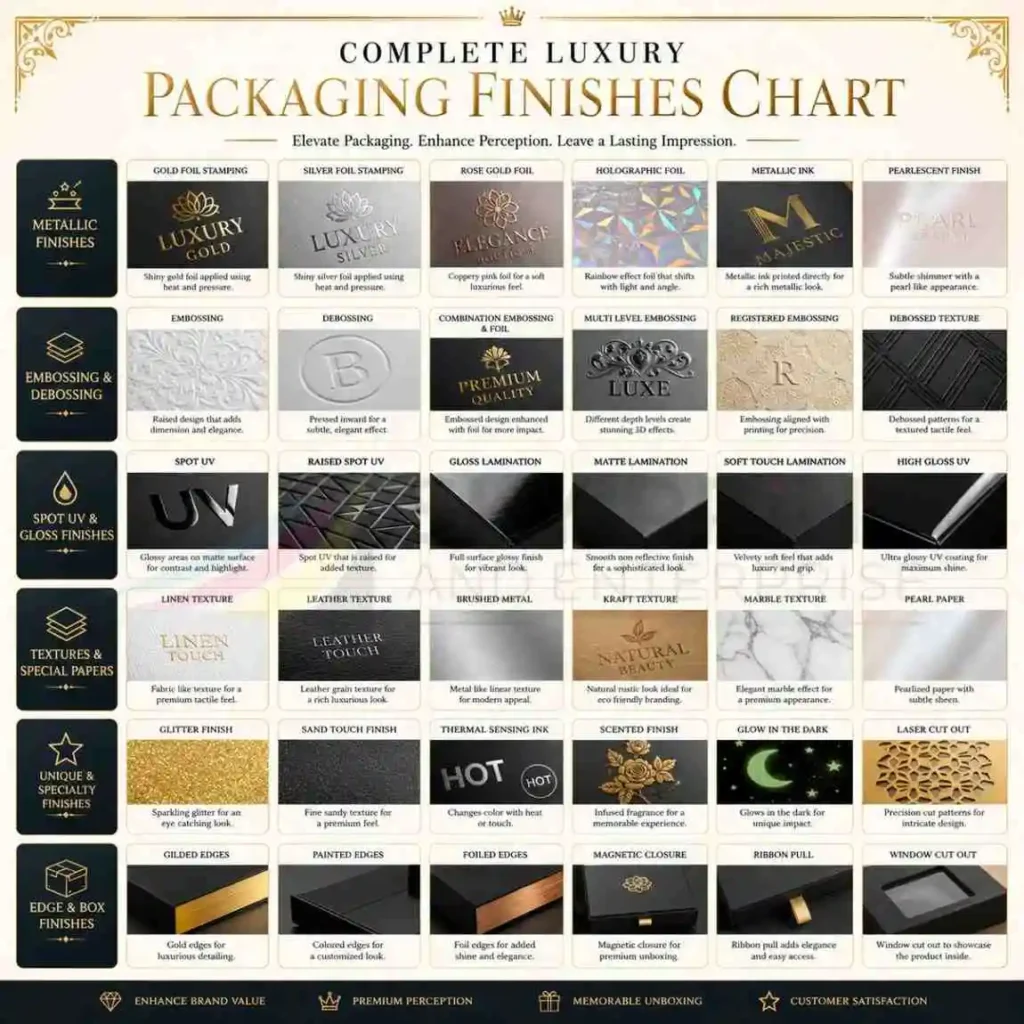
A complete comparison chart of luxury packaging finishes used to enhance premium custom boxes and branded packaging.
Luxury Packaging Finishes Guide: Types of Premium Packaging Finishes
Packaging manufacturers use dozens of finishing techniques, yet most luxury packaging projects combine a relatively small selection of proven premium finishes. Each technique serves a specific purpose, and together they create packaging that communicates quality before customers even touch the product.
| Finishing Technique | Primary Benefit | Common Applications |
|---|---|---|
| Matt Lamination | Elegant appearance | Luxury cosmetics, retail packaging |
| Gloss Lamination | Colour enhancement | Food, retail, promotional boxes |
| Soft-Touch Lamination | Velvet texture | Perfumes, jewellery, premium gifts |
| Foil Stamping | Metallic highlights | Luxury branding |
| Embossing | Raised texture | Logos, premium graphics |
| Debossing | Recessed artwork | Luxury branding |
| Spot UV | Gloss contrast | Premium product packaging |
| Speciality Coatings | Protection & aesthetics | Retail packaging |
Rather than applying every available finish, manufacturers recommend selecting only those that reinforce the intended customer experience. Consequently, the finished packaging appears refined instead of overly decorative.
Luxury Packaging Finishes Guide: Choosing the Right Material Before Applying Finishes
Even the most sophisticated finishing techniques cannot compensate for an unsuitable packaging material. Therefore, professional manufacturers always select the board or paper before recommending foils, coatings or embossing. The material determines print quality, structural strength, finishing compatibility and overall customer perception.
For premium retail packaging, coated cardboard remains one of the most versatile options because it accepts almost every luxury finish available. Gloss, matt and soft-touch laminations perform exceptionally well, while embossing and foil stamping produce crisp, highly detailed results. If you would like to understand board grades in greater detail, explore our guide to Cardboard Packaging Material.
Rigid board provides another outstanding foundation for luxury packaging. Since manufacturers wrap rigid boxes with printed papers before assembly, they can combine multiple finishing techniques without compromising structural strength. As a result, premium products such as Custom Rigid Boxes, Scarf Gift Boxes and Essential Oil Storage Boxes frequently use rigid construction to maximise both presentation and durability.
Natural kraft board creates a completely different visual effect. Instead of relying on multiple decorative finishes, kraft packaging often achieves premium appeal through simplicity. Manufacturers generally recommend one-colour printing or, in many cases, two-colour printing to preserve the natural appearance of the board. Moreover, kraft packaging typically remains unlaminated because gloss, matt or soft-touch films would hide the authentic recycled texture that customers appreciate. Learn more in our Kraft Packaging Material Guide.
Corrugated packaging also benefits from selected finishing techniques, particularly for premium subscription boxes and luxury e-commerce packaging. Digital printing, protective varnishes and carefully positioned foil details allow shipping boxes to reinforce brand identity while maintaining excellent structural performance. Our Corrugated Cardboard Material Guide explains these options in greater detail.
Professional Tips for Selecting the Best Packaging Material
Choosing the correct material before discussing finishes ultimately produces stronger packaging, more efficient manufacturing and better commercial results. Consequently, successful luxury packaging begins with sound structural decisions before decorative finishes enter the conversation.
Luxury Packaging Finishes Guide: Why Premium Brands Combine Multiple Finishes
The world’s most recognisable luxury brands rarely depend on a single finishing technique. Instead, they combine complementary finishes to create visual contrast, tactile interest and memorable unboxing experiences. Consequently, customers perceive the packaging as more valuable, even before they see the product inside.
A premium perfume box might combine matt lamination with embossed gold foil branding, while a jewellery presentation box could feature soft-touch lamination, magnetic closure and a velvet insert. Likewise, luxury gift packaging often pairs foil stamping with ribbon closures and rigid construction to reinforce exclusivity.
Many bespoke products within our Custom Gift Packaging collection demonstrate how carefully selected finishing combinations elevate both presentation and perceived value. Similarly, products such as Glitter Boxes, Holographic Boxes and Cardboard Box Texture showcase how speciality finishes can create distinctive retail experiences.
Throughout the remaining chapters of this Luxury Packaging Finishes Guide, we will examine each premium finishing technique individually, explain how manufacturers produce these effects and identify the industries where each finish delivers the greatest commercial value.
Luxury Packaging Finishes Guide: Lamination – The Foundation of Premium Packaging
Lamination is one of the most widely used finishing techniques in premium packaging because it improves both appearance and durability. Before manufacturers apply speciality finishes such as foil stamping, embossing or Spot UV, they often laminate the printed sheets to create a smooth, protected surface. Consequently, the packaging not only looks more refined but also withstands scratching, moisture, fingerprints and frequent handling throughout distribution and retail display.
Although many people think lamination simply adds shine, professional manufacturers use several different laminating films, each producing a unique visual and tactile effect. Therefore, choosing the correct laminate is one of the earliest decisions during packaging development. The selected finish influences colour vibrancy, texture, durability and even the customer’s emotional response when they first touch the package.
Luxury cosmetics, jewellery, electronics, premium food products and corporate gift packaging frequently rely on lamination because it creates a clean foundation for additional embellishments. As a result, many of today’s most recognisable luxury brands begin with a laminated surface before applying metallic foils, embossed logos or UV coatings.
In the following sections of this Luxury Packaging Finishes Guide, we will examine the four most popular lamination options and explain when each one delivers the greatest commercial value.
Luxury Packaging Finishes Guide: Gloss Lamination
Gloss lamination creates a smooth, highly reflective surface that intensifies printed colours and produces exceptional visual impact. Consequently, photographs appear sharper, colours become more vibrant and product images attract greater attention on retail shelves. Brands that rely on colourful graphics frequently choose gloss lamination because it maximises colour brilliance without altering the printed artwork.
Besides improving appearance, gloss lamination protects the printed surface from moisture, light abrasion and general handling. Therefore, products displayed in busy retail environments maintain their presentation for much longer than unprotected packaging.
Gloss lamination is particularly suitable for:
- Retail packaging
- Food packaging
- Children’s products
- Toy packaging
- Promotional packaging
- Consumer electronics
For example, colourful Toy Packaging often benefits from gloss lamination because the reflective finish enhances bright colours while providing additional surface protection. Likewise, many Printed Foldable Boxes use gloss lamination to create an attractive retail presentation without significantly increasing production costs.
Although gloss lamination creates outstanding visual impact, it reflects light more readily than matt finishes. Consequently, luxury brands that prefer understated elegance often select matt or soft-touch lamination instead.
Luxury Packaging Finishes Guide: Matt Lamination
Matt lamination remains one of the most popular finishes for luxury packaging because it creates a refined, sophisticated appearance without excessive reflection. Rather than producing a glossy surface, matt film diffuses light evenly across the package. Consequently, logos, typography and minimalist artwork appear clean, elegant and highly professional.
Premium cosmetic brands, fashion companies, jewellery manufacturers and luxury retailers frequently select matt lamination because it reinforces exclusivity through subtle presentation. Instead of demanding attention through shine, matt packaging communicates confidence, quality and craftsmanship.
Matt lamination also provides practical advantages. It protects printed artwork, reduces minor scuffing and creates an excellent base for premium embellishments. Therefore, manufacturers often combine matt lamination with gold foil, silver foil, embossing or Spot UV to produce striking visual contrast.
Many luxury products including Perfume Boxes, Serum Boxes and Bracelet Boxes use matt lamination because it allows metallic foils and embossed logos to stand out beautifully against the muted background.
If your objective is premium retail packaging with timeless appeal, matt lamination remains one of the safest and most versatile finishing choices available.
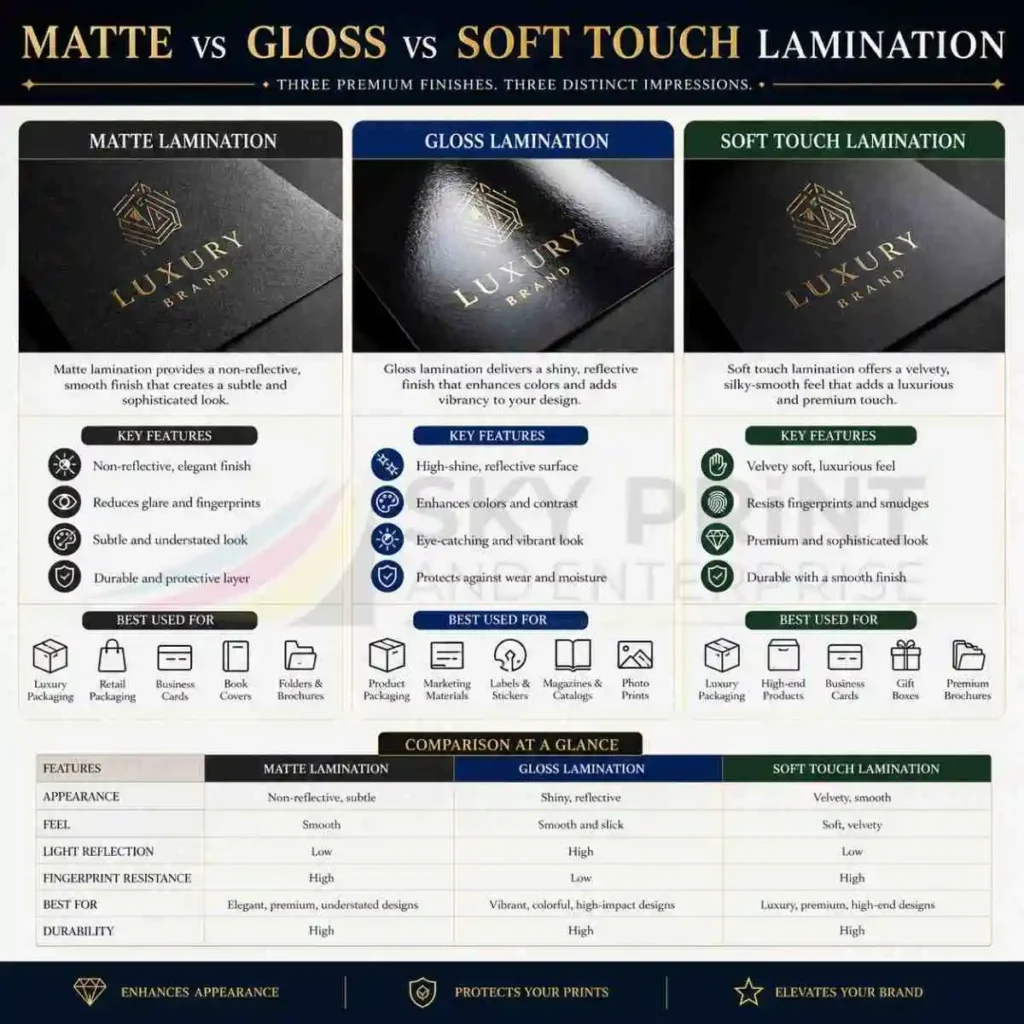
Understand the visual and tactile differences between matt, gloss and soft touch lamination for premium packaging.
Luxury Packaging Finishes Guide: Soft-Touch Lamination
Soft-touch lamination represents one of the highest-value finishes available in modern packaging. Unlike conventional laminating films, soft-touch coatings create a distinctive velvet-like texture that customers immediately notice when handling the package. Consequently, the finish transforms an ordinary box into a premium sensory experience.
Luxury packaging increasingly focuses on emotional engagement. Customers do not simply look at premium packaging—they hold it, examine it and interact with it before opening the product. Therefore, tactile finishes have become just as important as visual decoration.
Soft-touch lamination pairs exceptionally well with:
- Gold foil stamping
- Rose gold foil
- Embossed logos
- Raised Spot UV
- Magnetic rigid boxes
- Luxury inserts
High-end Custom Rigid Boxes, premium Gift Boxes and exclusive Custom Gift Packaging frequently feature soft-touch lamination because customers associate the smooth texture with luxury and superior craftsmanship.
Although soft-touch lamination costs more than standard matt or gloss films, many brands consider it an investment rather than an expense because it significantly enhances perceived product value.
Luxury Packaging Finishes Guide: Anti-Scratch Lamination
Luxury packaging often travels through multiple production stages before reaching customers. Consequently, manufacturers must protect premium surfaces from scratches, rubbing and handling damage. Anti-scratch lamination addresses this challenge by providing enhanced surface resistance while preserving an elegant matt appearance.
Unlike conventional matt lamination, anti-scratch film withstands repeated contact more effectively. As a result, dark-coloured packaging maintains its appearance throughout manufacturing, transportation and retail display. This makes anti-scratch lamination particularly valuable for black, navy and deep-coloured luxury packaging where even small marks become highly visible.
Manufacturers commonly recommend anti-scratch lamination for:
- Luxury cosmetic packaging
- Corporate presentation boxes
- High-end electronics packaging
- Jewellery presentation boxes
- Premium subscription packaging
- Rigid gift boxes
Many bespoke packaging projects combine anti-scratch lamination with foil stamping, embossing and magnetic closures to produce packaging that remains attractive even after extended handling. Consequently, brands preserve a premium appearance from factory to customer.
Although anti-scratch lamination increases production costs slightly, it often reduces replacement rates, customer complaints and visible wear. Therefore, businesses launching premium products frequently regard it as a worthwhile investment in long-term brand presentation.
Expert Recommendation
Lamination forms the foundation of many premium packaging projects. Instead of choosing a finish based solely on appearance, consider how customers will interact with the product, where the packaging will be displayed and how much protection it requires. Gloss lamination delivers vibrant retail appeal, matt lamination creates timeless elegance, soft-touch lamination offers a luxurious tactile experience, and anti-scratch lamination provides exceptional durability for premium products. Selecting the right option at the beginning of the project creates the perfect base for advanced finishes such as foil stamping, embossing and Spot UV.
Luxury Packaging Finishes Guide: Foil Stamping – The Signature of Premium Packaging
Few finishing techniques communicate luxury as effectively as foil stamping. Across cosmetics, jewellery, premium food, fashion and corporate gifting, metallic foil instantly elevates packaging by creating brilliant reflective details that standard printing cannot reproduce. Consequently, foil stamping has become one of the most recognised luxury packaging finishes worldwide.
Unlike metallic inks, foil stamping transfers an ultra-thin metallic film onto the packaging using precision-made metal dies, heat and pressure. The process creates crisp, highly reflective graphics that retain their brilliance over time. Therefore, brands use foil stamping to emphasise logos, product names, decorative borders and premium illustrations.
Because foil reflects light naturally, it immediately attracts attention without overwhelming the overall design. Rather than covering large areas, experienced packaging designers apply foil selectively to create elegant focal points. As a result, even minimalist packaging appears sophisticated and memorable.
Throughout this section of the Luxury Packaging Finishes Guide, you will discover the different types of foil, their applications and how manufacturers combine foil with embossing, soft-touch lamination and Spot UV to produce truly premium packaging.
Luxury Packaging Finishes Guide: Gold Foil Stamping
Gold foil remains the most popular luxury packaging finish because customers naturally associate gold with prestige, craftsmanship and exclusivity. Consequently, premium brands frequently use gold foil to reinforce quality before the package is even opened.
Manufacturers can apply gold foil to logos, typography, decorative borders and intricate patterns. When combined with matt or soft-touch lamination, the metallic surface creates exceptional visual contrast while maintaining an elegant overall appearance.
Gold foil works particularly well for:
- Luxury perfume boxes
- Premium jewellery packaging
- Wedding favour boxes
- Chocolate and confectionery packaging
- Luxury gift boxes
- Premium cosmetic packaging
Products such as Perfume Boxes, Wedding Favor Boxes and Date Boxes frequently incorporate gold foil because it enhances shelf appeal while reinforcing a premium brand image.
Luxury Packaging Finishes Guide: Silver, Rose Gold and Copper Foils
Although gold remains the classic choice, modern luxury packaging increasingly uses alternative metallic finishes to create distinctive branding. Consequently, silver, rose gold and copper foils have become extremely popular across premium retail packaging.
Silver Foil
Silver foil delivers a clean, contemporary appearance that suits electronics, premium skincare, healthcare products and luxury accessories. It pairs exceptionally well with black, navy and white packaging while creating a refined modern aesthetic.
Rose Gold Foil
Rose gold combines luxury with warmth. Consequently, many cosmetic, beauty and fashion brands select rose gold because it feels contemporary while maintaining an elegant premium image.
Copper Foil
Copper foil creates a handcrafted, artisan appearance that works particularly well with premium food products, coffee packaging and natural product ranges. It also complements textured boards and earthy colour palettes beautifully.
Selecting the correct foil colour allows brands to reinforce their identity while maintaining consistency across multiple packaging collections.
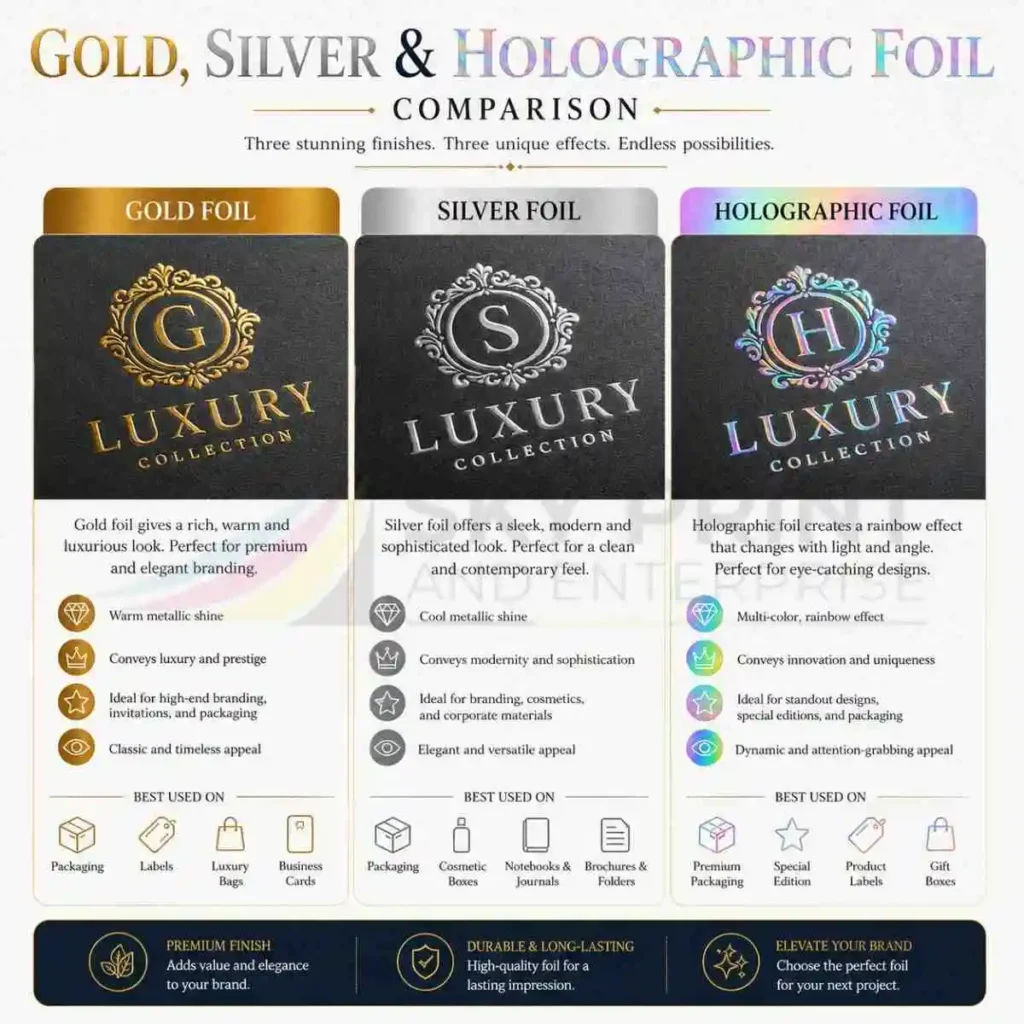
Compare gold, silver and holographic foil stamping to choose the right luxury finish for your packaging design.
Luxury Packaging Finishes Guide: Holographic and Speciality Foils
Luxury packaging no longer relies solely on traditional metallic colours. Today’s manufacturers also produce holographic, pearlescent and speciality foils that create constantly changing reflections as light moves across the surface. Consequently, these finishes immediately capture customer attention and produce highly distinctive packaging.
Holographic foil has become increasingly popular for cosmetics, technology products, collector editions and promotional packaging because it delivers vibrant colour shifts that cannot be achieved through conventional printing.
Brands seeking a modern retail appearance often combine holographic foil with minimalist artwork. Instead of decorating the entire package, they highlight only logos or selected design elements, allowing the holographic effect to become the centrepiece.
Products such as Holographic Boxes demonstrate how speciality foils create memorable shelf presence while reinforcing premium product positioning.
Luxury Packaging Finishes Guide: Combining Foil with Other Finishes
Foil stamping rarely appears alone in luxury packaging. Instead, manufacturers combine it with complementary finishing techniques to maximise visual impact while maintaining elegant presentation.
Some of the most successful combinations include:
- Matt lamination + Gold foil
- Soft-touch lamination + Rose gold foil
- Embossing + Gold foil
- Spot UV + Silver foil
- Debossing + Copper foil
- Rigid box + Magnetic closure + Foil logo
These combinations allow designers to create depth, texture and contrast without overcrowding the artwork. Consequently, the finished packaging appears refined rather than overly decorative.
For example, many Gift Boxes, Custom Rigid Boxes and Luxury Gift Packaging combine foil stamping with soft-touch lamination and embossed branding to create an exceptional unboxing experience.
Luxury Packaging Finishes Guide: Best Practices for Foil Stamping
Professional foil stamping requires careful planning from the beginning of the design process. Consequently, experienced manufacturers prepare dedicated foil artwork, accurate registration marks and suitable die layouts before production begins.
To achieve the highest-quality results, follow these recommendations:
- Use vector artwork for foil elements.
- Avoid extremely fine lines and tiny text.
- Allow adequate spacing between foil details.
- Choose foil colours that complement the packaging design.
- Combine foil with matt or soft-touch lamination for maximum contrast.
- Request production proofs before full manufacturing.
- Use embossing where additional depth is required.
- Apply foil selectively instead of covering large areas.
Following these principles produces sharper foil registration, cleaner finishing and more consistent production quality across every packaging run.
Expert Recommendation
Foil stamping should enhance a packaging design rather than dominate it. The most successful luxury packaging combines carefully positioned foil with complementary finishes such as soft-touch lamination, embossing or Spot UV. By maintaining balance and using metallic details strategically, brands create packaging that feels premium, communicates quality and leaves a lasting impression on customers.
Luxury Packaging Finishes Guide: Embossing and Debossing
Luxury packaging is no longer judged only by its appearance. Today’s consumers expect packaging to create a memorable tactile experience as well as an attractive visual presentation. Consequently, embossing and debossing have become two of the most valuable finishing techniques in premium packaging because they introduce physical texture that customers immediately notice when handling a product.
Unlike printed graphics, embossed and debossed artwork can be both seen and felt. This additional sensory dimension makes logos, patterns and brand names appear more refined while reinforcing perceptions of craftsmanship and exclusivity. As a result, luxury cosmetics, jewellery, fragrances, corporate gifts and premium food products frequently incorporate one or both techniques into their packaging.
Although embossing and debossing appear similar, they create opposite visual effects. Embossing raises selected design elements above the surface of the packaging, whereas debossing presses artwork into the board to create recessed impressions. Therefore, each technique communicates a different style and should be selected according to the desired brand personality.
Throughout this section of the Luxury Packaging Finishes Guide, we will explain how both processes work, where they perform best and how manufacturers combine them with foil stamping, soft-touch lamination and Spot UV to produce exceptional luxury packaging.
Luxury Packaging Finishes Guide: What Is Embossing?
Embossing is a finishing process that raises selected artwork above the surface of the packaging using matched metal dies, controlled pressure and precise registration. Instead of adding another printing colour, embossing physically reshapes the board, producing a three-dimensional effect that customers can both see and feel.
Because embossing relies on pressure rather than ink, it creates an elegant appearance without increasing visual complexity. Consequently, luxury brands frequently emboss company logos, monograms, decorative patterns and premium typography to strengthen their identity while maintaining minimalist packaging designs.
Embossing works particularly well on coated cardboard, rigid box wraps and premium paper stocks because these materials hold fine detail while maintaining structural integrity. As a result, embossed elements remain crisp throughout manufacturing and continue to enhance the packaging long after production has finished.
Some of the most common applications include:
- Luxury logo branding
- Company monograms
- Decorative borders
- Premium typography
- Floral and geometric patterns
- High-end product names
Many premium Perfume Boxes, Custom Cufflink Boxes, Bracelet Boxes and Custom Rigid Boxes use embossed branding because the raised texture immediately communicates quality and craftsmanship.
For premium packaging, embossing becomes even more effective when combined with matt or soft-touch lamination. The smooth laminated surface contrasts beautifully with the raised artwork, creating an elegant tactile experience that customers naturally associate with luxury products.
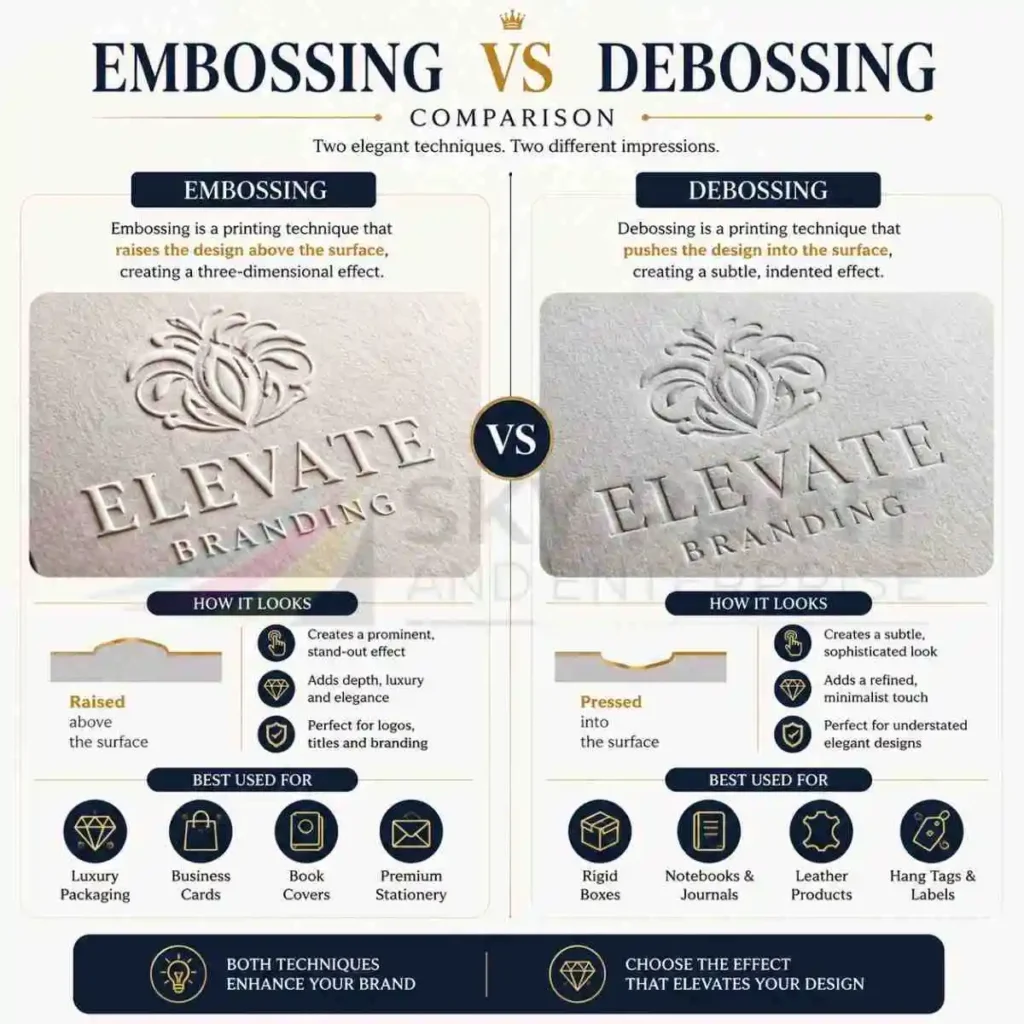
Compare embossing and debossing to understand how each finishing technique creates a distinctive luxury packaging effect.
Luxury Packaging Finishes Guide: What Is Debossing?
Debossing uses a similar manufacturing process to embossing, but instead of raising the artwork, it presses the design below the surface of the packaging. Consequently, logos and decorative elements appear recessed, producing a subtle and sophisticated appearance that many luxury brands prefer.
Because debossing relies on shadow and depth rather than reflection, it creates understated elegance that works particularly well with minimalist packaging. Rather than demanding attention, recessed artwork encourages customers to explore the packaging more closely.
Luxury fashion, boutique cosmetics and premium stationery brands frequently choose debossing because it reinforces exclusivity without overwhelming the overall design. Likewise, many artisan food brands combine debossing with textured papers to create authentic handcrafted packaging.
Debossing is commonly used for:
- Luxury logos
- Minimalist branding
- Corporate presentation packaging
- Fashion accessories
- Premium document folders
- Gift presentation boxes
Many bespoke Gift Boxes and elegant Scarf Gift Boxes use debossed branding because the recessed finish creates a refined appearance while allowing the packaging material itself to become part of the overall design.
Luxury Packaging Finishes Guide: Embossing vs Debossing
Although both techniques add texture, they create very different customer impressions. Therefore, choosing the correct option depends on your brand identity, packaging style and marketing objectives.
| Feature | Embossing | Debossing |
|---|---|---|
| Surface | Raised | Recessed |
| Visual Impact | Bold | Subtle |
| Touch | Pronounced | Elegant |
| Best For | Luxury logos | Minimal branding |
| Common Combination | Foil + Embossing | Soft-touch + Debossing |
Neither technique is inherently superior. Instead, the best choice depends entirely on the desired customer experience. Brands seeking bold luxury often select embossing, whereas companies favouring understated sophistication frequently choose debossing.
Luxury Packaging Finishes Guide: Sculptured and Multi-Level Embossing
Standard embossing produces a single raised level. However, premium packaging manufacturers can also create sculptured embossing and multi-level embossing to achieve far greater depth and realism.
Sculptured embossing uses specially engraved dies that reproduce fine curves, contours and gradients. Consequently, illustrations, crests and decorative artwork appear almost three-dimensional. Luxury perfume brands, premium spirits and collector’s edition products frequently use sculptured embossing to produce distinctive packaging that immediately stands apart from competitors.
Multi-level embossing goes even further by creating several raised heights within a single design. Rather than lifting every element equally, manufacturers vary the depth throughout the artwork to create exceptional visual realism.
Although these advanced techniques require more specialised tooling, they deliver outstanding presentation for premium retail products where first impressions strongly influence purchasing decisions.
When combined with gold foil, soft-touch lamination and rigid construction, sculptured embossing produces some of the highest-quality luxury packaging available in today’s market.
Expert Recommendation
Embossing and debossing should enhance brand identity rather than simply decorate the packaging. For maximum impact, use these techniques selectively on logos, product names or key design elements, then combine them with complementary finishes such as foil stamping or soft-touch lamination. A carefully balanced design consistently creates a stronger luxury impression than excessive embellishment.
Luxury Packaging Finishes Guide: Spot UV and Premium Protective Coatings
Luxury packaging succeeds when it combines visual appeal with tactile quality. While embossing creates physical texture and foil stamping introduces metallic brilliance, Spot UV and speciality coatings add another level of sophistication through selective gloss, depth and surface protection. Consequently, premium brands across cosmetics, jewellery, electronics and retail packaging frequently incorporate these finishes to create elegant packaging that immediately attracts attention.
Unlike conventional printing, Spot UV allows designers to highlight only specific areas of the artwork. Rather than coating the entire package, manufacturers apply a clear high-gloss varnish precisely where emphasis is required. As a result, logos, product names and decorative graphics stand out beautifully against matt or soft-touch laminated backgrounds.
Speciality varnishes also improve durability. Besides enhancing appearance, they protect printed surfaces from scratches, fingerprints and everyday handling. Therefore, luxury packaging maintains its premium presentation from production through transportation and finally into the customer’s hands.
In this chapter of the Luxury Packaging Finishes Guide, we explore Spot UV, Raised UV, drip-off coatings, aqueous coatings and protective varnishes to help you choose the most suitable finish for your packaging project.
Luxury Packaging Finishes Guide: Standard Spot UV
Spot UV is one of the most popular luxury packaging finishes because it creates dramatic visual contrast without changing the printed artwork. Instead of applying gloss across the entire package, manufacturers coat selected design elements with a transparent ultraviolet-cured varnish. Consequently, the treated areas become highly reflective while the surrounding surface remains matt or soft-touch.
The technique works exceptionally well on dark packaging where reflective highlights become more noticeable. Therefore, many premium cosmetic brands apply Spot UV to company logos, product names or decorative illustrations while leaving the remaining artwork matt.
Common applications include:
- Luxury logo enhancement
- Brand names
- Product photography
- Decorative patterns
- Packaging illustrations
- Premium typography
Many Serum Boxes, Perfume Boxes and Essential Oil Storage Boxes combine Spot UV with matt lamination because the glossy highlights immediately draw attention to premium branding.
Although Spot UV appears simple, accurate registration is essential. Even slight movement between the printed artwork and UV coating becomes noticeable. Consequently, professional manufacturers prepare dedicated Spot UV artwork and production files before printing begins.
Luxury Packaging Finishes Guide: Raised Spot UV (3D UV)
Raised Spot UV, sometimes called 3D UV, takes conventional Spot UV one step further by applying a thick layer of transparent varnish that creates both gloss and physical texture. Consequently, customers can see and feel the highlighted design elements, making the packaging significantly more interactive.
Unlike embossing, which reshapes the board itself, Raised UV builds a clear coating above the printed surface. Therefore, manufacturers can create highly detailed tactile effects without altering the structure of the packaging.
Raised UV works exceptionally well for:
- Luxury logos
- Premium typography
- Product illustrations
- Decorative icons
- Corporate branding
- Premium retail packaging
Because Raised UV adds noticeable texture, many luxury brands combine it with soft-touch lamination. The contrast between the velvety surface and the raised glossy artwork produces one of the most distinctive tactile experiences available in commercial packaging.
High-end Gift Boxes, Custom Rigid Boxes and premium Custom Gift Packaging frequently incorporate Raised UV because it immediately communicates exclusivity.
Luxury Packaging Finishes Guide: Protective Varnishes
Not every premium finish aims to create dramatic visual effects. Protective varnishes improve durability while maintaining the original appearance of the printed artwork. Consequently, they are widely used where brands require economical protection without introducing additional texture or metallic decoration.
The most common varnish options include:
| Varnish Type | Primary Purpose | Typical Use |
|---|---|---|
| Gloss Varnish | Colour enhancement | Retail packaging |
| Matt Varnish | Reduced reflection | Luxury packaging |
| Satin Varnish | Balanced finish | Corporate packaging |
| UV Varnish | High durability | Retail products |
Although varnishes are generally less expensive than laminations, they still improve resistance to fingerprints, moisture and surface abrasion. Therefore, they remain an excellent solution for many commercial packaging projects.
Luxury Packaging Finishes Guide: Aqueous (AQ) Coating
Aqueous coating, often abbreviated as AQ coating, is a fast-drying, water-based protective finish applied during the printing process. Unlike laminated films, aqueous coatings preserve the natural appearance of the printed board while providing additional resistance to scuffing and moisture.
Because AQ coating dries rapidly, it supports efficient commercial production and reduces manufacturing time. Consequently, it is widely used for high-volume packaging where speed, durability and cost efficiency are equally important.
Aqueous coating is particularly suitable for:
- Food packaging
- Burger boxes
- Pizza boxes
- Fish and chip boxes
- Shipping cartons
- Retail folding cartons
For example, Burger Boxes, Custom Pizza Boxes, Fish and Chip Boxes and Shipping Boxes frequently use aqueous coatings because they improve durability while remaining suitable for commercial production requirements.
Although AQ coating is highly effective for many packaging applications, it does not replace premium decorative finishes such as foil stamping or embossing. Instead, manufacturers often recommend it where practical protection is more important than luxury presentation.
Luxury Packaging Finishes Guide: Combining Spot UV with Other Finishes
One of the greatest advantages of Spot UV is its compatibility with other premium finishing techniques. Rather than using Spot UV alone, experienced packaging manufacturers combine it strategically to maximise contrast and customer engagement.
Some of the most effective combinations include:
- Matt lamination + Spot UV
- Soft-touch lamination + Raised UV
- Gold foil + Spot UV
- Embossing + Raised UV
- Debossing + Spot UV highlights
- Rigid box + Soft-touch + Raised UV + Gold foil
By combining finishes thoughtfully, brands create packaging that appeals to multiple senses while maintaining an elegant and balanced appearance. Consequently, customers perceive the packaging as significantly more premium than designs relying on a single finishing technique.
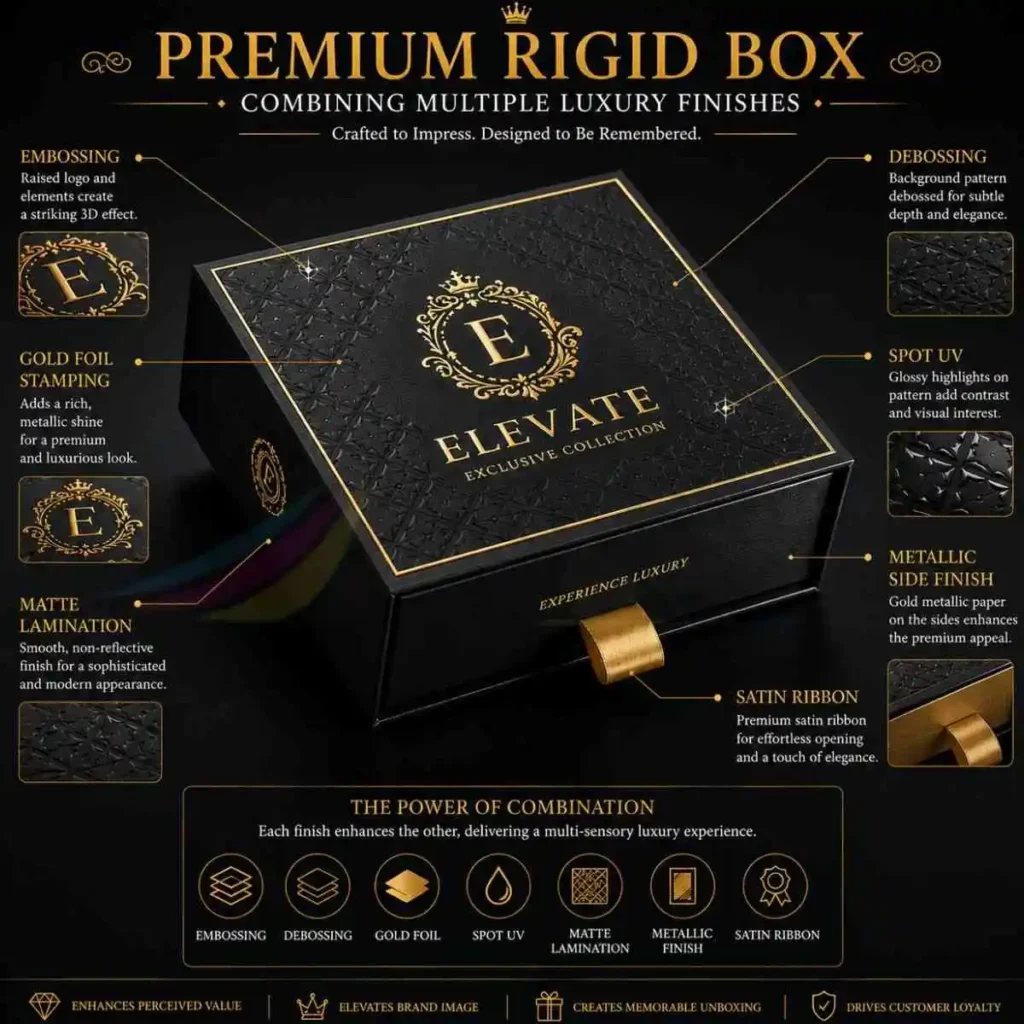
A premium rigid box showcasing luxury packaging finishes including embossing, debossing, gold foil, metallic edge finishing, spot UV coating and a satin ribbon closure.
Expert Recommendation
Use Spot UV and Raised UV to guide the customer’s attention rather than covering large areas of the packaging. Highlight logos, product names and key design elements while allowing matt or soft-touch surfaces to provide contrast. When combined with foil stamping and embossing, these finishes produce premium packaging that looks sophisticated, feels luxurious and strengthens brand recognition.
Luxury Packaging Finishes Guide: Structural Decorative Finishes
Luxury packaging is not defined only by printed decoration. The physical structure of the packaging also plays a significant role in creating a memorable customer experience. Consequently, premium brands increasingly use structural finishing techniques that transform an ordinary carton into a distinctive presentation box. Rather than relying solely on colours and coatings, these techniques introduce unique shapes, precision openings and premium details that immediately communicate craftsmanship.
Structural decorative finishes include die cutting, window patching, decorative cut-outs, edge painting and several speciality manufacturing processes. Each technique serves a practical purpose while simultaneously enhancing the appearance of the packaging. Therefore, designers often consider these features during the earliest stages of packaging development instead of adding them after the artwork has been completed.
When structural finishes are combined with foil stamping, embossing, Spot UV and premium laminations, they create packaging that engages customers visually and physically. As a result, the overall unboxing experience becomes more memorable and significantly increases perceived product value.
This chapter of the Luxury Packaging Finishes Guide explores the most popular structural finishing techniques used in premium packaging manufacturing and explains where each one delivers the greatest commercial benefit.
Luxury Packaging Finishes Guide: Precision Die Cutting
Die cutting is one of the most important manufacturing processes in premium packaging because it determines the final shape, folding accuracy and overall presentation of every box. Instead of cutting packaging manually, manufacturers use precision-engineered steel dies that cut, crease and score packaging materials with exceptional consistency.
Although every folding carton requires die cutting, luxury packaging frequently incorporates custom die-cut features that go far beyond standard box construction. Consequently, brands can create unique silhouettes, decorative openings and structural elements that immediately distinguish their packaging from competing products.
Common luxury die-cut applications include:
- Decorative product windows
- Unique outer box shapes
- Luxury sleeve openings
- Display packaging
- Premium gift packaging
- Retail presentation boxes
For example, bespoke Custom Box Sleeves often use intricate die-cut openings that reveal selected areas of the inner packaging while maintaining an elegant appearance. Likewise, many Gift Boxes and Custom Rigid Boxes incorporate precision die-cut components to improve both functionality and presentation.
Accurate die cutting also improves production efficiency. Because every crease and fold is positioned precisely, assembled packaging maintains clean edges, perfect alignment and excellent structural integrity throughout manufacturing.
Luxury Packaging Finishes Guide: Window Patching
Window patching allows customers to view the product without opening the packaging. Manufacturers create a die-cut opening before securely attaching a transparent plastic film behind the window. Consequently, the contents remain protected while becoming visible to potential buyers.
Luxury packaging uses window patching differently from standard retail cartons. Rather than creating large display windows, premium brands typically design smaller, carefully positioned openings that reveal only selected portions of the product. This approach generates curiosity while preserving an exclusive presentation.
Window patching is particularly effective for:
- Luxury confectionery
- Premium food products
- Wedding favour packaging
- Gift packaging
- Speciality cosmetics
- Seasonal promotional products
Products such as Indian Mithai Boxes, Date Boxes and selected Wedding Favor Boxes frequently benefit from elegant window patching because customers appreciate seeing the premium product before purchase.
When combined with foil stamping or embossing around the window, the finished packaging achieves an excellent balance between product visibility and premium presentation.
Luxury Packaging Finishes Guide: Decorative Cut-Out Effects
Decorative cut-outs use precision die cutting to remove selected sections of the packaging and create distinctive visual effects. Unlike conventional window patching, decorative cut-outs may remain open without transparent film, depending on the product and packaging requirements.
Luxury brands frequently use geometric shapes, monograms, floral motifs and brand-inspired patterns to produce elegant packaging with greater visual depth. Consequently, customers immediately recognise the packaging as something different from standard retail cartons.
Decorative cut-outs work particularly well for:
- Luxury gift packaging
- Jewellery presentation boxes
- Premium invitation packaging
- Fashion accessories
- Corporate presentation boxes
- Collector’s edition packaging
Many premium Scarf Gift Boxes, Custom Cufflink Boxes and luxury promotional products use decorative cut-outs because they immediately create a memorable first impression before the customer even opens the package.
Luxury Packaging Finishes Guide: Edge Painting and Coloured Edges
Edge painting is a specialist finishing technique that colours the exposed edges of rigid boards or premium paper products. Although subtle, coloured edges dramatically enhance perceived quality because they demonstrate attention to detail throughout every part of the packaging.
Manufacturers typically apply metallic gold, silver, black, white or custom brand colours depending on the packaging design. Consequently, even a simple rigid presentation box appears considerably more luxurious without introducing additional printed graphics.
Edge painting is particularly popular for:
- Luxury rigid boxes
- Jewellery packaging
- Premium stationery
- Corporate presentation boxes
- Collector’s edition products
- Luxury keepsake packaging
When combined with soft-touch lamination, embossed branding and magnetic closures, coloured edges produce exceptionally elegant packaging that reinforces premium positioning.
Although edge painting requires additional production time, many luxury brands regard it as a worthwhile investment because customers immediately recognise the superior craftsmanship.
For colour consistency and international print standards, see the
International Organization for Standardization (ISO),
which publishes recognised standards for manufacturing and print quality.
Luxury Packaging Finishes Guide: Best Practices for Structural Decorative Finishes
Structural finishing techniques should always support functionality as well as appearance. Therefore, experienced packaging designers evaluate product protection, manufacturing efficiency and customer usability before introducing decorative structural elements.
For the best commercial results, consider these recommendations:
- Keep die-cut openings structurally strong.
- Use window patching only where product visibility adds value.
- Align decorative cut-outs with printed artwork.
- Maintain sufficient board strength around openings.
- Combine structural finishes with premium print finishes rather than relying on structure alone.
- Prototype complex designs before mass production.
- Ensure decorative features support the overall brand identity.
Following these principles produces packaging that remains visually impressive while performing reliably throughout shipping, retail display and customer handling.
Expert Recommendation
Structural decorative finishes create memorable packaging because customers experience them before interacting with the product itself. Rather than adding decorative elements purely for appearance, ensure every die-cut, window or structural feature contributes to usability, product protection and brand storytelling. When these techniques are combined with premium print finishes, they produce packaging that stands out both visually and functionally.
Luxury Packaging Finishes Guide: Premium Closures and Interior Finishes
Luxury packaging extends far beyond the exterior of the box. Once customers lift the lid, open the magnetic flap or remove the product, the interior presentation becomes equally important. Consequently, premium brands invest heavily in luxury closures, custom inserts and refined interior finishes that transform a simple package into an unforgettable unboxing experience.
Modern consumers often judge premium products by the complete opening experience rather than by appearance alone. Therefore, rigid construction, concealed magnets, satin ribbons and precision-cut inserts have become standard features across high-end cosmetics, jewellery, fashion accessories, premium food and corporate gifting.
These finishing elements also improve functionality. Besides enhancing presentation, they protect delicate products during transportation, reduce movement inside the box and reinforce the perception of superior quality. As a result, customers receive packaging that feels carefully engineered rather than simply manufactured.
This chapter of the Luxury Packaging Finishes Guide explains the most popular interior finishing techniques and demonstrates how manufacturers combine them to create packaging that customers are reluctant to throw away.
Luxury Packaging Finishes Guide: Magnetic Closure Boxes
Magnetic closures represent one of the defining features of modern luxury packaging. Hidden magnets are integrated into the rigid board during manufacturing, allowing the lid to close securely with a smooth and satisfying action. Consequently, customers immediately associate magnetic packaging with premium craftsmanship and attention to detail.
Unlike conventional tuck-end cartons, magnetic closure boxes provide excellent structural strength while maintaining a clean, seamless appearance. Therefore, they are widely used for luxury gifts, premium electronics, cosmetics, jewellery, corporate presentations and subscription packaging.
Magnetic closure packaging offers several important advantages:
- Elegant opening and closing experience.
- Improved product protection.
- Reusable premium packaging.
- Excellent structural durability.
- Higher perceived product value.
- Suitable for long-term storage.
Many premium Custom Rigid Boxes, Gift Boxes and bespoke Custom Gift Packaging use concealed magnetic closures because they create a refined unboxing experience while encouraging customers to keep the packaging long after purchase.
For maximum impact, manufacturers frequently combine magnetic closures with soft-touch lamination, gold foil stamping and embossed branding to produce packaging that reflects true luxury.
Luxury Packaging Finishes Guide: Ribbon Closures and Pull Tabs
Ribbon closures introduce elegance through both appearance and functionality. Rather than opening the box directly, customers interact with a satin or grosgrain ribbon that gently reveals the product inside. Consequently, the opening process feels more deliberate and significantly more luxurious.
Ribbon closures are available in various colours, widths and materials, allowing brands to match their corporate identity or seasonal packaging collections. Gold, ivory, black and deep navy remain particularly popular because they complement premium packaging without distracting from the printed artwork.
Manufacturers commonly incorporate ribbons into:
- Luxury gift boxes.
- Wedding favour packaging.
- Premium jewellery boxes.
- Fashion accessory packaging.
- Corporate presentation boxes.
- Collector’s edition products.
Products such as Scarf Gift Boxes, Bracelet Boxes and Custom Cufflink Boxes frequently use ribbon pull tabs because they improve accessibility while reinforcing the premium presentation.
Although ribbons appear to be simple decorative additions, they contribute significantly to the overall customer experience and often become one of the most memorable aspects of luxury packaging.
Luxury Packaging Finishes Guide: Premium Inserts
A luxury box should protect the product just as effectively as it presents it. Consequently, premium inserts are designed not only to prevent movement during transport but also to position the product beautifully when the box is opened.
The choice of insert depends on the product’s size, weight and fragility. Manufacturers therefore select materials that balance protection with presentation while maintaining efficient production.
| Insert Type | Best Applications | Luxury Appearance |
|---|---|---|
| EVA Foam | Electronics, jewellery, watches | ★★★★★ |
| Velvet Foam | Luxury jewellery | ★★★★★ |
| Satin Fabric | Perfumes, cosmetics, gifts | ★★★★★ |
| Cardboard Inserts | Retail packaging | ★★★★☆ |
| Moulded Paper Inserts | Eco-friendly packaging | ★★★★☆ |
| Vacuum Formed Trays | Cosmetics, electronics | ★★★★★ |
Many luxury Perfume Boxes, Essential Oil Storage Boxes, Serum Boxes and premium gift collections use precision-cut inserts because they hold each product securely while presenting it elegantly.
Luxury Packaging Finishes Guide: Sustainable Interior Packaging
Luxury packaging and sustainability no longer compete with one another. Instead, manufacturers increasingly produce premium interior components using recyclable and responsibly sourced materials. Consequently, brands can maintain an elegant presentation while reducing environmental impact.
Popular sustainable alternatives include moulded paper pulp, recycled cardboard inserts, FSC-certified paperboard, biodegradable protective materials and recyclable rigid board constructions. These solutions minimise plastic usage while continuing to provide excellent product protection.
Eco-conscious luxury brands often combine sustainable inserts with natural textures, minimalist printing and carefully selected finishing techniques to create packaging that reflects both environmental responsibility and premium quality.
If sustainability forms part of your brand strategy, consider pairing recyclable inserts with premium finishes such as embossing, debossing or foil stamping instead of relying on unnecessary plastic decoration. This balanced approach delivers an attractive package while supporting modern environmental expectations.
For packaging sustainability guidance in the UK, visit
WRAP UK,
which provides best practices for recyclable and resource-efficient packaging.
Luxury Packaging Finishes Guide: Creating a Memorable Unboxing Experience
Today’s consumers frequently share premium purchases on social media, making the unboxing experience an extension of the brand itself. Therefore, every element inside the box should contribute to a consistent and carefully considered presentation.
Luxury packaging performs best when exterior finishes transition naturally into premium interior details. For example, a customer might first notice a gold foil logo, then feel the soft-touch lamination, hear the magnetic closure engage and finally reveal a perfectly positioned product resting within a custom insert. Together, these carefully planned interactions create a memorable experience that strengthens customer satisfaction and encourages repeat purchases.
Brands that invest in premium interior finishes consistently improve perceived value because customers recognise the attention given to every detail rather than only the visible exterior.
Expert Recommendation
Luxury packaging should impress customers from the moment they first see the box until the product is fully revealed. Premium closures, elegant ribbons and precisely engineered inserts transform packaging into an experience instead of a container. When combined with high-quality structural design and professional finishing techniques, these interior features significantly increase both perceived value and long-term brand recognition.
Luxury Packaging Finishes Guide: Combining Multiple Finishes for Maximum Impact
Premium packaging rarely relies on a single finishing technique. Instead, luxury brands combine carefully selected finishes that complement one another while reinforcing the product’s positioning. Consequently, the most successful packaging projects create depth, texture, reflection and tactile appeal without appearing excessive or cluttered.
Although every finishing technique adds value individually, their combined effect often produces significantly greater customer impact. For example, a gold foil logo becomes even more striking when applied over soft-touch lamination, while embossed branding creates greater depth when paired with Spot UV highlights. Therefore, experienced packaging designers develop finishing strategies rather than selecting finishes independently.
Successful luxury packaging also follows a clear visual hierarchy. Instead of decorating every element equally, designers guide the customer’s attention toward the brand name, product title or key graphic. As a result, the packaging appears elegant, balanced and considerably more expensive than heavily decorated alternatives.
Throughout this chapter of the Luxury Packaging Finishes Guide, we examine how different finishing combinations work together and explain how businesses can maximise perceived value while maintaining commercial practicality.
Luxury Packaging Finishes Guide: The Most Effective Finish Combinations
Some finishing combinations consistently outperform others because they engage multiple senses simultaneously. Consequently, these combinations have become standard choices for luxury retail packaging across numerous industries.
| Combination | Appearance | Ideal Products |
|---|---|---|
| Soft-touch + Gold Foil | Elegant and luxurious | Perfumes, cosmetics |
| Matt Lamination + Spot UV | Modern premium contrast | Retail packaging |
| Embossing + Gold Foil | Premium branding | Luxury gift boxes |
| Debossing + Soft-touch | Minimal luxury | Fashion brands |
| Raised UV + Foil | Modern premium finish | Electronics, skincare |
| Rigid Box + Magnetic Closure | Exceptional unboxing | Corporate gifts |
Premium Gift Boxes, Custom Rigid Boxes, Perfume Boxes and Bracelet Boxes frequently combine several of these techniques to achieve maximum visual impact while maintaining elegant simplicity.
Rather than selecting every available finish, focus on combinations that support your brand identity and product positioning. A carefully balanced design almost always outperforms excessive decoration.
Luxury Packaging Finishes Guide: Cost vs Perceived Value
One of the biggest misconceptions in packaging is that expensive finishes automatically create better packaging. In reality, customers respond more strongly to thoughtful design than to the number of decorative effects. Therefore, businesses should evaluate every finishing technique according to the value it adds rather than its production cost alone.
For example, soft-touch lamination combined with a single gold foil logo often creates a stronger luxury impression than applying multiple competing finishes across the entire package. Likewise, an embossed logo positioned correctly may generate greater brand recognition than covering the packaging with metallic decoration.
When planning a packaging budget, consider these questions:
- Will this finish strengthen the brand identity?
- Will customers notice the improvement immediately?
- Does it improve the unboxing experience?
- Will it justify a higher retail price?
- Does it improve durability or functionality?
- Can the finish be reproduced consistently at scale?
Answering these questions helps businesses allocate their packaging budget more effectively while ensuring every finishing technique contributes genuine commercial value.
Luxury Packaging Finishes Guide: Recommended Finishes by Industry
Different industries require different packaging strategies. Consequently, manufacturers rarely recommend identical finishing combinations across unrelated products.
| Industry | Recommended Luxury Finishes |
|---|---|
| Cosmetics | Soft-touch, gold foil, Spot UV |
| Jewellery | Embossing, foil, rigid boxes |
| Premium Food | Matt lamination, foil, window patch |
| Fashion | Debossing, soft-touch, ribbons |
| Corporate Gifts | Rigid box, magnetic closure, EVA insert |
| Retail Products | Matt lamination, Spot UV, AQ coating |
Selecting finishes according to product category creates stronger branding while avoiding unnecessary manufacturing costs. Consequently, businesses achieve better commercial results with packaging specifically designed for their market.
Expert Recommendation
Luxury packaging should never become luxurious simply because it includes numerous finishing techniques. Instead, every finish should serve a clear purpose, whether it improves presentation, strengthens branding, enhances durability or creates a memorable customer experience. The most successful premium packaging projects combine restraint with craftsmanship, allowing each carefully selected finish to contribute meaningfully to the overall design.
Luxury Packaging Finishes Guide: Trends Shaping Premium Packaging
Luxury packaging continues to evolve as customer expectations, manufacturing technology and sustainability requirements change. While premium finishes such as foil stamping, embossing and Spot UV remain industry favourites, brands now focus equally on responsible material selection, refined design and memorable customer experiences. Consequently, luxury packaging has become more sophisticated while also becoming more environmentally responsible.
Consumers increasingly value authenticity over excessive decoration. Therefore, many premium brands now combine minimalist artwork with carefully selected luxury finishes rather than covering every surface with decorative effects. This balanced approach creates stronger brand recognition while reducing unnecessary production costs.
Another significant trend is the growing importance of reusable packaging. Instead of producing disposable boxes, manufacturers design rigid packaging that customers keep for storage, gifting or display. As a result, the packaging continues promoting the brand long after the original purchase.
Understanding these market trends allows businesses to invest in packaging that remains relevant for years rather than following short-lived design fashions.
Luxury Packaging Finishes Guide: Sustainable Luxury Finishes
Sustainability has become one of the most influential factors in packaging development. Fortunately, businesses no longer need to choose between premium presentation and environmental responsibility. Instead, manufacturers now offer numerous finishing techniques that maintain a luxury appearance while supporting sustainable packaging goals.
Modern sustainable packaging commonly includes:
- FSC-certified paperboard and cardboard.
- Recyclable rigid box constructions.
- Water-based coatings.
- Plastic-free structural designs.
- Recycled paper inserts.
- Soy-based or vegetable-based printing inks.
- Minimalist artwork that reduces excessive ink coverage.
- Reusable premium presentation boxes.
Many premium Honey Packaging, Indian Mithai Boxes, Custom Pizza Boxes and bespoke retail packaging projects increasingly combine environmentally responsible materials with luxury finishes to satisfy both customers and retailers.
Rather than reducing quality, sustainable packaging often strengthens brand reputation because modern consumers actively support businesses that demonstrate environmental responsibility.
For sustainable packaging materials, refer to the
Forest Stewardship Council (FSC),
which explains responsible forest certification used throughout the packaging industry.
Luxury Packaging Finishes Guide: How to Choose the Right Finish
Selecting the ideal finishing combination becomes much easier when you follow a structured decision-making process. Instead of choosing finishes purely because they look attractive, evaluate every option according to your product, target audience and commercial objectives.
| Question | Recommended Direction |
|---|---|
| Premium luxury product? | Soft-touch, foil, embossing |
| Retail shelf impact? | Gloss, Spot UV, foil |
| Eco-conscious brand? | Recyclable board, AQ coating |
| Maximum durability? | Anti-scratch lamination |
| Luxury gifting? | Rigid box, ribbon, magnetic closure |
| Large production volume? | Commercially efficient finish combinations |
Working through these questions before artwork development prevents unnecessary production changes later. Consequently, businesses reduce manufacturing costs while achieving a stronger finished product.
Luxury Packaging Finishes Guide: Common Mistakes to Avoid
Even premium packaging can lose its impact if finishing techniques are applied without careful planning. Fortunately, most problems are easy to avoid when packaging development begins with a clear production strategy.
The most common mistakes include:
- Using too many decorative finishes on one package.
- Applying foil over complicated artwork.
- Ignoring readability when adding Spot UV.
- Selecting finishes before choosing the packaging material.
- Using low-quality artwork for premium finishing.
- Failing to request production samples.
- Choosing finishes that exceed the available budget.
- Ignoring sustainability expectations.
- Overlooking shipping and handling requirements.
- Designing without consulting the packaging manufacturer.
Avoiding these mistakes results in cleaner designs, smoother production and more consistent packaging quality across every manufacturing batch.
Luxury Packaging Finishes Guide: Final Professional Advice
The best luxury packaging does not depend on the most expensive finishes. Instead, it results from thoughtful planning, premium materials, skilled manufacturing and a consistent brand identity. Every finish should support a specific purpose, whether that purpose is attracting attention, improving durability, enhancing the tactile experience or strengthening brand recognition.
Before beginning production, work closely with your packaging manufacturer to review materials, structural design, artwork preparation and finishing combinations. Producing physical prototypes also allows you to evaluate colour, texture, functionality and customer experience before committing to a full production run. Sky Print and Enterprisecan help businesses evaluate suitable materials and finishing options based on their product requirements, branding and production goals.
Businesses that invest time in planning almost always achieve better packaging, lower production costs and stronger long-term brand recognition than companies that select finishes without a clear strategy.
Whether you manufacture cosmetics, luxury food products, jewellery, fashion accessories, electronics or premium gifts, choosing the right finishing combination can transform packaging into a powerful marketing asset that continues representing your brand long after the purchase has been completed.
Choosing the right material is equally important, so businesses should consider choosing the right GSM for packaging before selecting premium finishes. A well-planned structure also starts with how to design packaging for your product, ensuring the final box supports both branding and functionality.
Conclusion
Luxury packaging finishes combine design, engineering and craftsmanship to create packaging that customers remember. From premium laminations and metallic foils to embossing, Spot UV, rigid box construction and elegant interior presentation, every finishing technique contributes to the overall customer experience. However, the most successful packaging projects focus on balance rather than excess, ensuring every finish serves a clear commercial purpose.
If you are developing bespoke packaging for retail, cosmetics, food, fashion, jewellery or corporate products, selecting the right combination of materials and finishes can significantly improve shelf appeal, customer perception and brand value. Investing in well-planned luxury packaging today can create long-term benefits through stronger brand recognition, increased customer loyalty and a more memorable unboxing experience.
At Sky Print and Enterprise, we manufacture custom luxury packaging with premium finishing options, bespoke structural designs and sustainable material choices tailored to your products. Whether you require rigid presentation boxes, luxury gift packaging or high-end retail cartons, our team can help transform your packaging ideas into exceptional finished products.
Luxury Packaging Finishes Guide – Frequently Asked Questions
Below are answers to the most common questions businesses ask when selecting luxury packaging finishes, premium materials and decorative printing techniques.
1. What are luxury packaging finishes?
Luxury packaging finishes are specialist printing and manufacturing techniques that improve the appearance, texture and perceived value of packaging. Popular finishes include foil stamping, embossing, debossing, Spot UV, soft-touch lamination, matt lamination, gloss lamination and premium coatings.
2. Which luxury packaging finish is the most popular?
Gold foil stamping remains one of the most widely used luxury packaging finishes because it creates an elegant metallic appearance that immediately communicates premium quality.
3. What is the difference between embossing and debossing?
Embossing raises artwork above the packaging surface, whereas debossing presses artwork into the material. Both techniques create texture, but they produce different visual effects.
4. Is Spot UV better than gloss lamination?
Spot UV highlights selected artwork with a glossy finish, while gloss lamination covers the entire surface. Many luxury brands combine matt lamination with Spot UV to create attractive visual contrast.
5. Which packaging finish feels the most premium?
Soft-touch lamination is often considered the most luxurious because it creates a smooth, velvety texture that customers immediately notice when handling the packaging.
6. Can multiple luxury finishes be combined?
Yes. Many premium packaging projects combine foil stamping, embossing, Spot UV and soft-touch lamination to create elegant packaging with both visual and tactile appeal.
7. Does foil stamping use metallic ink?
No. Foil stamping transfers a metallic foil onto the packaging using heat and pressure, producing a brighter finish than metallic printing inks.
8. Which packaging materials support luxury finishes?
Premium cardboard, rigid board, coated paperboard and speciality papers provide excellent surfaces for luxury finishing techniques.
9. Can kraft packaging use luxury finishes?
Yes. Kraft packaging supports embossing, debossing and foil stamping. However, because kraft has a natural textured surface, the visual appearance differs from coated white boards.
10. Are luxury packaging finishes environmentally friendly?
Many finishes now support sustainable packaging through recyclable materials, water-based coatings and responsibly sourced paperboard. Your packaging manufacturer can recommend environmentally responsible options.
11. Which finish is best for perfume packaging?
Perfume packaging commonly combines soft-touch lamination, gold foil, embossing and rigid box construction to create a premium presentation.
12. Which finish works best for cosmetic packaging?
Matt or soft-touch lamination combined with foil stamping and Spot UV remains one of the most popular combinations for luxury cosmetic packaging.
13. Does Spot UV scratch easily?
Spot UV is durable under normal handling. However, anti-scratch lamination provides additional protection where packaging experiences frequent contact.
14. What is Raised Spot UV?
Raised Spot UV builds a thicker layer of UV varnish above the printed surface, creating both gloss and a noticeable tactile effect.
15. What is soft-touch lamination?
Soft-touch lamination is a specialist film that gives packaging a smooth, velvet-like texture while improving durability and creating a premium appearance.
16. Which finish creates the best unboxing experience?
Magnetic closures, ribbon pulls, rigid construction and premium inserts combined with foil stamping create one of the most memorable luxury unboxing experiences.
17. Is luxury packaging suitable for food products?
Yes. Premium food products such as chocolates, dates, confectionery and gourmet gifts often use luxury finishes alongside food-safe materials.
18. Can luxury packaging be recycled?
Many luxury packaging solutions can be recycled when designed with recyclable boards and environmentally responsible finishing materials.
19. Which industries use luxury packaging finishes?
Luxury finishes are widely used in cosmetics, perfumes, jewellery, premium food, fashion, electronics, corporate gifts and subscription packaging.
20. How do I choose the right luxury packaging finish?
Choose finishes according to your product, target audience, budget, branding and sustainability goals. Working with an experienced packaging manufacturer helps you achieve the best balance between appearance, functionality and cost.