
Packaging Size & Dimensions Guide
This Packaging Size Guide explains everything you need to know about measuring packaging correctly for commercial printing, retail products and shipping. Whether you require folding cartons, rigid boxes, corrugated packaging or luxury gift boxes, understanding accurate packaging dimensions helps reduce production costs, improve product protection and create a better customer experience. Throughout this Packaging Size & Dimensions Guide, you will learn how manufacturers measure boxes, choose the correct dimensions and avoid common sizing mistakes before production begins.
📚 Table of Contents
- 📏 What Is a Packaging Size Guide?
- 📦 Why Packaging Dimensions Matter
- 📐 Understanding Packaging Dimensions
- 📊 How to Measure Packaging Correctly
- 📦 Internal vs External Dimensions
- 📋 Standard Packaging Sizes
- 🏭 Industry Packaging Dimension Case Studies
- 📐 Measuring Different Product Shapes
- 🧮 Calculate Packaging Dimensions
- ⚠ Common Packaging Dimension Problems
- 🏭 Packaging Standards & Manufacturing Best Practices
- ❓ Frequently Asked Questions (1–15)
- 💬 More FAQs (16–30)
- 🏁 Final Thoughts
Why Every Business Needs a Packaging Size Guide
Selecting the correct packaging dimensions is one of the most important decisions in custom packaging. Even an attractive design, premium printing and luxury finishes cannot compensate for a box that is too large, too small or poorly proportioned. Therefore, understanding how packaging sizes are measured should always be the first step before creating artwork, choosing materials or requesting a quotation from a packaging manufacturer.
Many businesses focus entirely on branding and visual appearance while overlooking packaging measurements. However, manufacturers begin every packaging project by calculating the product dimensions, material thickness, structural requirements and shipping considerations. Consequently, accurate measurements help reduce waste, improve production efficiency and ensure the finished packaging protects the product throughout storage, transportation and retail display.
Packaging Dimensions Influence More Than Just Box Size
Packaging dimensions affect almost every stage of manufacturing. The size of the box determines the amount of paperboard required, the size of the printing sheet, the dimensions of the cutting die and even the shipping carton used for delivery. Furthermore, larger boxes generally require more material and longer production times, while unnecessarily oversized packaging increases shipping costs and creates additional waste.
On the other hand, packaging that is too small can damage products, make assembly difficult or create unnecessary pressure on delicate items. As a result, businesses should always measure products carefully before finalising structural packaging designs. Professional manufacturers also consider protective inserts, internal clearances, folding tolerances and material thickness when calculating the final box dimensions.
Accurate Measurements Improve Customer Experience
Well-designed packaging should feel proportionate to the product inside. Customers often associate perfectly fitted packaging with higher product quality because the presentation appears more professional. Sky Print & Enterprise helps businesses achieve the right balance with carefully designed custom packaging solutions. Conversely, oversized packaging may make products look inexpensive, while packaging that is difficult to open can create frustration during the unboxing experience.
For luxury retail packaging, cosmetics packaging , food packaging, and e-commerce deliveries, choosing the correct dimensions improves product presentation while reducing movement inside the box. Consequently, businesses can minimise product damage, reduce returns, and strengthen customer confidence in their brand.
Throughout this guide, we will explain how professional packaging manufacturers calculate box dimensions, measure products correctly, choose suitable packaging sizes, and prepare packaging for commercial production. We will also explore industry-specific examples, practical measuring techniques, and common mistakes businesses should avoid before ordering custom packaging.
Packaging Size Guide: What Are Packaging Dimensions?
Packaging dimensions describe the physical measurements of a box or package used during design, manufacturing and shipping. In most commercial packaging projects, manufacturers record three primary measurements: length, width and height. These dimensions define the overall size of the finished package and provide the foundation for structural design, artwork preparation and production planning.
Although measuring a box appears straightforward, professional packaging manufacturers follow internationally recognised conventions to ensure consistency throughout the manufacturing process. Therefore, businesses should always understand which dimension represents length, width and height before requesting quotations or approving packaging drawings. Using inconsistent measurements often leads to incorrect dielines, unsuitable materials and unnecessary production delays.
Understanding Length, Width and Height – Packaging Size Guide
Length usually represents the longest opening of the box when viewed from the front. Width refers to the shorter side of the opening, while height measures the distance from the base to the top of the assembled package. Consequently, packaging dimensions are generally written in the format Length × Width × Height (L × W × H).
For example, a cosmetic carton measuring 120 × 40 × 180 mm has a front panel that is 120 mm wide, a side panel measuring 40 mm and an overall height of 180 mm. Maintaining this consistent measuring sequence allows designers, manufacturers and customers to communicate clearly throughout the packaging development process.
Why Manufacturers Use Standard Measurement Conventions – Packaging Size Guide
Consistent measurement standards reduce misunderstandings between packaging suppliers and customers. Every department, including structural design, artwork preparation, printing, die making and quality control, relies on identical dimensions throughout production. Therefore, recording measurements in the correct order eliminates confusion and ensures every stage of manufacturing proceeds efficiently.
Professional manufacturers also distinguish between internal and external dimensions depending on the packaging application. Internal measurements determine whether the product fits comfortably inside the box, whereas external dimensions influence shipping calculations, pallet configuration and warehouse storage. Consequently, selecting the correct measurement method is just as important as measuring accurately.
As you continue reading this Packaging Size Guide, you will learn how internal and external measurements differ, how material thickness influences box dimensions and how professional packaging engineers determine the ideal size for different products and industries.
Accurate product measurements provide the starting point for determining the internal dimensions of custom packaging.
Packaging Size Guide: Internal vs External Box Dimensions
One of the most common mistakes businesses make when ordering custom packaging is confusing internal dimensions with external dimensions. Although the difference may appear small, even a few millimetres can determine whether a product fits perfectly inside its packaging or arrives damaged. Therefore, professional packaging manufacturers always confirm which measurements should be used before creating structural drawings, producing cutting dies or preparing print-ready artwork. Understanding this distinction helps businesses avoid costly production errors while ensuring products remain protected throughout storage, transportation and retail display.
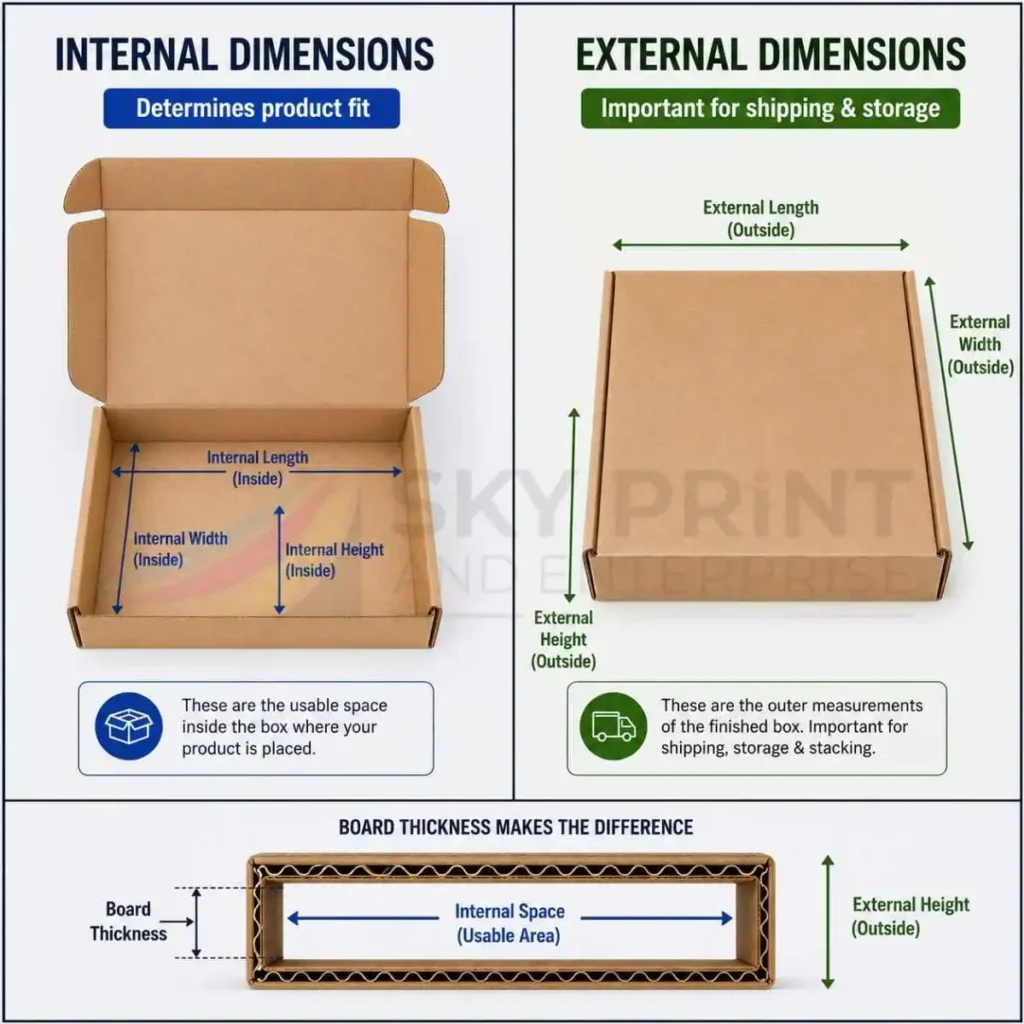
In commercial packaging, internal dimensions describe the usable space available inside the box. These measurements determine whether the product, protective insert, or multiple items fit comfortably without excessive movement. Sky Print & Enterprise considers these measurements carefully when developing custom packaging to ensure a precise fit.
External dimensions, however, measure the overall size of the assembled box, including the thickness of the packaging material. Consequently, the external size is always slightly larger than the internal size, especially when thicker materials such as corrugated board or rigid board are used.
Understanding Internal Packaging Dimensions – Packaging Size Guide
Manufacturers generally begin every packaging project by measuring the product rather than the box itself. They record the product’s length, width and height before adding the necessary clearance for easy insertion, protective cushioning and manufacturing tolerances. As a result, the calculated internal dimensions become the starting point for the structural packaging design.
For example, a premium perfume bottle measuring 70 × 40 × 140 mm cannot simply be placed inside a box of identical dimensions. Instead, the structural designer normally adds several millimetres of clearance to allow for smooth assembly and safe product removal. If the packaging includes foam inserts, cardboard partitions or moulded pulp trays, additional space must also be included. Consequently, accurate internal dimensions improve product protection while creating a more professional unboxing experience.
Why Internal Measurements Matter Most – Packaging Size Guide
Businesses should always provide product dimensions rather than estimated box sizes when requesting quotations from a packaging manufacturer. This allows structural designers to calculate the most suitable internal measurements based on the packaging material, box style and intended use. Furthermore, manufacturers can optimise material usage, reduce waste and improve production efficiency because they work from accurate product data instead of assumptions.
Whether you are designing perfume boxes, custom cake boxes or custom mailer boxes, correctly calculated internal dimensions ensure that products fit securely while maintaining the appearance and quality expected by customers.
Packaging Size Guide: How to Measure Length, Width and Height Correctly
Accurately measuring packaging dimensions is the foundation of every successful packaging project. Even a beautifully designed box with premium printing and luxury finishes cannot perform well if its measurements are incorrect. Therefore, professional packaging manufacturers follow a consistent measuring method before producing structural designs, packaging artwork or cutting dies. Whether you are ordering folding cartons, rigid boxes or corrugated shipping cartons, using the correct measuring sequence helps prevent manufacturing errors and ensures the finished packaging fits the product precisely.
The standard method used throughout the packaging industry is Length × Width × Height (L × W × H). Although this format is recognised worldwide, many customers accidentally reverse the measurements or measure the assembled box from the wrong angle. Consequently, suppliers may manufacture packaging that differs from what the customer expected. Taking a few minutes to measure correctly can save considerable time, money and production delays later in the project.
The Standard Method for Measuring Packaging Dimensions – Packaging Size Guide
Begin by placing the product or assembled box on a flat surface with the opening facing upwards. The length is always the longest side of the opening, while the width is the shorter side. Finally, measure the height from the bottom of the box to the top edge. Recording dimensions in this sequence creates consistency between designers, manufacturers and commercial printers, reducing the risk of confusion during production.
When measuring products instead of finished packaging, use the same approach. Measure the longest side first, followed by the shorter side and finally the overall height. If the product has irregular shapes, protruding parts or delicate components, measure the maximum dimensions rather than the average size. Furthermore, remember to allow sufficient clearance for inserts, protective cushioning or wrapping materials where necessary. This approach ensures the product fits comfortably without creating excessive empty space inside the box.
Many businesses also forget that packaging materials occupy physical space. A rigid box manufactured from thick greyboard requires more material than a lightweight folding carton, so the external dimensions become larger even when the internal capacity remains the same. Understanding this relationship helps businesses compare quotations accurately and avoid misunderstandings during production.
Common Measuring Mistakes and How to Avoid Them – Packaging Size Guide
One of the most common mistakes is estimating dimensions instead of measuring the actual product. Even a difference of three or four millimetres can affect the structural design, particularly for luxury packaging or products that require a snug fit. Therefore, always measure the final product, including lids, caps, protective wrapping or accessories, before requesting a quotation.
Another frequent error is confusing centimetres with millimetres. Professional packaging manufacturers generally work in millimetres because this provides greater accuracy during structural design and die-making. Consequently, businesses should specify the measurement unit clearly whenever they send product dimensions or packaging specifications.
It is equally important to measure products after they have been fully assembled. For example, a perfume bottle should be measured with its cap fitted, while a honey jar should include the lid. Likewise, food packaging such as custom pizza boxes or burger boxes should be sized according to the finished product rather than the individual ingredients. These practical considerations help manufacturers create packaging that protects products effectively while presenting them professionally.
Best Practices Before Sending Measurements to Your Manufacturer
Before approving any packaging design, double-check every measurement and confirm whether the dimensions represent the product, the internal box size or the finished external dimensions. Additionally, include details about inserts, promotional leaflets, tissue paper or protective materials that will be placed inside the packaging. Sharing complete information enables the structural design team to recommend the most suitable box style, board grade and manufacturing method.
If you are uncertain about the correct measurements, ask your packaging supplier to prepare a structural sample before full production begins. A prototype allows you to test the fit, evaluate the presentation and identify potential issues before investing in printing and manufacturing. Consequently, businesses minimise costly revisions while achieving packaging that performs well throughout production, distribution and the customer’s unboxing experience.
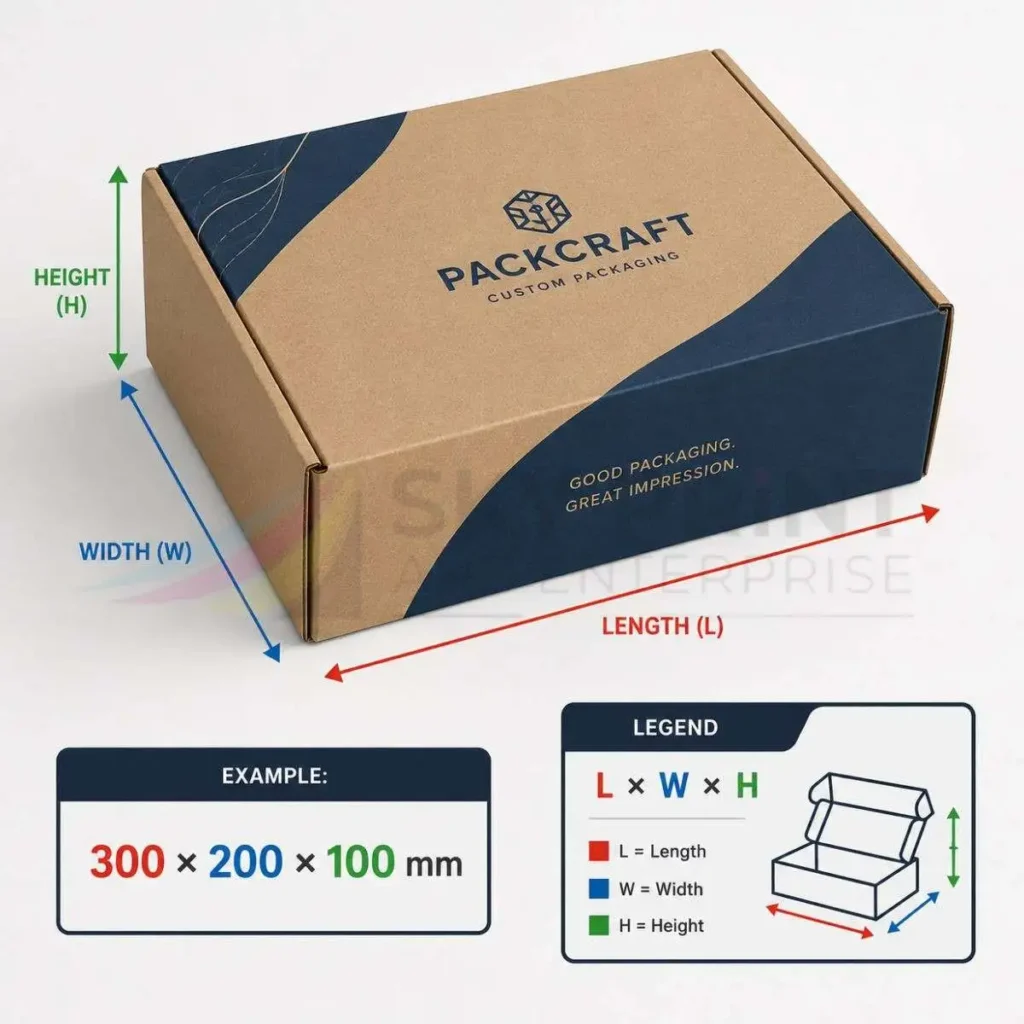
Packaging dimensions are normally specified as length, width and height, giving manufacturers the basic measurements required for box production.
Packaging Size Guide: Standard Packaging Sizes Explained
Many businesses ask whether standard packaging sizes exist for products such as cosmetics, food, electronics or retail gifts. The answer is both yes and no. While the packaging industry uses common box dimensions for many applications, there is no universal size that suits every product. Therefore, manufacturers usually begin with standard structural formats and then customise the dimensions to match the product, branding and production requirements. This approach reduces material waste, improves manufacturing efficiency and creates packaging that protects the product without using unnecessary board.
Standard packaging sizes are particularly useful because they simplify production planning. Die-makers, structural designers and printing companies work with common sheet sizes and machinery, so packaging dimensions that fit these production standards often cost less to manufacture. However, businesses should never choose a box simply because it matches a standard size. Instead, the packaging should always be designed around the product while considering storage, shipping and customer presentation.
Why Standard Box Sizes Are Used – Packaging Size Guide
Manufacturers develop standard packaging sizes after producing thousands of packaging projects across different industries. As a result, many products naturally fall within similar dimensional ranges. Cosmetic cartons, food boxes, presentation boxes and shipping cartons frequently use proven structural layouts because these sizes perform well on commercial printing presses, die-cutting equipment and automatic folding and gluing machines. Consequently, selecting dimensions close to these standards can reduce tooling costs and improve production efficiency.
For example, many retail businesses ordering perfume boxes or face wash packaging begin with common carton proportions before adjusting the dimensions to suit the bottle size. Similarly, food manufacturers producing chocolate packaging, cake boxes or Indian mithai boxes usually follow established structural formats that provide sufficient strength while maintaining an attractive retail appearance.
When Custom Packaging Sizes Are the Better Choice – Packaging Size Guide
Although standard dimensions offer many advantages, they are not always the best solution. Premium products often require bespoke packaging that reflects the brand’s identity while providing a perfect fit. Luxury packaging, promotional gift boxes and subscription packaging frequently include inserts, ribbons, magnetic closures or multiple compartments that cannot be accommodated within standard box dimensions. Therefore, structural designers calculate completely bespoke measurements to ensure every component fits precisely.
Custom packaging also becomes essential when products have unusual shapes or fragile components. For example, businesses manufacturing golf subscription boxes, honey packaging or custom mailer boxes often require dimensions that balance product protection with shipping efficiency. Furthermore, bespoke packaging helps eliminate excessive empty space, reducing transportation costs and improving the customer’s unboxing experience.
Balancing Standardisation with Product Requirements
Professional packaging manufacturers rarely recommend choosing either standard or custom dimensions without first reviewing the product. Instead, they evaluate the product size, weight, fragility, packaging material, production volume and shipping method before suggesting the most suitable dimensions. Consequently, businesses receive packaging that performs efficiently throughout manufacturing while presenting the product professionally in retail stores or during home delivery.
As your product range grows, maintaining consistent packaging proportions across multiple product sizes also strengthens brand recognition. Customers quickly recognise products that share the same structural design language, even when the dimensions vary. Therefore, combining standard manufacturing principles with carefully customised measurements often delivers the best balance between production efficiency, cost control and premium presentation.
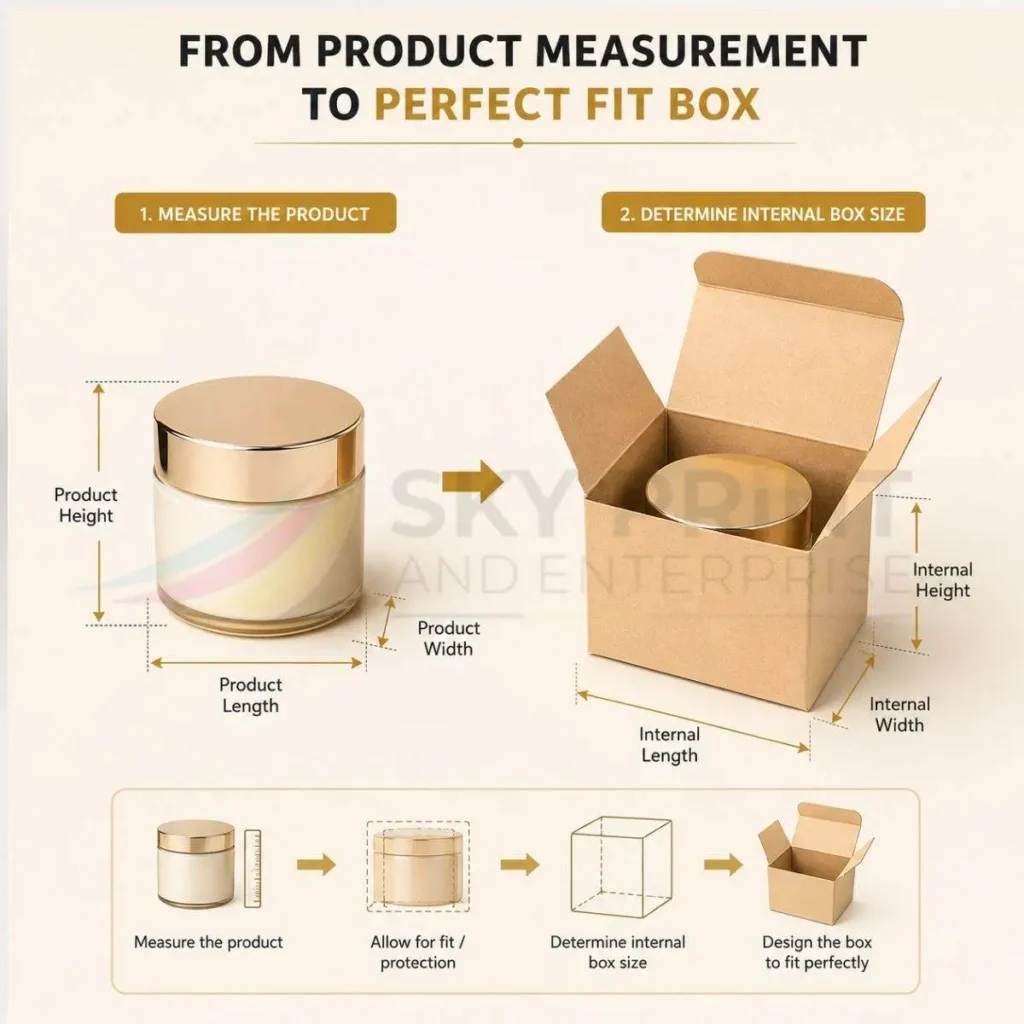
Accurate product measurements provide the starting point for determining the internal dimensions of custom packaging.
Packaging Size Guide: How to Choose the Right Box Size for Your Product
Selecting the correct box size involves much more than measuring the product and adding a few millimetres. Professional packaging manufacturers evaluate the product’s dimensions, weight, fragility, presentation requirements, shipping method and packaging material before recommending the most suitable box. Consequently, choosing the right packaging dimensions improves product protection, reduces material waste and creates a better customer experience. Whether you manufacture cosmetics, food products, electronics or luxury gifts, investing time in selecting the correct box size saves money throughout production and distribution.
Many businesses assume that larger packaging offers better protection. However, oversized boxes often create the opposite effect. Excessive empty space allows products to move during transportation, increasing the risk of scratches, breakages and damaged corners. Furthermore, larger packaging consumes more board, increases shipping costs and reduces warehouse efficiency. Therefore, the goal should always be to achieve the smallest practical box without compromising product safety or presentation.
Start with the Product, Not the Packaging
Professional structural designers always begin by measuring the finished product, including lids, caps, labels, shrink wrapping and any accessories supplied inside the box. They then determine whether the product requires protective inserts, tissue paper, foam, cardboard partitions or instruction leaflets. These additional components influence the internal dimensions and should always be considered before the structural design begins.
For example, a custom beard balm box requires only a small amount of clearance around the container, whereas a custom cake box must provide additional space to protect decorative icing during transport. Similarly, a presentation folder should accommodate printed documents comfortably without bending the edges. Every product therefore requires its own structural approach rather than relying on standard dimensions.
💡 Manufacturer’s Tip
Measure the finished product exactly as your customer will receive it. Include caps, sleeves, protective wrapping, promotional inserts and accessories before calculating the packaging dimensions.
Consider Protection, Storage and Shipping Together
Packaging dimensions should support the entire supply chain rather than simply fitting the product. Manufacturers consider pallet sizes, courier restrictions, stacking strength and warehouse storage before approving the structural design. Consequently, even small dimensional changes can reduce shipping costs and improve logistics efficiency when products are manufactured in large quantities.
E-commerce packaging provides an excellent example. A custom mailer box should fit the product securely while remaining compact enough to reduce courier charges. Likewise, food packaging such as pizza boxes, burger boxes and sandwich boxes must protect the contents without affecting freshness, presentation or ease of handling.
✓ Quick Checklist Before Choosing a Box Size – Packaging Size Guide
- Measure the finished product accurately.
- Allow clearance for easy insertion and removal.
- Include space for inserts, leaflets or accessories.
- Consider the thickness of the packaging material.
- Review shipping and pallet requirements.
- Check retail display and shelf dimensions.
- Request a structural sample before mass production.
Balance Product Protection with Brand Presentation
Excellent packaging should protect the product while reinforcing your brand image. Luxury products often benefit from close-fitting packaging because it creates a premium unboxing experience, whereas fragile products require additional clearance for protective inserts. Consequently, the correct packaging dimensions depend upon both functional and marketing objectives rather than measurements alone.
Businesses producing perfume boxes, chocolate packaging or gift boxes frequently invest in structural samples before approving production. This allows them to evaluate product fit, customer presentation and manufacturing practicality before commercial printing begins. Although prototypes add a small amount to the development process, they often prevent expensive production errors and deliver a far better finished product.
📦 Industry Example
A premium perfume box may require only 2–3 mm of internal clearance to create a luxury presentation. In contrast, a honey jar or decorated celebration cake requires considerably more space to accommodate protective inserts and prevent damage during transport. Choosing the correct packaging size therefore depends on both the product and its intended use.
Packaging Size Guide: Retail Packaging Dimensions and Shelf Considerations
Retail packaging must do much more than simply contain a product. It should attract attention, fit neatly on shelves, stack efficiently in warehouses and provide customers with a positive shopping experience. Therefore, when developing retail packaging dimensions, manufacturers consider not only the product size but also retail display requirements, merchandising strategies and transportation efficiency. A well-proportioned box enhances product visibility while reducing wasted shelf space and shipping costs.
Although every retailer has different display systems, products that are consistent in size are generally easier to stock, organise and replenish. Consequently, businesses should design packaging dimensions with retail environments in mind instead of focusing solely on manufacturing. This approach improves operational efficiency while presenting products professionally across supermarkets, boutiques, pharmacies and department stores.
Design Packaging for Retail Shelves
Retail shelves have limited space, making packaging dimensions an important commercial decision. Oversized boxes reduce the number of products displayed, while packaging that is too small may disappear amongst competing brands. Therefore, structural designers carefully balance visibility, branding and practicality when determining the final box size.
Products packaging at eye level particularly benefit from consistent dimensions because they create an organised appearance and improve shelf impact. Luxury products often use slightly taller packaging to increase visibility, whereas everyday consumer goods generally prioritise efficient shelf utilisation. Understanding where your product will be sold helps determine the most effective packaging proportions.
🏪 Retail Example
A premium perfume box may be designed taller than competing products to improve visibility, while a chocolate box is often designed to maximise the number of units displayed on a retail shelf.
Maintain Consistent Dimensions Across Product Ranges – Packaging Size Guide
Many successful brands use a consistent packaging structure across multiple product variants. Instead of creating completely different box sizes, they maintain similar proportions while adjusting only the height or width where necessary. As a result, products appear visually connected, strengthening brand recognition and improving merchandising.
For example, cosmetic brands frequently use matching structural designs for cleansers, moisturisers and serums, even though the products have different capacities. Likewise, confectionery companies often develop coordinated packaging for chocolates, sweets and gift assortments. This consistency makes retail displays look more professional while simplifying production and inventory management.
💡 Best Practice
Where possible, create a packaging family with consistent widths or depths. This improves shelf presentation, simplifies manufacturing and strengthens your overall brand identity.
Consider Retail Handling and Customer Convenience
Packaging dimensions should also make products easy to handle. Customers should be able to pick up the product comfortably, while retail staff should find it easy to stack, replenish and transport. Therefore, designers consider ergonomic handling alongside visual appearance when finalising the structural design.
Products such as face wash boxes, beard balm packaging and customised diaries should fit naturally in customers’ hands while remaining stable on display shelves. Even small improvements to packaging proportions can enhance usability and encourage purchasing decisions.
✓ Retail Packaging Checklist
- Optimise dimensions for shelf visibility.
- Maintain consistent sizing across product ranges.
- Consider customer handling and ergonomics.
- Reduce unnecessary empty space.
- Ensure packaging stacks securely.
- Confirm dimensions with retailers where required.
- Prototype the packaging before full production.
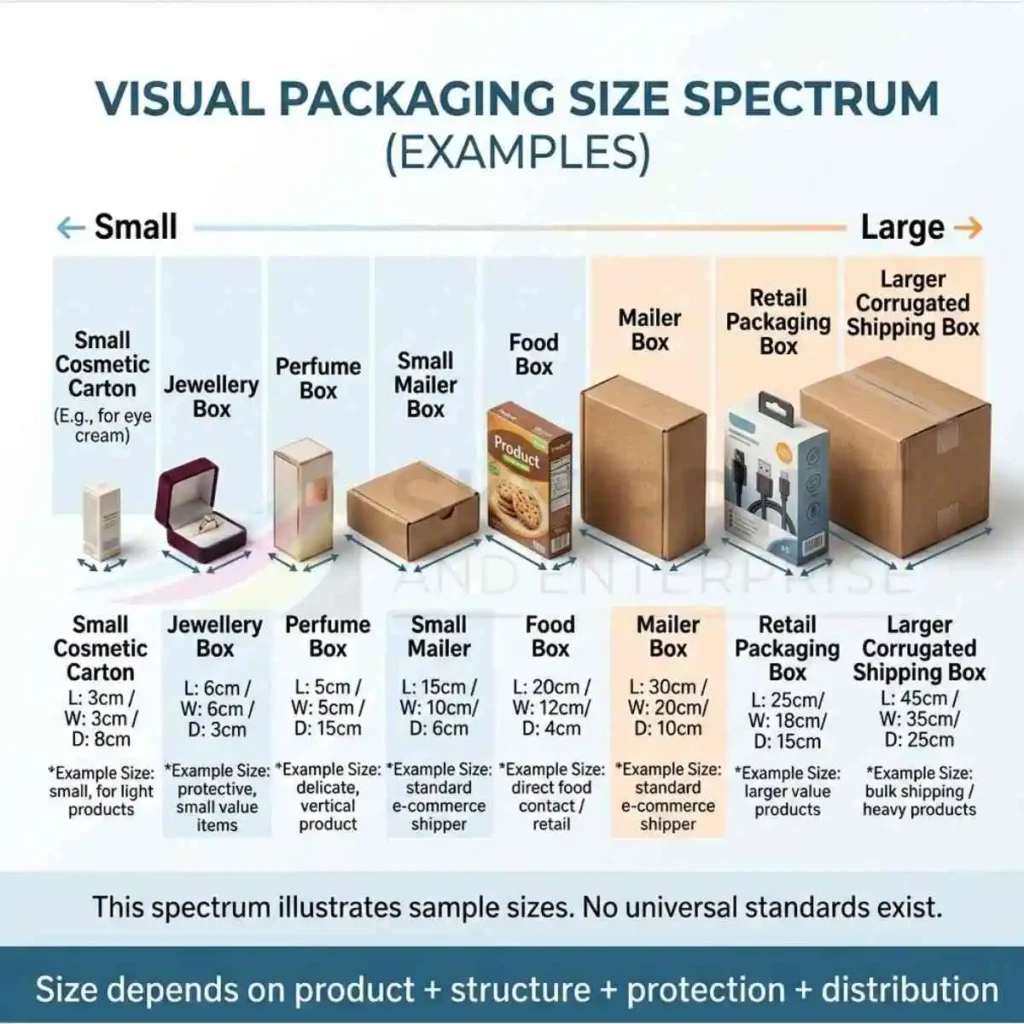
Packaging dimensions vary according to the product, box structure, protection requirements and distribution channel.
Packaging Size Guide: Packaging Dimensions for Different Industries
Every industry has unique packaging requirements because products differ in size, weight, fragility and customer expectations. Therefore, there is no universal packaging dimension that suits every application. A cosmetic box, for example, requires very different proportions from a shipping carton or a food container. Professional packaging manufacturers evaluate the product, intended use and supply chain before recommending suitable dimensions.
Choosing industry-appropriate packaging dimensions improves product protection, reduces production waste and enhances customer satisfaction. Moreover, it ensures that packaging performs efficiently during manufacturing, warehousing, transportation and retail display.
📦 Why Industry Standards Matter
Different industries follow different packaging practices. Food packaging prioritises hygiene, cosmetic packaging focuses on presentation, while e-commerce packaging concentrates on shipping performance. Selecting the correct dimensions therefore depends on the product’s purpose rather than appearance alone.
Food Packaging Dimensions
Food packaging must provide enough internal space to protect the contents without allowing unnecessary movement. Manufacturers also consider ventilation, grease resistance, stacking strength and transportation requirements. Consequently, structural dimensions vary according to the type of food being packaged.
Products such as custom pizza boxes, burger boxes, fish and chip boxes, sandwich boxes and custom cake boxes all require different internal clearances based on the food they contain. Even small adjustments to height or width can improve product protection and customer convenience.
Cosmetic Packaging Dimensions
Cosmetic packaging usually aims for a close-fitting, premium appearance. Boxes should securely hold bottles, tubes or jars while maintaining elegant proportions. Excessive empty space often reduces the perceived quality of luxury products, whereas overly tight packaging may damage labels or decorative finishes.
Packaging for perfume boxes, face wash boxes and beard balm boxes frequently includes cardboard inserts or rigid supports that influence the final internal dimensions. Therefore, manufacturers calculate both product clearance and insert thickness before producing the dieline.
📊 Typical Packaging Priorities by Industry
| Material | Typical Thickness | Dimension Impact |
|---|---|---|
| Food | Product protection | Internal clearance |
| Cosmetics | Luxury presentation | Close-fitting structure |
| Retail | Shelf visibility | Consistent proportions |
| E-commerce | Shipping efficiency | External dimensions |
E-commerce and Shipping Packaging Dimensions – Packaging Size Guide
Shipping packaging requires a balance between durability and cost efficiency. Oversized boxes increase courier charges, whereas undersized packaging may damage products during transport. Consequently, structural designers minimise unused space while ensuring sufficient room for protective materials such as paper cushioning, foam inserts or corrugated partitions.
Businesses using custom mailer boxes or subscription packaging often optimise dimensions to reduce volumetric shipping costs. Even a small reduction in box size can produce significant savings across thousands of deliveries each year.
✅ Key Takeaways
- Every industry requires different packaging dimensions.
- Food packaging prioritises protection and hygiene.
- Luxury packaging focuses on presentation and fit.
- E-commerce packaging aims to minimise shipping costs.
- Always design packaging around the product, not the other way round.
Packaging Size Guide: How Material Thickness Affects Packaging Dimensions
Many businesses measure their product accurately but still receive packaging that feels either too tight or slightly oversized. In most cases, the issue is not the product measurement itself but the packaging material. Cardboard, kraft board, corrugated board and rigid board all have different thicknesses. Therefore, professional packaging manufacturers always consider material thickness when calculating the final structural dimensions.
Ignoring board thickness may appear insignificant; however, even one or two millimetres can affect product fit, especially for luxury packaging, cosmetics and rigid boxes. Consequently, experienced structural designers calculate both the internal and external dimensions before producing the dieline or beginning commercial production.
📏 Manufacturer’s Insight
A folding carton made from 350gsm cardboard may increase the external dimensions by less than one millimetre. However, a rigid box manufactured from 2 mm greyboard can increase the overall dimensions by several millimetres. Therefore, structural calculations should always be completed before artwork is prepared.
Different Packaging Materials Create Different Dimensions
Every packaging material behaves differently during converting and assembly. Lightweight folding cartons maintain relatively small tolerances, whereas corrugated and rigid packaging require additional allowances because of their greater thickness. Furthermore, laminated finishes, foam inserts and internal partitions can all affect the usable space inside the box.
For example, businesses ordering custom mailer boxes generally prioritise shipping strength, while luxury perfume boxes often use rigid board to create a premium feel. Although both products may hold similar-sized items, their external dimensions can differ considerably because the packaging materials are completely different.
📊 Material Comparison
| Material | Typical Thickness | Dimension Impact |
|---|---|---|
| Cardboard | Low | Minimal |
| Kraft Board | Low–Medium | Small |
| Corrugated Board | Medium–High | Noticeable |
| Rigid Board | High | Significant |
Choose Dimensions Based on the Final Packaging Construction
Structural designers never calculate packaging dimensions using product measurements alone. Instead, they evaluate the complete packaging construction, including board thickness, inserts, protective materials, laminations and assembly methods. As a result, the finished packaging protects the product while remaining easy to manufacture and assemble.
This approach is particularly important for products such as chocolate packaging, honey packaging and presentation folders, where both presentation and structural accuracy are essential.
✅ Best Practice Checklist – Packaging Size Guide
- Measure the finished product accurately.
- Choose the packaging material first.
- Allow for board thickness.
- Include inserts and protective components.
- Confirm both internal and external dimensions.
- Approve a structural prototype before production.
Packaging Size Guide: Common Packaging Dimension Mistakes to Avoid
Even experienced businesses occasionally make mistakes when specifying packaging dimensions. Although these errors may appear minor during the planning stage, they often result in production delays, increased costs and packaging that fails to perform as expected. Therefore, understanding the most common sizing mistakes helps businesses achieve better results while avoiding unnecessary revisions during manufacturing.
Professional packaging manufacturers review every structural design before production begins. However, accurate information from the customer remains essential because the structural engineer can only design packaging using the measurements and specifications provided. Consequently, spending extra time checking dimensions before artwork preparation usually prevents expensive corrections later.
⚠️ Common Mistake
Many businesses send approximate product measurements rather than measuring the finished product. Even a small error of 2–3 mm can affect structural fitting, particularly for luxury packaging, cosmetic cartons and rigid boxes.
Ignoring Internal Clearance
One of the most frequent mistakes is designing packaging around the exact product dimensions without allowing sufficient clearance. Products rarely slide perfectly into a box that matches their measurements exactly. Instead, manufacturers add appropriate tolerance to allow easy assembly, safe product removal and room for protective components.
For example, a perfume box may require only a few millimetres of clearance, whereas a honey packaging box needs additional space for protective inserts and safe transportation.
Choosing Oversized Packaging
Some businesses intentionally choose larger boxes because they believe additional space provides better protection. In reality, oversized packaging often allows products to move during transport, increasing the likelihood of scratches, dents and breakages. Furthermore, larger boxes consume more board, increase courier charges and reduce pallet efficiency.
Instead, structural designers aim to achieve the smallest practical dimensions while maintaining adequate protection. This approach improves sustainability, reduces production costs and creates a more premium customer experience.
📊 Mistakes vs Best Practices – Packaging Size Guide
| Common Mistake | Recommended Practice |
|---|---|
| Using estimated measurements | Measure the finished product accurately |
| Ignoring inserts | Include all internal components |
| Oversized packaging | Optimise internal dimensions |
| No prototype | Approve a structural sample first |
Skipping Structural Prototypes
Another costly mistake is approving commercial production without testing a structural sample. A prototype allows businesses to confirm product fit, evaluate customer presentation and identify design issues before printing begins. Consequently, manufacturers can refine the packaging dimensions without wasting materials or delaying production.
Whether you are producing custom mailer boxes, chocolate packaging or presentation folders, a structural sample remains one of the most valuable investments during packaging development.
✅ Key Takeaways – Packaging Size Guide
- Measure the finished product, not the prototype.
- Allow suitable internal clearance.
- Include inserts and protective materials.
- Avoid unnecessarily large packaging.
- Always test a structural prototype before production.
Packaging Size Guide: Optimising Packaging Dimensions for Cost, Protection and Sustainability
Choosing the correct packaging dimensions is not only about ensuring that a product fits inside a box. Professional manufacturers optimise every millimetre to balance production costs, shipping efficiency, product protection and customer presentation. Consequently, well-designed packaging saves money throughout the supply chain while creating a better experience for retailers and customers alike.
Many businesses focus on reducing the unit price of packaging. However, experienced packaging engineers understand that the overall cost depends on much more than the price of the box itself. Material consumption, pallet utilisation, courier charges, warehouse space and production efficiency all depend upon selecting the correct packaging dimensions from the beginning.
⭐ Expert Recommendation
The most economical box is rarely the smallest or the largest. Instead, it is the box that protects the product efficiently while using the minimum amount of material and shipping space.
Smaller Packaging Can Deliver Bigger Savings – Packaging Size Guide
Reducing a box by only a few millimetres may appear insignificant. Nevertheless, when thousands of units are manufactured, even a small reduction can decrease board consumption, reduce transport costs and improve pallet efficiency. Therefore, structural designers constantly optimise packaging dimensions without compromising product safety.
For example, businesses producing custom mailer boxes frequently reduce unnecessary void space because courier charges often depend upon parcel dimensions. Likewise, compact catalogue packaging and presentation folders minimise storage requirements while improving handling efficiency.
💰 Where Businesses Save Money
| Optimisation | Business Benefit |
|---|---|
| Reduce unnecessary box size | Lower board consumption |
| Improve pallet layout | Lower transport costs |
| Better product fit | Less damage and fewer returns |
| Optimise warehouse storage | Higher operational efficiency |
Optimise Dimensions Without Reducing Protection – Packaging Size Guide
Although compact packaging offers many advantages, reducing dimensions excessively can create problems. Products require sufficient clearance for safe insertion, protective materials and comfortable removal by the customer. Consequently, manufacturers calculate structural tolerances rather than simply making every box as small as possible.
Luxury products such as perfume boxes and beard balm packaging often require foam inserts or premium cardboard supports. Similarly, honey packaging and fragile food products benefit from additional protective spacing during transportation. The ideal packaging dimensions therefore balance presentation with product safety.
📈 Packaging Optimisation Workflow
Measure Product
Select Material
Add Clearance
Create Prototype
Mass Production
Think Beyond the Packaging Itself – Packaging Size Guide
Successful packaging design considers the complete product journey rather than focusing solely on manufacturing. The dimensions should support warehouse storage, courier handling, retail shelving and the customer’s unboxing experience. Therefore, structural packaging should always be evaluated as part of the wider supply chain instead of being treated as an isolated component.
🎯 Remember These Five Principles
- Optimise dimensions instead of simply reducing them.
- Balance product protection with material efficiency.
- Consider shipping, warehousing and retail display together.
- Prototype before approving commercial production.
- Design packaging around the customer’s experience.
Packaging Size Guide: Shipping, Palletisation and Warehouse Dimension Planning
Packaging dimensions influence far more than the appearance of a product. Once manufacturing is complete, every box moves through warehouses, distribution centres, courier networks and retail stores before reaching the customer. Therefore, professional packaging engineers design packaging that performs efficiently throughout the entire supply chain rather than focusing solely on the product itself.
Businesses that optimise packaging dimensions for logistics often reduce transportation costs, improve warehouse utilisation and minimise product damage. Consequently, considering shipping and pallet dimensions during the design stage usually delivers significant long-term savings.
🚚 Supply Chain Insight
The most successful packaging is not simply attractive—it moves efficiently through warehouses, fits neatly onto pallets, stacks safely during transport and reaches customers without damage.
Why Shipping Dimensions Matter
Courier companies increasingly calculate charges using volumetric weight rather than product weight alone. As a result, unnecessarily large packaging can increase shipping costs even when the product itself is lightweight. Reducing external dimensions by only a few millimetres may allow more products to fit onto each pallet or inside each delivery vehicle, lowering logistics costs across every order.
Businesses shipping custom mailer boxes, printed catalogues or customised diaries frequently benefit from dimensional optimisation because these products are distributed in large quantities. Better packaging dimensions therefore improve both profitability and operational efficiency.
📦 Benefits of Optimised Shipping Dimensions
💰 Lower Courier Costs
Reduce volumetric weight and improve delivery efficiency.
📦 Better Pallet Usage
Fit more units onto every pallet with less wasted space.
🛡 Better Protection
Reduce product movement during transportation.
♻️ Less Material Waste
Use only the board required for safe packaging.
Plan Packaging Around Pallet Dimensions
Professional manufacturers rarely design packaging in isolation. Instead, they calculate how individual boxes will fit together on standard pallets before approving production. Efficient pallet layouts improve warehouse storage, simplify inventory management and reduce transportation costs. Furthermore, uniform packaging dimensions create more stable pallet loads, decreasing the likelihood of damage during distribution.
Whether manufacturing chocolate packaging, cake boxes or honey packaging, considering pallet efficiency at the design stage can generate substantial savings over the lifetime of a product.
📊 Dimension Planning Priorities – Packaging Size Guide
| Supply Chain Stage | Dimension Objective |
|---|---|
| Manufacturing | Efficient die-cutting and material usage |
| Warehousing | Maximum storage capacity |
| Transportation | Lower freight and courier costs |
| Retail Display | Easy shelving and attractive presentation |
Warehouse Efficiency Begins with Packaging Design
Well-planned packaging dimensions make warehouse operations faster, safer and more organised. Uniform box sizes simplify stacking, improve picking accuracy and maximise storage capacity. Consequently, businesses spend less time handling products while reducing the risk of damaged inventory.
Companies that invest in intelligent structural packaging design often experience benefits far beyond manufacturing. Optimised packaging supports every stage of the supply chain, from production and shipping to retail display and customer delivery, making it a valuable long-term investment rather than simply a packaging decision.
🎯 Logistics Checklist
- Optimise external dimensions before production.
- Review pallet layouts during structural design.
- Reduce unused internal space wherever possible.
- Consider courier dimensional weight charges.
- Design packaging for efficient warehouse storage.
- Prototype and test before commercial production.
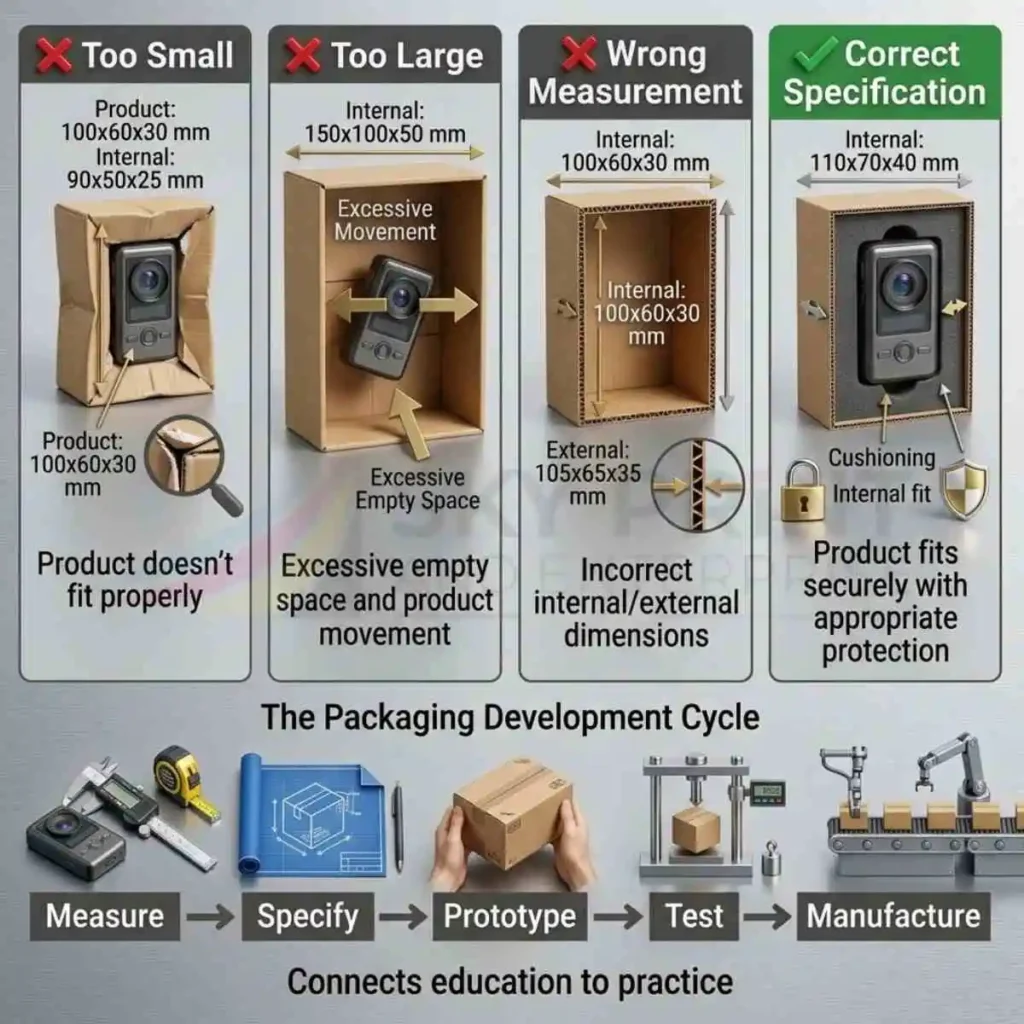
Correct packaging dimensions provide an appropriate fit while avoiding excessive movement, wasted space and manufacturing problems.
Packaging Size Guide: How to Choose the Correct Box Size Every Time
Selecting the correct packaging size is one of the most important decisions during product development. A well-designed box protects the product, improves customer satisfaction and reduces manufacturing costs. Conversely, choosing incorrect packaging dimensions can increase material consumption, create shipping problems and damage your brand image. Therefore, businesses should follow a structured process rather than relying on estimates or standard box sizes.
Professional packaging manufacturers begin with the product itself before considering materials, inserts, printing requirements and transportation. Consequently, every successful packaging project starts with accurate measurements and careful planning rather than choosing a box from an existing catalogue.
🎯 Packaging Engineer’s Advice – Packaging Size Guide
Never ask, “What box size do I need?”
Instead ask,
“What dimensions will protect my product while keeping manufacturing, shipping and storage as efficient as possible?”
That single change in thinking leads to much better packaging.
Step 1 – Measure the Finished Product
Always measure the final product exactly as it will be packed. Include lids, caps, sleeves, labels, protective wrapping and every accessory supplied to the customer. Many packaging problems begin because businesses measure only the primary product and forget additional components that require internal space.
For example, a face wash box may also contain an information leaflet, while a perfume box often includes a rigid insert. These additional items influence the final internal dimensions and should always be included before the structural design begins.
📐 The Professional Measurement Workflow
Measure Product
Add Accessories
Add Clearance
Approve Prototype
Step 2 – Select the Correct Packaging Material
Once the product dimensions are confirmed, manufacturers select the most appropriate packaging material. The choice depends upon product weight, presentation requirements, shipping conditions and sustainability objectives. Because every material has a different thickness, it directly affects both the internal and external dimensions of the finished packaging.
Luxury products generally use rigid board, whereas e-commerce packaging commonly relies on corrugated materials. Retail cartons often use folding boxboard to balance appearance and cost. Selecting the correct material before finalising dimensions therefore prevents costly redesigns later.
⚖️ Compare Before You Decide – Packaging Size Guide
📦 Smaller Box
- ✓ Lower shipping costs
- ✓ Less material
- ✓ Better pallet efficiency
- ✓ More sustainable
📦 Larger Box
- ✓ More internal space
- ✓ Easier to insert products
- ⚠ Higher courier costs
- ⚠ More board consumption
Step 3 – Test Before Manufacturing
Even after accurate calculations, professional manufacturers produce a structural prototype before commercial production. Testing allows businesses to confirm product fit, evaluate customer experience and identify improvements before investing in large production quantities. Consequently, prototyping remains one of the simplest ways to reduce manufacturing risk.
Whether producing cake boxes, chocolate packaging, mailer boxes or presentation folders, testing the packaging before commercial printing almost always saves both time and money.
🏁 Final Decision Checklist
Packaging Size Guide: Expert Recommendations for Choosing the Right Packaging Dimensions
Choosing the correct packaging dimensions requires more than measuring a product with a ruler. Successful packaging combines structural engineering, material selection, manufacturing efficiency and customer experience into one carefully planned solution. Therefore, businesses should evaluate every packaging project from multiple perspectives rather than focusing on dimensions alone.
Professional packaging manufacturers consider the complete product journey, including production, warehousing, transportation, retail display and unboxing. Consequently, well-planned packaging dimensions improve operational efficiency while strengthening your brand image.
👨🏭 Packaging Engineer’s Advice
The best packaging dimensions are not the smallest or the largest. They are the dimensions that protect the product, minimise waste, optimise logistics and create an outstanding customer experience.
Choose Packaging Based on Product Requirements
Different products require different structural solutions. Heavy products demand stronger materials, luxury products benefit from premium presentation and food products require packaging that supports hygiene and safe transportation. Therefore, selecting packaging dimensions should always begin with understanding how the product will be used, transported and presented.
📦 Packaging Decision Guide
🍕 Food Packaging
Prioritise product protection, ventilation where required and efficient stacking.
💄 Cosmetic Packaging
Create close-fitting dimensions with premium inserts and luxury finishes.
📬 E-commerce Packaging
Reduce unused space to lower courier costs while protecting products.
🎁 Luxury Packaging
Balance elegant presentation with structural strength and precise tolerances.
Think About the Entire Supply Chain
Effective packaging dimensions support every stage of the product journey. Manufacturing becomes more efficient, warehouse storage improves, shipping costs decrease and customers receive products in excellent condition. Furthermore, consistent packaging sizes simplify inventory management and create a more professional appearance across your product range.
Whether you require custom mailer boxes, pizza boxes, perfume boxes, cake boxes or chocolate packaging, choosing the correct dimensions from the beginning helps avoid unnecessary costs later.
🧭 Packaging Selection Roadmap
Measure Product
Select Material
Optimise Dimensions
Create Prototype
Manufacture
✅ Expert Checklist Before Ordering Packaging
- Measure the finished product, including accessories.
- Select the most suitable packaging material.
- Allow appropriate internal clearance.
- Optimise external dimensions for shipping and storage.
- Approve a structural prototype.
- Confirm artwork and production specifications.
- Test packaging before large-scale manufacturing.
Packaging Size Guide: International Packaging Standards and Dimension Requirements
Businesses selling products across multiple countries quickly discover that packaging dimensions involve more than simply measuring a product. Different regions have their own manufacturing practices, logistics systems, pallet sizes, courier requirements and retail expectations. Therefore, packaging dimensions that perform well in one market may require adjustments before they are suitable for another.
Professional packaging manufacturers evaluate both the destination market and the distribution network before recommending structural dimensions. Consequently, businesses planning to supply retailers, wholesalers or distributors internationally should consider packaging standards during the earliest stages of product development rather than after production has begun.
🌍 Global Manufacturing Insight
Successful international packaging is designed for the entire supply chain. The best packaging dimensions work efficiently during manufacturing, shipping, warehousing, customs handling, retail display and final customer delivery.
Why International Packaging Standards Matter
As businesses expand into international markets, packaging must comply with different transportation methods, warehouse systems and customer expectations. Although the product itself may remain unchanged, the packaging dimensions often require careful refinement to maximise efficiency throughout the supply chain. Furthermore, correctly planned packaging helps reduce freight costs while improving pallet utilisation and stock management.
For example, companies exporting custom mailer boxes, catalogues or perfume packaging frequently optimise external dimensions to improve container loading and international courier performance.
🌎 Packaging Dimension Considerations by Market – Packaging Size Guide
| Market | Primary Focus | Dimension Consideration |
|---|---|---|
| United Kingdom | Retail presentation | Efficient pallet storage |
| European Union | Cross-border logistics | Consistent transport dimensions |
| United States | Courier optimisation | Volumetric shipping efficiency |
| International Export | Product protection | Container utilisation |
Metric and Imperial Measurements
One of the most common challenges in international packaging is the difference between metric and imperial measurements. Most European manufacturers produce packaging using millimetres, whereas some international buyers continue to provide dimensions in inches. Therefore, accurate conversion is essential before creating structural drawings or packaging dielines.
Professional manufacturers normally standardise all production drawings in millimetres because this provides greater precision during die-cutting, printing and finishing. Consequently, businesses should confirm measurement units before approving artwork or structural designs to avoid costly manufacturing errors.
📌 Best Practice for International Orders
📐 Use Millimetres
Maintain consistent engineering measurements throughout production.
🚚 Plan for Shipping
Consider courier, pallet and container dimensions before manufacturing.
📦 Test Prototypes
Approve structural samples before international production begins.
Design Packaging for Global Supply Chains – Packaging Size Guide
Modern packaging rarely remains within a single country. Products often move between manufacturers, fulfilment centres, distributors and retailers before reaching customers. Therefore, packaging dimensions should support efficient handling at every stage of the supply chain rather than focusing solely on the manufacturing process.
Whether producing pizza boxes, chocolate packaging, cake boxes or honey packaging, internationally optimised packaging dimensions improve efficiency, reduce logistics costs and strengthen customer satisfaction across global markets.
✅ International Packaging Checklist
- Use consistent metric measurements throughout production.
- Review destination market requirements before manufacturing.
- Optimise packaging dimensions for pallets and containers.
- Consider volumetric shipping charges.
- Approve international prototypes before commercial production.
- Ensure packaging performs throughout the complete supply chain.
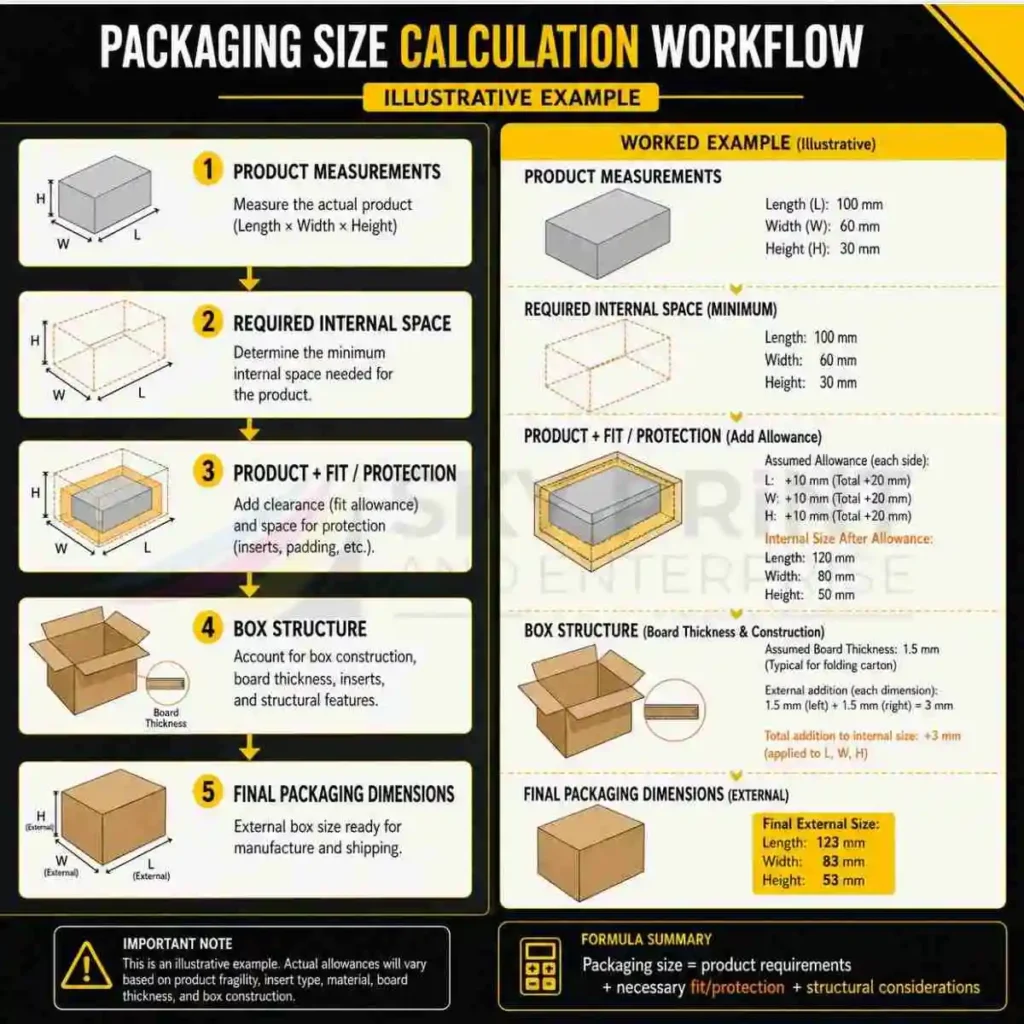
Packaging dimensions are developed by combining product measurements with fit, protection, structural and manufacturing requirements.
Packaging Size Guide: How to Calculate Packaging Dimensions Like a Professional
One of the most common questions manufacturers receive is, “How large should my packaging be?” Although there is no universal answer, professional packaging engineers follow a structured calculation process rather than relying on estimates. By understanding how internal dimensions, material thickness and protective clearance work together, businesses can produce packaging that protects products while reducing unnecessary manufacturing and shipping costs.
Whether you manufacture food packaging, luxury retail boxes or e-commerce mailers, accurate dimension calculations help improve product protection, reduce wasted board and create a better customer experience. Furthermore, calculating packaging dimensions correctly at the beginning prevents expensive redesigns later in the production process.
📐 Professional Packaging Formula
Correct packaging dimensions are calculated by measuring the finished product, allowing suitable internal clearance, selecting the appropriate packaging material and then determining the final external dimensions after accounting for board thickness.
Step 1 – Measure the Finished Product
Begin by measuring the complete product exactly as the customer will receive it. Include accessories, labels, sleeves, instruction booklets and protective wrapping where applicable. Businesses producing perfume boxes, face wash packaging and honey packaging frequently discover that these additional components influence the final internal dimensions.
Step 2 – Add Internal Clearance
After measuring the product, allow sufficient clearance so that it can be inserted and removed comfortably without damaging either the product or the packaging. However, excessive clearance creates unnecessary movement during transportation. Therefore, experienced packaging designers strike a balance between ease of use and product protection.
🧮 Packaging Calculation Workflow
Measure Product
Add Clearance
Select Material
Calculate External Size
Approve Prototype
Step 3 – Select the Packaging Material
Material selection directly affects the finished dimensions because different boards have different thicknesses. For example, corrugated packaging occupies more space than folding boxboard, while rigid board produces considerably thicker walls. Consequently, packaging dimensions should never be finalised until the material specification has been confirmed.
If you are unsure which substrate is most appropriate, explore our material resources covering cardboard packaging, kraft packaging materials, corrugated cardboard and rigid box materials. These guides explain how different materials influence strength, durability and overall packaging dimensions.
📊 Typical Dimension Adjustments
| Material | Impact on Dimensions | Best For |
|---|---|---|
| Folding Boxboard | Minimal increase | Retail packaging |
| Corrugated Board | Moderate increase | Shipping boxes |
| Rigid Board | Largest increase | Luxury packaging |
Step 4 – Verify the Final Dimensions
Before approving commercial production, compare the calculated dimensions with the finished prototype. Check product fit, opening performance, stacking ability and transportation efficiency. Businesses manufacturing custom mailer boxes, pizza boxes, burger boxes and presentation folders often identify small improvements during this stage that significantly enhance production efficiency.
Finally, review whether the chosen dimensions suit your product category. For example, businesses in the food industry may wish to explore our Food Packaging Boxes, while cosmetic brands can compare options in our Cosmetic Packaging Boxes collection. Likewise, retailers shipping products directly to consumers may benefit from solutions within our Retail Packaging Boxes range.
✅ Professional Dimension Calculation Checklist
- Measure the complete product, including accessories.
- Add only the clearance required for safe insertion and removal.
- Select the packaging material before confirming dimensions.
- Calculate both internal and external measurements.
- Review shipping, storage and pallet efficiency.
- Approve a physical prototype before mass production.
- Consult an experienced packaging manufacturer whenever dimensions are critical.
Packaging Size Guide: Common Packaging Dimension Problems and How to Solve Them
Even carefully designed packaging can develop problems if dimensions are not calculated correctly. Products may move during transport, lids may fail to close properly or shipping costs may increase unnecessarily because the packaging is larger than required. Fortunately, most of these issues can be prevented during the design stage by reviewing structural dimensions, material selection and manufacturing tolerances before production begins.
Professional packaging manufacturers treat packaging as an engineering process rather than simply producing boxes. Consequently, they analyse every stage of the supply chain to identify potential problems before commercial production starts. Whether you manufacture food packaging, retail cartons or luxury rigid boxes, solving these issues early saves considerable time and money.
⚠ Packaging Engineer’s Rule
If the packaging problem appears during production, it is usually expensive to fix. If it is identified during structural design, it is usually inexpensive to correct. Therefore, prototype testing should never be skipped.
Problem 1 – The Product Moves Inside the Box
Excessive movement is one of the most common packaging problems. When too much empty space exists inside the packaging, products can shift during transportation, increasing the risk of scratches, breakage and poor presentation. Furthermore, movement creates a disappointing unboxing experience because the product no longer appears premium.
🔧 Recommended Solution
- Reduce internal clearance.
- Add a custom insert where appropriate.
- Review the product measurements.
- Select a more suitable box style.
This issue frequently occurs with perfume boxes, cosmetic packaging and gift boxes because premium presentation requires minimal product movement.
Problem 2 – Packaging Is Larger Than Necessary
Oversized packaging wastes material, increases shipping charges and occupies valuable warehouse space. Although larger boxes may appear safer, they often require additional void fill while increasing transportation costs. Therefore, manufacturers should optimise dimensions rather than automatically selecting the next available box size.
Businesses producing custom mailer boxes and companies using retail packaging boxes benefit significantly from compact structural designs because even small dimensional improvements reduce logistics costs across thousands of shipments.
📦 Compare the Two Approaches
❌ Oversized Packaging
- Higher courier costs
- More board consumption
- Additional void fill
- Poor pallet utilisation
✅ Optimised Packaging
- Lower shipping costs
- Less material waste
- Improved protection
- Higher storage efficiency
Problem 3 – The Lid Does Not Close Properly
Boxes that fail to close correctly usually indicate incorrect internal measurements or insufficient allowance for board thickness. Additionally, oversized inserts and poorly positioned products can prevent the lid from closing completely. Therefore, manufacturers should always evaluate structural prototypes before approving production.
This issue commonly affects cake boxes, mithai boxes and premium gift packaging where presentation is equally important as protection.
Problem 4 – Packaging Fails During Transportation
Sometimes the box dimensions are correct, yet products still arrive damaged. In many cases the real issue is material selection rather than sizing. Heavy products require stronger substrates, while fragile products often benefit from structural inserts or corrugated protection. Consequently, packaging dimensions should always be evaluated alongside material specifications.
If your products require greater strength, compare solutions available through our Corrugated Cardboard Material, Rigid Box Material and Packaging Materials UK services before finalising production.
🛠 Packaging Problem Decision Guide
📦
Product Moves?
Reduce clearance or add inserts.
🚚
Shipping Costs High?
Optimise external dimensions.
📏
Lid Won’t Close?
Review measurements and board thickness.
🛡
Product Damaged?
Upgrade material and internal protection.
✅ Prevent Problems Before Production
- Measure every finished product accurately.
- Select the correct packaging material.
- Optimise both internal and external dimensions.
- Test prototypes under realistic handling conditions.
- Review shipping, storage and retail display requirements.
- Approve structural and printed samples before mass production.
- Work with an experienced packaging manufacturer to minimise production risks.
Packaging Size Guide: Packaging Standards, Compliance and Manufacturing Best Practices
Selecting the correct packaging dimensions is only one part of creating successful packaging. Businesses must also ensure that their packaging complies with industry expectations, manufacturing tolerances, transportation requirements and retail handling practices. Therefore, professional packaging manufacturers evaluate every project from both an engineering and commercial perspective before production begins. This approach improves consistency, reduces production issues and helps businesses deliver products safely to customers.
Whether you manufacture food cartons, cosmetic packaging, retail boxes or luxury rigid packaging, following recognised manufacturing best practices helps minimise waste while improving production efficiency. Consequently, businesses that invest time in structural planning generally experience fewer packaging failures and lower long-term production costs.
🏭 Professional Manufacturing Advice
Good packaging dimensions do not happen by accident. They result from accurate measurements, appropriate materials, structural testing and careful quality control throughout the manufacturing process.
Understand Manufacturing Tolerances
Every manufacturing process includes acceptable dimensional tolerances. Although modern die-cutting equipment delivers exceptional accuracy, paperboard and corrugated materials naturally expand and contract depending on humidity, storage conditions and production methods. Therefore, experienced packaging engineers always include suitable manufacturing tolerances when preparing structural drawings.
Ignoring these tolerances can create problems during folding, gluing and product assembly. Conversely, allowing realistic production tolerances ensures that packaging performs consistently throughout large production runs.
📋 Best Practice During Production
📐 Accurate Measurements
Always measure finished products before creating packaging.
📄 Material Selection
Choose board strength before finalising dimensions.
🧪 Prototype Testing
Verify fit before mass production begins.
Choose Materials That Match the Product
Packaging dimensions should always be considered alongside the selected packaging material. Lightweight retail cartons, for example, require different structural calculations from heavy-duty corrugated shipping boxes. Likewise, rigid boxes require thicker board than folding cartons, which influences both internal and external dimensions. Consequently, material selection directly affects manufacturing accuracy and packaging performance.
Businesses comparing materials can explore our dedicated services for Cardboard Packaging Material, Kraft Packaging Material, Corrugated Cardboard Material and Rigid Box Material. Each material offers different advantages depending on the product, distribution method and required level of protection.
Packaging Standards Across Different Industries
Different industries apply different priorities when determining packaging dimensions. Food manufacturers generally focus on hygiene, stackability and efficient transportation. Cosmetic brands prioritise presentation and precision, whereas e-commerce businesses often seek the smallest practical dimensions to reduce shipping costs. Therefore, understanding the expectations of your industry helps you select the most appropriate packaging solution.
🏷 Industry Packaging Priorities
| Industry | Primary Objective | Recommended Packaging |
|---|---|---|
| Food | Protection & hygiene | Food Packaging Boxes |
| Cosmetics | Luxury presentation | Cosmetic Packaging |
| Retail | Shelf appeal | Retail Packaging |
| Luxury Gifts | Premium experience | Luxury Packaging |
Quality Control Before Commercial Production
Professional packaging manufacturers inspect structural samples before beginning commercial production. During this stage they verify dimensions, folding performance, glue accuracy, insert fit and overall product presentation. Furthermore, sample approval allows businesses to identify improvements before committing to large production quantities.
For example, manufacturers producing cake boxes, chocolate packaging, pizza boxes or catalogues routinely review structural samples before final production to ensure every dimension performs as expected.
✅ Manufacturing Quality Checklist
- Confirm all product measurements before production.
- Verify internal and external packaging dimensions.
- Choose the correct packaging material.
- Review manufacturing tolerances.
- Approve structural prototypes.
- Inspect printed samples before mass production.
- Carry out quality checks throughout the production run.
- Evaluate packaging performance after shipping.
Packaging Size Guide: Frequently Asked Questions
Choosing the correct packaging dimensions often raises practical questions about measurements, materials, shipping and manufacturing. Below are answers to some of the most frequently asked questions from businesses looking to develop custom packaging.
1. How do I calculate the correct packaging size?
Measure the finished product first, including accessories, labels and protective wrapping. Then add only the clearance required for safe insertion before selecting the appropriate packaging material and creating a structural prototype.
2. Should I measure internal or external box dimensions?
Packaging designers always begin with the required internal dimensions because these determine whether the product fits correctly. External dimensions are then calculated after considering the board thickness and structural design.
3. How much clearance should I leave inside a box?
The ideal clearance depends on the product, packaging style and material. Fragile products generally require more protective space, whereas luxury retail packaging usually benefits from tighter tolerances for a premium presentation.
4. Why is my product moving inside the packaging?
Movement usually indicates excessive internal clearance or a lack of structural inserts. Reducing unused space or adding a custom insert normally resolves the issue.
5. Does packaging material affect the finished dimensions?
Yes. Corrugated board, rigid board, kraft board and folding boxboard all have different thicknesses. Therefore, material selection directly influences the external dimensions of the finished packaging.
6. Which measurement unit should I use?
Professional packaging manufacturers normally work in millimetres because they provide greater accuracy during structural design, die-cutting and production.
7. Why do packaging manufacturers ask for product dimensions first?
The product determines every structural decision. Without accurate product dimensions, it is impossible to calculate the correct packaging size or prepare an accurate dieline.
8. Can one box size fit multiple products?
Sometimes, although it depends on the size variation between products. If several products differ significantly, custom inserts or alternative box sizes generally provide better protection and presentation.
💡 Expert Tip
Always measure the finished product rather than the individual component. Even small accessories, labels or inserts can change the required packaging dimensions and affect production accuracy.
9. Why is prototype testing important?
A prototype allows you to confirm fit, appearance, structural strength and customer experience before investing in commercial production. Consequently, it helps prevent costly manufacturing mistakes.
10. How do I reduce shipping costs through packaging?
Optimising external dimensions, eliminating unnecessary empty space and selecting appropriate packaging materials all help reduce courier charges and improve pallet efficiency.
11. Which packaging material is best for heavy products?
Heavy products generally benefit from stronger materials such as corrugated cardboard or rigid board. The most suitable option depends on the product weight, transportation method and presentation requirements.
12. Can packaging dimensions affect customer experience?
Absolutely. Well-designed packaging improves presentation, protects the product and creates a smoother unboxing experience. Conversely, oversized or poorly fitting packaging can reduce customer satisfaction.
13. Should packaging be designed before artwork?
Yes. Structural dimensions and the dieline should always be approved before artwork is created. This ensures the printed design aligns correctly with folds, glue flaps and cut lines.
14. Why do luxury boxes have tighter tolerances?
Luxury packaging aims to create a premium presentation. Smaller internal clearances reduce product movement while improving the overall appearance and perceived quality.
15. Can Sky Print and Enterprise help with packaging dimensions?
Yes. At Sky Print and Enterprise, we help businesses determine suitable packaging dimensions, recommend appropriate materials, prepare structural designs and manufacture high-quality custom packaging for retail, food, cosmetics, e-commerce and many other industries.
More Frequently Asked Questions – Packaging Size Guide
Every packaging project has unique requirements. The following questions address additional concerns regarding packaging dimensions, manufacturing, shipping and material selection.
16. What happens if my packaging is too small?
Packaging that is too small can damage the product during assembly, distort the box shape and make it difficult for customers to remove the product safely. Therefore, manufacturers should always allow suitable internal clearance before production.
17. What happens if my packaging is too large?
Oversized packaging increases board usage, shipping costs and warehouse space requirements. It can also allow products to move during transport, increasing the likelihood of damage.
18. Should inserts be included when calculating box dimensions?
Yes. Inserts occupy internal space and must always be considered before finalising packaging dimensions. Ignoring insert thickness may result in an incorrect fit.
19. Do printed finishes affect packaging dimensions?
Most decorative finishes such as lamination, foil stamping and embossing have minimal influence on box size. However, they should still be considered during production planning to ensure consistent quality.
20. Which industries require the most accurate packaging dimensions?
Cosmetics, pharmaceuticals, electronics, food products, luxury goods and retail packaging all rely on highly accurate dimensions because presentation, protection and production efficiency are equally important.
21. Can one packaging design be produced using different materials?
Often, yes. However, changing from folding boxboard to corrugated board or rigid board usually requires adjustments to structural dimensions because material thickness differs significantly.
📌 Quick Reminder
- Measure twice.
- Prototype once.
- Approve before production.
22. Why are prototypes recommended before bulk production?
A prototype allows you to inspect dimensions, structural strength, artwork positioning and product fit before manufacturing large quantities. Consequently, prototypes reduce risk while improving final quality.
23. Which packaging is best for e-commerce deliveries?
Strong corrugated mailer boxes remain one of the most popular solutions because they protect products while keeping shipping dimensions compact. You can explore our Custom Mailer Boxes for e-commerce applications.
24. How do I choose the right packaging material?
The product’s weight, fragility, presentation requirements and shipping method all influence material selection. You can compare available options through our Packaging Materials UK service or explore our dedicated guides for cardboard, kraft, corrugated and rigid materials.
25. Are custom packaging dimensions more expensive than standard sizes?
Not necessarily. Although custom tooling may involve an initial investment, correctly sized packaging often reduces material waste, shipping costs and product damage, making it more economical over time.
26. Which products benefit most from custom packaging?
Luxury cosmetics, food products, subscription boxes, electronics, jewellery, apparel and promotional products all benefit from packaging designed specifically around their dimensions.
27. Can packaging dimensions improve sustainability?
Yes. Optimised packaging dimensions reduce unnecessary material usage, minimise transport emissions and improve pallet efficiency. Consequently, well-designed packaging supports both environmental and commercial objectives.
28. Should packaging dimensions be reviewed for international shipping?
Absolutely. International transportation introduces additional handling stages and shipping methods. Reviewing packaging dimensions beforehand helps improve container utilisation and reduces logistics costs.
29. How often should packaging dimensions be reviewed?
Packaging dimensions should be reviewed whenever the product changes, new materials are introduced or shipping requirements evolve. Regular evaluations help maintain consistent quality and operational efficiency.
30. Where can I get professional advice on custom packaging sizes?
If you need expert assistance, Sky Print and Enterprise can help you determine suitable packaging dimensions, recommend appropriate materials and manufacture bespoke packaging for food, cosmetics, retail, e-commerce, luxury products and many other industries. You can also explore our packaging services, browse our Boxes by Style collection or discover solutions within our Retail Packaging and Food Packaging categories.
Final Thoughts on Choosing the Right Packaging Size
Choosing the correct packaging dimensions involves far more than measuring a product and selecting a box. Successful packaging combines accurate measurements, appropriate materials, structural engineering, manufacturing expertise and practical logistics planning. When these elements work together, businesses benefit from lower shipping costs, improved product protection, more efficient production and a stronger customer experience.
Throughout this Packaging Size Guide, we have explored how to measure different products, calculate packaging dimensions, select suitable materials, avoid common mistakes and apply industry best practices. Whether you require packaging for cosmetics, food, retail products, e-commerce or luxury brands, following these principles will help you achieve consistent, professional results.
Why Choose Sky Print and Enterprise?
- ✔ Custom packaging manufactured to your exact dimensions.
- ✔ Expert advice on structural design and material selection.
- ✔ Premium cardboard, kraft, corrugated and rigid packaging solutions.
- ✔ Luxury finishing options for retail and branded packaging.
- ✔ Low and high-volume manufacturing.
- ✔ UK-based service with international production capability.
To learn more about our capabilities, explore our Packaging Services, compare our Packaging Materials, browse our Boxes by Style, or discover bespoke solutions across our Cosmetic Packaging, Food Packaging, Jewellery Packaging and Apparel Packaging collections.