
Packaging Quality Testing Guide: Why Quality Testing Is the Foundation of Successful Packaging
Packaging Quality Testing Guide begins with one simple principle: every packaging product should protect, present and perform exactly as intended. Whether you manufacture folding cartons, corrugated boxes, rigid boxes, paper bags or commercial printed products, consistent quality testing reduces defects before they become expensive business problems. Therefore, professional testing is no longer optional. Instead, it has become an essential part of modern packaging manufacturing, procurement and brand management.
Moreover, packaging quality extends far beyond visual appearance. A beautifully printed box may still fail if the board strength is inadequate, the adhesive bond weakens during transit or the colours vary between production batches. Consequently, manufacturers, procurement managers and brand owners rely on structured testing procedures to verify that every packaging component meets predefined quality standards before mass production begins.
Throughout this Packaging Quality Testing Guide, you’ll discover how leading manufacturers evaluate materials, print quality, structural performance, finishing accuracy and transportation durability. Furthermore, you’ll learn how systematic quality control protects brand reputation, reduces waste and improves customer satisfaction while lowering long-term production costs.
High-performing packaging is never achieved by chance. Instead, it results from carefully controlled testing procedures that verify material quality, manufacturing consistency, print accuracy and structural performance before products reach customers.
Why Every Packaging Project Requires Quality Verification
Every packaging project carries unique performance requirements. For example, food packaging must protect freshness, cosmetic packaging must preserve premium shelf appeal, while e-commerce packaging must withstand demanding distribution networks. Likewise, luxury packaging requires exceptional finishing quality because even small imperfections can affect customer perception.
Because of these differences, manufacturers establish quality checkpoints throughout production rather than inspecting finished cartons alone. As a result, potential defects are identified earlier, corrective action becomes easier and production efficiency improves considerably. Meanwhile, procurement teams gain greater confidence that every delivery will satisfy agreed specifications.
Reduced production errors through consistent inspection procedures.
Consistent packaging strengthens customer confidence and protects brand identity.
Packaging Quality Testing Guide: What You’ll Learn Throughout This Guide
This Packaging Quality Testing Guide explains every major quality testing stage used within professional packaging manufacturing. In addition, each section focuses on practical decision-making rather than theory alone. Therefore, you’ll understand not only what should be tested but also why each inspection directly influences packaging performance, production efficiency and customer satisfaction.
| Guide Area | Primary Objective |
|---|---|
| Material Quality Testing | Verify board, paper and substrate performance before production. |
| Print & Finish Inspection | Maintain colour consistency, registration and premium finishing quality. |
| Performance Testing | Confirm packaging strength throughout storage, handling and transportation. |
- Understand the purpose of the Packaging Quality Testing Guide.
- Recognise why quality testing protects products and brands.
- Learn how structured inspection improves manufacturing consistency.
- Prepare for the detailed testing methods covered in the following sections.
Section Summary: The Packaging Quality Testing Guide provides the foundation for producing reliable, consistent and commercially successful packaging. Therefore, every packaging project should begin with clearly defined quality standards rather than relying solely on final inspection. In the next section, we’ll explore how professional manufacturers evaluate packaging materials before production and why material testing determines the long-term success of every packaging solution.
Guide Navigation
Packaging Quality Testing Guide
Jump directly to any section of the guide.
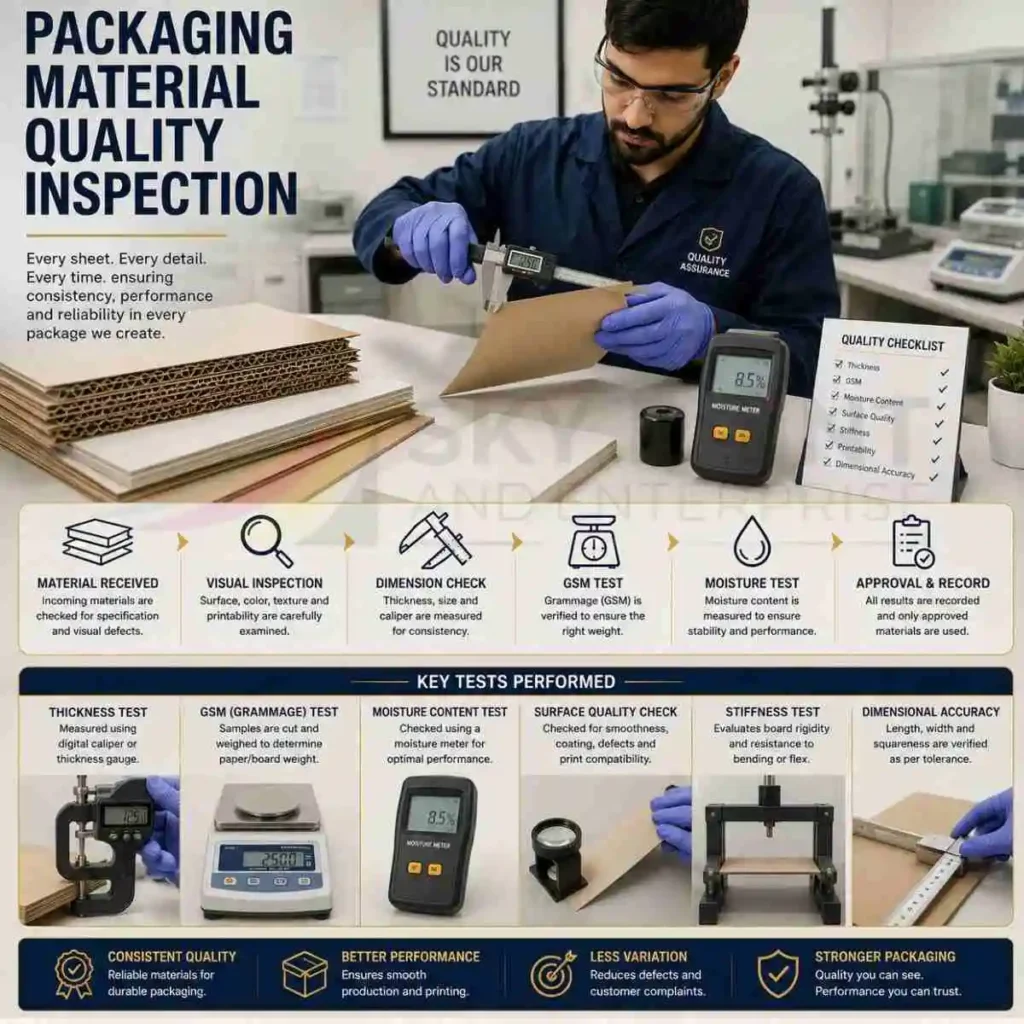
Packaging materials are inspected for thickness, GSM, moisture and surface quality before production.
Packaging Quality Testing Guide: Material Quality Testing Before Production
Packaging Quality Testing Guide places material inspection at the beginning of every successful packaging project because the finished product can never outperform the raw materials used to manufacture it. Therefore, professional packaging manufacturers carefully examine paperboard, kraft board, corrugated board, rigid board and speciality substrates before production starts. Although modern printing presses and converting equipment are highly advanced, poor-quality materials still lead to structural failures, inconsistent printing and unnecessary production waste.
Moreover, early material testing reduces manufacturing risks while improving production efficiency. Consequently, procurement managers can approve materials with confidence, production teams experience fewer interruptions, and brand owners receive packaging that performs consistently across every production batch. Instead of reacting to defects after manufacturing, quality-focused companies prevent them before they occur.
Every packaging material has unique mechanical properties. Therefore, manufacturers should never assume that two boards with the same GSM will deliver identical strength, stiffness or print performance. Laboratory testing confirms the actual performance before production begins.
Key Material Properties That Require Verification
Professional material inspection evaluates several characteristics simultaneously because packaging performance depends on the interaction of multiple properties rather than a single measurement. For example, board thickness influences rigidity, while fibre composition affects folding performance and print quality. Likewise, moisture content directly impacts dimensional stability, die-cutting accuracy and glue adhesion.
Furthermore, manufacturers compare incoming materials against approved specifications to ensure every delivery meets the same quality standards. As a result, production remains consistent, colour reproduction improves and converting equipment operates more efficiently throughout the manufacturing process.
Board thickness, GSM, stiffness, moisture content and dimensional accuracy.
Surface smoothness, coating quality, ink absorption and colour consistency.
Compression strength, tear resistance and fold durability during converting.
Businesses selecting packaging substrates should also understand the differences between available materials. Therefore, reviewing the Packaging Materials service page helps procurement teams compare suitable options before requesting quotations or approving production specifications.
Common Material Defects Found During Inspection
Material testing identifies problems that are often invisible during a basic visual inspection. However, specialised measuring equipment quickly detects variations that could compromise production quality. Because of this, manufacturers perform incoming quality control before releasing materials to the factory floor.
| Inspection Area | Potential Issue | Production Impact |
|---|---|---|
| Board Thickness | Inconsistent caliper | Poor folding and inaccurate die-cutting. |
| Moisture Content | Excess humidity | Warping, curling and unstable dimensions. |
| Surface Quality | Uneven coating | Reduced print quality and finishing defects. |
- Verify board GSM and caliper.
- Measure moisture content before production.
- Inspect surface finish and fibre consistency.
- Confirm supplier specifications match approved samples.
- Reject materials showing visible damage or contamination.
Section Summary: The Packaging Quality Testing Guide demonstrates that reliable packaging begins with reliable materials. Therefore, thorough material inspection reduces production waste, improves printing consistency and strengthens structural performance throughout the packaging lifecycle. In the next section, we’ll examine the laboratory testing methods manufacturers use to scientifically evaluate packaging materials before they enter full-scale production.
Packaging Quality Testing Guide: Laboratory Testing Methods for Packaging Materials
Packaging Quality Testing Guide continues with laboratory testing because visual inspections alone cannot accurately predict how packaging will perform during manufacturing, warehousing or distribution. Therefore, professional packaging manufacturers use calibrated laboratory equipment to measure physical, mechanical and environmental properties before approving materials for production. Although a board may appear flawless, scientific testing often reveals weaknesses that could lead to crushing, tearing, colour variation or structural failure later in the supply chain.
Moreover, laboratory testing provides measurable data instead of assumptions. Consequently, procurement managers can compare suppliers objectively, quality teams can establish acceptance criteria and manufacturers can maintain consistent production standards across every batch. As a result, decisions become evidence-based rather than relying solely on experience or appearance.
Industry Best Practice
Leading packaging manufacturers rarely rely on one laboratory test. Instead, they combine multiple performance tests because packaging must withstand printing, die-cutting, gluing, storage, transport and customer handling before reaching its final destination.
Essential Laboratory Tests Used by Manufacturers
Each packaging material requires a different combination of laboratory evaluations. For example, folding cartons typically undergo stiffness, caliper and surface smoothness testing, whereas corrugated packaging also requires compression and burst strength analysis. Likewise, rigid board is evaluated for density, dimensional stability and bonding performance. Furthermore, moisture analysis remains essential because humidity directly affects printing, converting and storage conditions.
Many manufacturers also compare test results against recognised quality standards before approving production. Therefore, laboratory reports become valuable quality records that support consistency across repeat orders and long-term supplier relationships.
Measures material thickness to ensure accurate folding, die-cutting and structural consistency.
Verifies moisture levels to minimise warping, curling and dimensional changes.
Evaluates structural strength for stacking, storage and transportation.
Laboratory Results and Production Decisions
Testing data becomes valuable only when manufacturers apply it during production planning. Consequently, quality engineers review laboratory results before approving materials for printing and converting. If results fall outside the acceptable tolerance range, corrective action can begin immediately instead of allowing defective materials onto the production line. Meanwhile, suppliers receive measurable feedback that supports continuous improvement.
Businesses choosing specialist materials should also compare substrate performance before manufacturing. For example, understanding the characteristics of cardboard packaging materials helps ensure the selected board matches both structural and printing requirements.
| Laboratory Test | Measures | Why It Matters |
|---|---|---|
| Caliper Test | Material thickness | Improves converting accuracy and structural consistency. |
| Burst Strength | Resistance to rupture | Protects products during handling and shipping. |
| Surface Smoothness | Printability | Supports sharp graphics and uniform ink coverage. |
| Moisture Content | Water percentage | Maintains dimensional stability throughout production. |
- Use calibrated laboratory equipment.
- Record measurable test data for every material batch.
- Compare results against approved quality specifications.
- Reject materials outside acceptable tolerances.
- Archive laboratory reports for traceability and future production.
Section Summary: This Packaging Quality Testing Guide shows that laboratory testing transforms quality control from visual judgement into measurable science. Therefore, manufacturers can approve materials with confidence, reduce production risks and achieve repeatable packaging performance. In the next section, we’ll explore board strength testing, including compression, burst and edge crush evaluations that determine whether packaging can withstand real-world handling and transport.
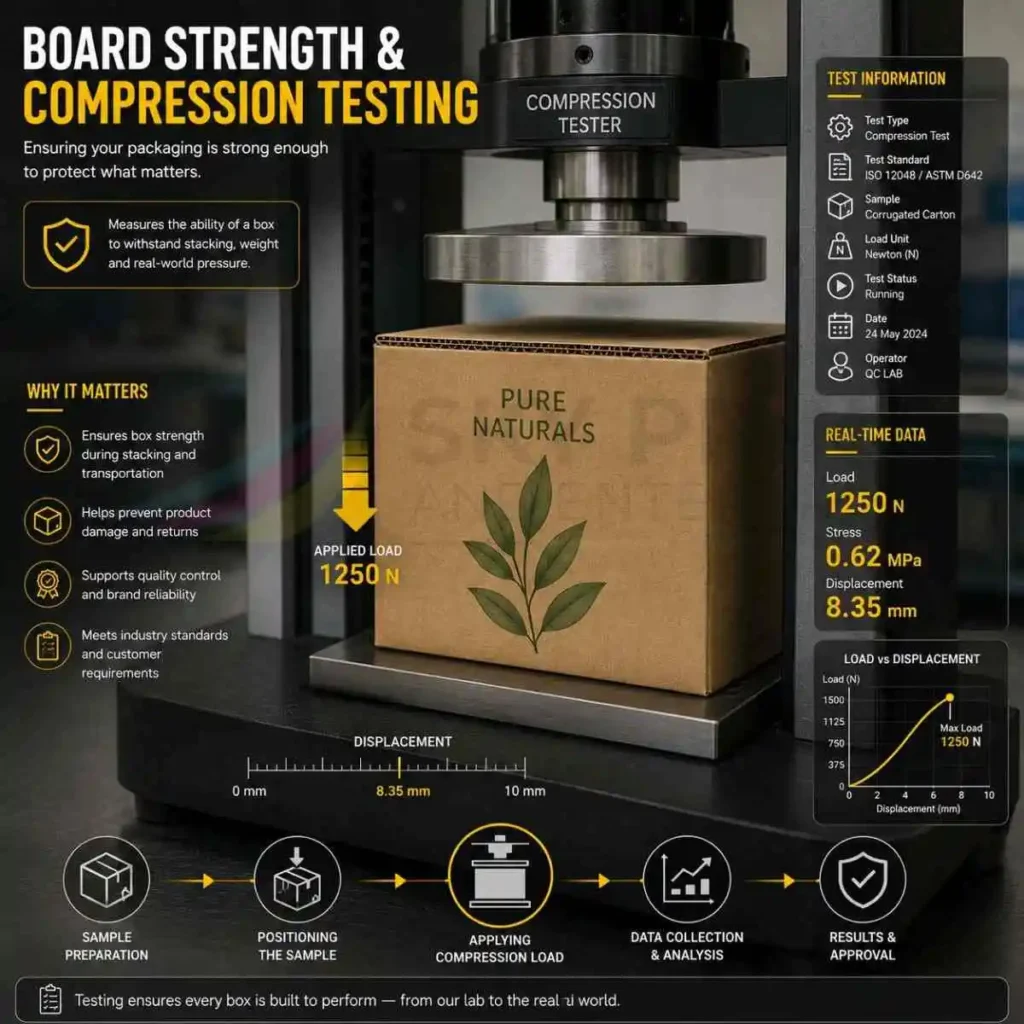
Board strength testing helps determine whether packaging can withstand stacking, handling and transport.
Packaging Quality Testing Guide: Board Strength Testing for Reliable Packaging Performance
Packaging Quality Testing Guide now focuses on one of the most critical stages of quality assurance—board strength testing. Regardless of how attractive the packaging appears, it must withstand manufacturing, filling, stacking, warehousing, transportation and customer handling without losing its structural integrity. Therefore, manufacturers perform specialised strength tests to verify that every packaging material can perform under real operating conditions. Moreover, these tests help prevent costly product damage, rejected shipments and dissatisfied customers.
Although premium graphics influence purchasing decisions, structural performance ultimately determines whether packaging successfully protects its contents. Consequently, board strength testing has become a standard procedure for folding cartons, corrugated boxes, rigid boxes and many other paper-based packaging solutions. Instead of relying on assumptions, manufacturers validate packaging performance using internationally recognised testing methods.
Executive Manufacturing Insight
Strong packaging is not simply thicker packaging. Instead, fibre quality, board construction, flute profile, moisture content and manufacturing accuracy all contribute to the final strength of a carton. Therefore, comprehensive testing always evaluates the complete packaging structure rather than a single characteristic.
The Most Important Board Strength Tests
Professional manufacturers perform several mechanical tests because each measures a different aspect of packaging performance. For example, the Edge Crush Test (ECT) evaluates how well corrugated board withstands vertical compression during stacking. Likewise, the Box Compression Test (BCT) measures the strength of a fully assembled carton under load. Meanwhile, Burst Strength Testing determines how much pressure paperboard can tolerate before rupturing, making it particularly valuable for transport packaging and export applications.
Furthermore, folding endurance, tear resistance and puncture resistance are assessed whenever packaging will experience repeated handling. As a result, manufacturers gain a complete understanding of how the packaging will behave throughout its lifecycle rather than during production alone.
Measures vertical stacking strength for corrugated packaging used in warehouses and logistics.
Evaluates how much weight a completed carton can support before collapsing.
Determines resistance to internal pressure and sudden impact during transport.
Matching Board Strength to the Application
Not every packaging product requires maximum strength. However, every product requires the appropriate level of protection for its intended use. Therefore, manufacturers first evaluate product weight, transportation conditions, storage duration and stacking requirements before selecting suitable materials. Consequently, businesses avoid unnecessary material costs while maintaining dependable packaging performance.
For instance, luxury cosmetic cartons prioritise print quality and presentation, whereas shipping cartons require significantly higher compression performance. Similarly, businesses comparing substrates should understand the advantages of corrugated cardboard materials, especially for products travelling through demanding distribution networks.
| Strength Test | Primary Purpose | Typical Packaging |
|---|---|---|
| Edge Crush Test (ECT) | Stacking strength | Corrugated shipping cartons |
| Box Compression Test | Load-bearing capacity | Distribution and warehouse packaging |
| Burst Strength Test | Resistance to rupture | Paperboard and corrugated packaging |
| Tear Resistance | Handling durability | Retail and consumer packaging |
- Match board grade to the product weight.
- Verify compression strength for storage and stacking.
- Evaluate burst and tear resistance where appropriate.
- Confirm test results meet the approved specification.
- Review performance before authorising full-scale production.
Section Summary: The Packaging Quality Testing Guide demonstrates that board strength testing is fundamental to dependable packaging performance. Therefore, selecting materials based on verified strength data helps manufacturers reduce failures, optimise material usage and deliver packaging that performs consistently from production to final delivery. In the next section, we’ll examine moisture content testing and environmental conditioning to understand how temperature and humidity influence packaging quality.
Packaging Quality Testing Guide: Moisture Content and Environmental Conditioning
Packaging Quality Testing Guide places significant importance on moisture content because even the highest-quality packaging materials can fail if they absorb or lose excessive moisture. Therefore, professional manufacturers carefully monitor humidity and environmental conditions before, during and after production. Although moisture changes are often invisible to the naked eye, they can dramatically affect board strength, print quality, dimensional accuracy and overall packaging performance.
Moreover, paper-based packaging materials naturally absorb moisture from the surrounding environment. Consequently, manufacturers must stabilise materials under controlled conditions before testing or production begins. Otherwise, laboratory results may become inconsistent, die-cutting accuracy may decrease and folding performance can deteriorate. As a result, environmental conditioning has become a standard practice within modern packaging manufacturing facilities.
Quality Control Insight
Most packaging materials perform best within controlled environmental conditions. Therefore, manufacturers often condition paperboard for at least 24 hours before conducting laboratory tests, ensuring accurate and repeatable quality measurements.
Why Moisture Control Matters in Packaging Manufacturing
Moisture directly influences the physical behaviour of paper fibres. For example, excessive humidity softens fibres, reduces stiffness and increases the likelihood of board deformation. On the other hand, extremely dry conditions may cause brittleness, surface cracking and poor folding characteristics. Likewise, fluctuations in humidity can affect adhesive performance, lamination quality and finishing processes such as foil stamping or embossing.
Furthermore, moisture variations often create dimensional changes that lead to inaccurate die-cutting and registration issues during printing. Because of this, maintaining a stable production environment improves both manufacturing efficiency and product consistency throughout every production run.
Maintains board strength and dimensional accuracy throughout production.
Improves ink adhesion, colour accuracy and registration quality.
Reduces downtime caused by material movement or converting issues.
Environmental Conditioning Before Quality Testing
Environmental conditioning allows packaging materials to reach equilibrium before laboratory testing begins. Consequently, all samples experience identical temperature and humidity conditions, making the test results more reliable and easier to compare. Instead of measuring temporary environmental effects, manufacturers evaluate the true performance characteristics of the material itself.
Likewise, different packaging materials respond differently to moisture. For example, kraft packaging often reacts differently from rigid board or coated paperboard. Therefore, understanding the characteristics of kraft packaging materials helps procurement teams choose substrates that suit both environmental conditions and product requirements.
| Environmental Factor | Potential Effect | Quality Impact |
|---|---|---|
| High Humidity | Board softening | Reduced compression strength and stiffness. |
| Low Humidity | Fibre brittleness | Cracking during folding and converting. |
| Temperature Changes | Material expansion or contraction | Registration and dimensional inconsistencies. |
| Uncontrolled Storage | Variable moisture levels | Unpredictable manufacturing performance. |
- Condition materials before laboratory testing.
- Monitor warehouse humidity regularly.
- Maintain stable production temperatures.
- Protect packaging materials during storage and transport.
- Record environmental conditions alongside quality reports.
Section Summary: The Packaging Quality Testing Guide highlights that environmental control is just as important as material selection. Therefore, managing moisture and conditioning packaging materials before testing improves measurement accuracy, production stability and long-term packaging performance. In the next section, we’ll examine print quality testing, including colour accuracy, registration, ink adhesion and visual inspection methods that ensure consistently high-quality printed packaging.
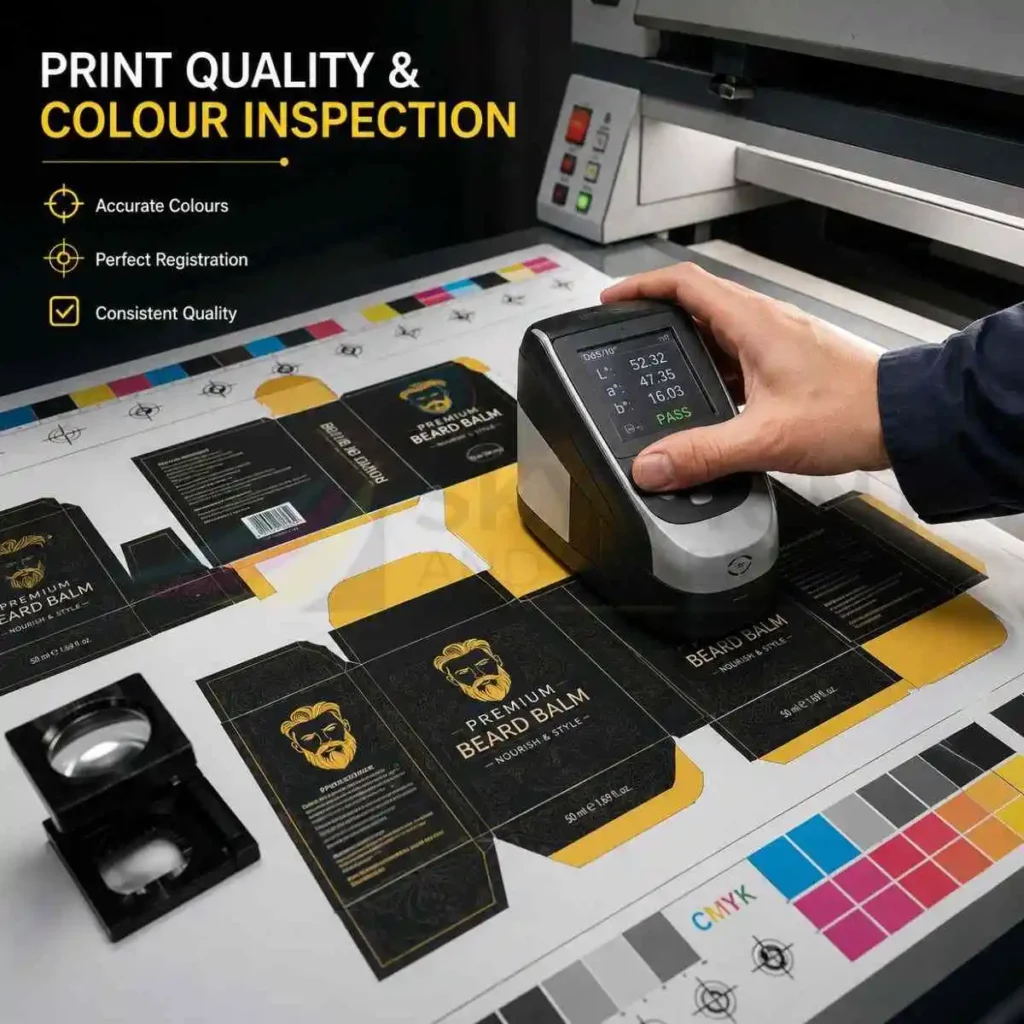
Colour accuracy, registration and print consistency are checked throughout production.
Packaging Quality Testing Guide: Print Quality Testing and Colour Accuracy
Packaging Quality Testing Guide now moves from material performance to one of the most visible aspects of packaging quality—print inspection. Although structural integrity protects the product, printed graphics communicate the brand, influence purchasing decisions and create customer confidence. Therefore, manufacturers must verify that every printed sheet, carton or label meets strict quality standards before production continues. Moreover, consistent print quality prevents expensive reprints, customer complaints and brand inconsistencies across multiple production batches.
Modern packaging buyers expect colours, logos, typography and finishing effects to remain identical regardless of production quantity. Consequently, professional manufacturers combine visual inspections with digital measuring equipment to evaluate every stage of the printing process. As a result, colour consistency, registration accuracy and print sharpness remain within agreed tolerances throughout the production run.
Packaging Quality Testing Guide: Critical Elements of Print Quality Inspection
Print quality testing evaluates much more than colour appearance. For example, inspectors examine image resolution, text clarity, barcode readability, ink density, registration alignment and coating uniformity. Likewise, they verify that every printed sheet matches the approved proof before converting begins. Furthermore, digital spectrophotometers accurately measure colour values, allowing operators to detect even the smallest variation that may be invisible to the human eye.
Because of this scientific approach, manufacturers achieve repeatable colour consistency across repeat orders. Meanwhile, procurement teams receive packaging that accurately represents established brand guidelines, regardless of production volume or printing method.
Maintain consistent CMYK, Pantone or brand colours throughout every production batch.
Ensure every printing plate aligns perfectly to produce crisp text and graphics.
Identify streaks, scuff marks, pinholes, hickeys, ghosting and ink contamination before finishing.
Packaging Quality Testing Guide: Common Print Defects Found During Inspection
Although modern presses deliver exceptional accuracy, quality inspectors continue monitoring production because defects can develop at any stage. Therefore, operators perform scheduled sampling throughout the print run instead of checking only the first sheets. Consequently, production teams can correct issues immediately, reducing waste and maintaining consistent output.
Artwork preparation also contributes significantly to print quality. Therefore, businesses planning bespoke packaging should ensure their files meet professional production standards before manufacturing begins.
| Inspection Area | Typical Defect | Corrective Action |
|---|---|---|
| Colour Matching | Colour variation | Recalibrate ink densities and colour settings. |
| Registration | Misaligned colours | Adjust plate registration before continuing production. |
| Image Quality | Blurred graphics | Inspect plates, blankets and print pressure. |
| Surface Finish | Scuffing or streaking | Review drying, coating and handling procedures. |
- Approve a calibrated colour proof before production.
- Inspect print registration at scheduled intervals.
- Measure colour using calibrated spectrophotometers.
- Check barcodes, QR codes and variable data for readability.
- Reject printed sheets showing visible defects or contamination.
- Record inspection data for future production consistency.
Section Summary: The Packaging Quality Testing Guide demonstrates that exceptional packaging quality depends on consistent print inspection as much as structural strength. Therefore, combining digital measurement with continuous visual inspection ensures every package reflects the intended brand identity while maintaining production efficiency. In the next section, we’ll examine finishing quality testing, including lamination, foil stamping, embossing, varnishes and coating performance.
Packaging Quality Testing Guide: Finishing Quality Testing for Premium Packaging
Packaging Quality Testing Guide continues with finishing quality testing because premium packaging is judged by both its appearance and its tactile experience. Although excellent printing creates visual appeal, finishing techniques determine how customers perceive the product when they first pick it up. Therefore, manufacturers inspect every finishing process carefully to ensure decorative effects remain durable, consistent and free from defects. Moreover, premium finishes often represent a significant proportion of the total packaging cost, making quality verification essential before dispatch.
Whether a project includes matt lamination, gloss lamination, soft-touch coating, spot UV, foil stamping, embossing or debossing, every finish must meet precise production standards. Consequently, manufacturers evaluate adhesion, alignment, surface durability and visual consistency throughout the production process. As a result, luxury packaging maintains its premium appearance from the factory to the retail shelf and finally into the customer’s hands.
Packaging Quality Testing Guide: What Should Be Inspected During Finishing?
Every finishing process introduces unique quality requirements. For example, foil stamping must align perfectly with printed graphics, while embossing should produce crisp and uniform relief without damaging the paper fibres. Likewise, lamination must bond evenly across the sheet without bubbling, peeling or silvering. Furthermore, spot UV coatings require accurate registration because even slight movement can reduce the visual impact of the finished packaging.
Because of these variables, quality inspectors evaluate both the decorative appearance and the physical performance of each finish. Meanwhile, production teams regularly compare finished samples against approved press proofs to maintain consistency throughout the manufacturing run.
Inspect foil adhesion, edge sharpness, colour consistency and accurate registration.
Verify bonding strength, scratch resistance and the absence of bubbling or lifting.
Evaluate depth, pressure consistency and fibre integrity across every impression.
Packaging Quality Testing Guide: Preventing Common Finishing Defects
Professional manufacturers monitor finishing operations continuously because environmental conditions, machine settings and substrate characteristics all influence the final result. Therefore, operators perform routine inspections during production rather than waiting until every carton has been completed. Consequently, defects can be corrected immediately, reducing waste and improving manufacturing efficiency.
Businesses investing in luxury packaging should also understand how different materials interact with decorative finishes. For example, selecting the correct rigid box materials significantly improves embossing definition, foil adhesion and premium presentation.
| Finishing Process | Quality Check | Common Defect |
|---|---|---|
| Matt or Gloss Lamination | Bonding and surface smoothness | Peeling, bubbling or wrinkles |
| Foil Stamping | Registration and adhesion | Misalignment or incomplete transfer |
| Embossing | Depth and pressure consistency | Flattened or cracked impressions |
| Spot UV | Gloss level and positioning | Registration shift or uneven coating |
- Compare every finish with the approved production proof.
- Inspect foil registration under adequate lighting.
- Check lamination for peeling, bubbles and scratches.
- Measure embossing depth across multiple samples.
- Confirm coatings cure completely before packing.
- Protect finished packaging from abrasion during handling and transport.
Section Summary: The Packaging Quality Testing Guide demonstrates that finishing quality directly influences perceived product value and customer satisfaction. Therefore, consistent inspection of decorative processes ensures luxury packaging maintains its premium appearance while remaining durable throughout storage, transportation and retail display. In the next section, we’ll examine dimensional accuracy testing, including die-cutting precision, folding tolerances and assembly verification to ensure every package is manufactured exactly to specification.
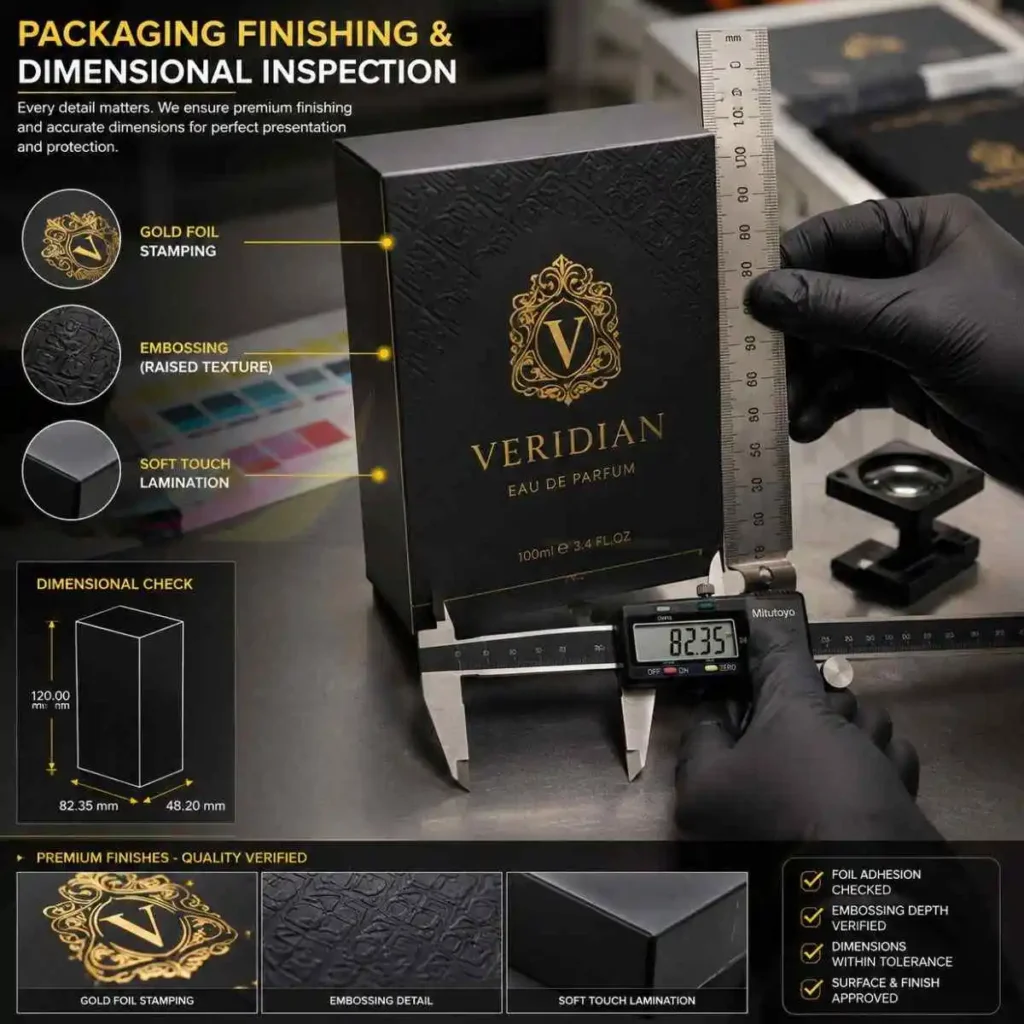
Finished packaging is checked for dimensions, alignment, finishing and assembly accuracy.
Packaging Quality Testing Guide: Dimensional Accuracy and Die-Cutting Verification
Packaging Quality Testing Guide now examines dimensional accuracy because even premium materials, exceptional printing and flawless finishes cannot compensate for incorrect packaging dimensions. Therefore, manufacturers verify die-cutting accuracy, folding tolerances and assembly precision throughout production to ensure every package performs exactly as intended. Moreover, dimensional errors often create costly downstream problems, including poor product fit, inefficient packing operations and customer complaints.
Packaging dimensions influence nearly every aspect of performance. For example, oversized packaging increases material usage, shipping costs and storage requirements. Conversely, undersized packaging may damage products, interfere with automated filling lines or prevent secure closure. Consequently, dimensional quality control has become one of the most important stages in professional packaging manufacturing.
Packaging Quality Testing Guide: Why Dimensional Tolerances Matter
Every packaging style includes acceptable dimensional tolerances because paper-based materials naturally expand and contract slightly during manufacturing. Likewise, humidity, grain direction, converting methods and board thickness can influence final measurements. Because of this, manufacturers define tolerance ranges before production begins rather than expecting impossible precision.
Furthermore, maintaining dimensional consistency improves efficiency across the entire supply chain. As a result, automated filling systems operate more reliably, products fit correctly inside inserts and shipping cartons stack more effectively during transportation. Meanwhile, repeat orders maintain consistent performance because approved specifications remain unchanged.
Correct dimensions protect products while reducing movement inside the packaging.
Accurate dimensions improve converting, gluing and packing line performance.
Consistent sizes improve stacking efficiency and reduce transportation risks.
Packaging Quality Testing Guide: Measuring Die-Cut and Assembly Accuracy
Quality inspectors use calibrated measuring tools to verify flat dimensions, panel widths, depth measurements, crease locations and assembled box dimensions. Consequently, any deviation can be identified before large production volumes are completed. In addition, assembled packaging samples are tested using actual products whenever possible because real-world fit testing often reveals issues that flat measurements alone cannot detect.
Businesses selecting packaging styles should also evaluate how structural designs influence dimensional tolerances. Therefore, reviewing different options within the Boxes by Style collection can help teams understand how box construction affects fit, assembly and overall packaging performance.
| Inspection Area | Verification Method | Potential Issue |
|---|---|---|
| Length, Width & Depth | Digital measuring tools | Incorrect product fit |
| Crease Positions | Dimensional comparison | Poor folding performance |
| Die-Cut Accuracy | Template verification | Misaligned panels or closures |
| Assembled Box Size | Physical fit testing | Product insertion problems |
- Verify dimensions against approved artwork and dielines.
- Measure multiple samples from each production batch.
- Confirm crease locations and panel alignment.
- Assemble cartons to test real-world product fit.
- Record tolerance ranges within quality documentation.
- Reject batches exceeding approved dimensional tolerances.
Section Summary: The Packaging Quality Testing Guide shows that dimensional accuracy is essential for packaging performance, manufacturing efficiency and customer satisfaction. Therefore, manufacturers should verify both flat and assembled dimensions before approving production. In the next section, we’ll examine adhesive strength testing and carton assembly quality to ensure glued packaging remains secure throughout handling, storage and transportation.
Packaging Quality Testing Guide: Adhesive Strength Testing and Carton Assembly Verification
Packaging Quality Testing Guide now focuses on adhesive performance because a packaging box is only as strong as the joints holding it together. Although board quality, printing and finishing receive considerable attention, adhesive failure can cause an otherwise perfect package to collapse during filling, transportation or retail handling. Therefore, manufacturers verify glue application, bonding strength and carton assembly before approving every production batch. Moreover, early adhesive testing prevents product damage, production delays and costly customer returns.
Modern packaging manufacturing relies on precise adhesive application rather than excessive glue. Consequently, quality inspectors evaluate glue placement, bond integrity and curing performance instead of simply checking whether adhesive is present. As a result, packaging remains structurally reliable while maintaining clean folds, professional presentation and efficient production speeds.
Packaging Quality Testing Guide: Evaluating Adhesive Bond Strength
Manufacturers inspect adhesive performance throughout the converting process because different packaging materials require different bonding characteristics. For example, coated paperboard, kraft board and rigid board each interact differently with water-based, hot-melt or specialist adhesives. Likewise, environmental conditions such as temperature and humidity influence curing performance. Therefore, production teams regularly perform bond strength tests under controlled conditions before releasing completed cartons.
Furthermore, quality inspectors examine glue lines for continuity, cleanliness and positioning. Because of this, they can identify insufficient adhesive, glue overflow or contamination before these issues affect production quality. Meanwhile, random sampling throughout the manufacturing run confirms that adhesive performance remains consistent from the first carton to the last.
Verify that glued joints remain secure under normal handling and transport conditions.
Inspect adhesive placement to ensure full contact across every bonding surface.
Confirm adhesives cure completely before packaging is stacked or transported.
Packaging Quality Testing Guide: Carton Assembly Quality Checks
Assembly verification extends beyond adhesive testing because cartons must fold accurately, close correctly and maintain their intended shape after construction. Consequently, inspectors assemble production samples and evaluate squareness, flap alignment, locking mechanisms and overall structural stability. In addition, filled product trials confirm that the completed packaging performs under actual operating conditions rather than laboratory simulations alone.
For example, manufacturers producing custom mailer boxes often conduct repeated opening and closing tests to ensure locking tabs, glued joints and structural panels remain secure throughout the customer experience.
| Inspection Point | Verification Method | Possible Failure |
|---|---|---|
| Glue Bond | Manual pull test | Joint separation |
| Carton Squareness | Assembly inspection | Distorted box shape |
| Flap Alignment | Dimensional verification | Poor closing performance |
| Adhesive Cure | Time and strength evaluation | Premature joint failure |
- Inspect adhesive placement across every glue flap.
- Verify bond strength after the recommended curing period.
- Check assembled cartons for squareness and alignment.
- Perform random sampling throughout production.
- Conduct filled-pack trials using actual products whenever possible.
- Document all adhesive inspections for production traceability.
Section Summary: The Packaging Quality Testing Guide demonstrates that reliable adhesive performance is fundamental to structural packaging integrity. Therefore, combining bond strength evaluation with comprehensive assembly verification ensures cartons remain secure during production, distribution and customer use. In the next section, we’ll explore transit simulation testing, including drop, vibration and compression testing, to evaluate how packaging performs throughout real-world logistics.
Packaging Quality Testing Guide: Transit Simulation Testing for Shipping Performance
Packaging Quality Testing Guide now examines transit simulation testing because packaging must protect products throughout the entire supply chain, not just inside the factory. Although a carton may pass material, printing and assembly inspections, it can still fail when exposed to repeated handling, stacking, vehicle vibration or accidental impacts. Therefore, manufacturers perform transit simulation tests to evaluate packaging under conditions that closely replicate real-world distribution. Consequently, businesses reduce product damage, improve customer satisfaction and minimise costly returns.
Modern logistics involve multiple handling stages, including warehouses, distribution centres, courier hubs and retail environments. Moreover, international shipments often experience varying temperatures, humidity levels and stacking pressures. Because of this, quality engineers recreate these conditions inside controlled testing laboratories before approving packaging for commercial production.
Pack Product
Transit Testing
Inspect Damage
Approve Design
Packaging Quality Testing Guide: The Most Important Transit Simulation Tests
Transit simulation combines several individual tests because packaging rarely encounters only one type of stress during transportation. For example, cartons may experience vibration during road transport, compression while stacked in warehouses and sudden impacts during loading or delivery. Likewise, export packaging may travel by road, sea and air before reaching its destination. Therefore, manufacturers evaluate packaging using multiple testing methods rather than relying on a single assessment.
Furthermore, these tests help optimise packaging design. As a result, manufacturers can reduce unnecessary material usage while maintaining product protection and transportation efficiency.
- Crushed corners
- Split glue joints
- Damaged products
- Collapsed carton walls
- Customer complaints
- Structure remains intact
- Products stay protected
- Graphics remain undamaged
- Reliable customer delivery
- Lower replacement costs
Packaging Quality Testing Guide: Drop, Compression and Vibration Testing
Drop testing evaluates how packaging performs when accidentally dropped from predetermined heights. Meanwhile, vibration testing reproduces the continuous movement experienced during transportation by road, rail or air. In addition, compression testing measures how cartons behave when stacked for prolonged periods inside warehouses or shipping containers. Consequently, manufacturers gain confidence that the packaging can protect products under genuine distribution conditions.
For businesses shipping products directly to customers, these tests are particularly valuable. For example, companies using subscription boxes should validate packaging performance under repeated courier handling because monthly deliveries experience frequent loading, unloading and transport cycles.
| Transit Test | Purpose | Typical Failure Identified |
|---|---|---|
| Drop Test | Impact resistance | Corner crushing or product damage |
| Compression Test | Stacking strength | Collapsed cartons |
| Vibration Test | Transport movement | Product movement or abrasion |
| Environmental Test | Climate exposure | Material distortion |
Many packaging failures occur after production rather than during manufacturing. Therefore, transit simulation testing often identifies weaknesses that traditional factory inspections cannot detect, allowing manufacturers to improve packaging before products reach customers.
Section Summary: The Packaging Quality Testing Guide demonstrates that transit simulation testing bridges the gap between factory performance and real-world distribution. Therefore, combining drop, vibration, compression and environmental testing enables manufacturers to validate packaging under realistic logistics conditions while reducing damage, returns and unnecessary transportation costs. In the next section, we’ll explore barcode verification, label inspection and packaging identification testing to ensure products remain fully traceable throughout the supply chain.
Barcode Verification, Label Inspection and Product Traceability
Packaging Quality Testing Guide now focuses on barcode verification and label inspection because accurate product identification is essential throughout manufacturing, warehousing, retail and distribution. Although a package may be structurally perfect, incorrect barcodes, unreadable QR codes or inaccurate product information can interrupt supply chains and create expensive operational issues. Therefore, manufacturers inspect every identification element before production approval. Moreover, reliable traceability protects inventory accuracy, improves customer confidence and supports regulatory compliance.
Modern packaging often contains far more than a product name and logo. For example, cartons may include GS1 barcodes, QR codes, batch numbers, expiry dates, recycling symbols, handling instructions and variable data. Consequently, every printed identifier must remain accurate, durable and machine-readable under normal operating conditions. As a result, products move efficiently through automated scanning systems without unnecessary delays or manual intervention.
What Should Be Verified During Barcode Inspection?
Barcode inspection evaluates both print quality and data accuracy because a perfectly printed barcode is useless if it contains incorrect information. Likewise, accurate data provides little value if scanners cannot read the printed symbol consistently. Therefore, quality inspectors verify barcode dimensions, quiet zones, contrast, print clarity and encoded information using specialised verification equipment. Furthermore, variable data such as batch numbers and expiry dates should remain legible after packing, storage and transportation.
Meanwhile, QR codes require additional attention because many customers use mobile devices to access digital instructions, product authentication or promotional campaigns. Consequently, manufacturers test QR codes across multiple devices before approving commercial production.
- Low print contrast
- Smudged ink
- Incorrect dimensions
- Poor quiet zones
- Unreadable QR codes
- Machine-readable codes
- Accurate product data
- Sharp print quality
- Correct positioning
- Reliable retail scanning
Packaging Quality Testing Guide: Label Accuracy and Regulatory Compliance
Label inspection extends beyond barcode quality because every printed label must present accurate information. For example, product descriptions, ingredient declarations, safety warnings, country of origin, recycling instructions and legal symbols should match the approved artwork. In addition, inspectors confirm that labels remain securely attached and resistant to abrasion, moisture and normal handling.
Similarly, businesses producing custom labels and stickers should verify adhesive performance alongside print quality to ensure identification remains intact throughout storage, transport and retail display.
| Inspection Area | Verification Method | Quality Objective |
|---|---|---|
| Barcode Quality | Barcode verifier | Reliable scanner performance |
| QR Code | Multi-device scanning | Fast customer access |
| Variable Data | Visual verification | Accurate batch identification |
| Label Adhesion | Peel testing | Long-term durability |
- Checking only the first production sample.
- Ignoring barcode verification after lamination or varnishing.
- Overlooking variable data during batch changes.
- Using low-contrast colours for machine-readable codes.
- Skipping final scan tests before dispatch.
Section Summary: The Packaging Quality Testing Guide demonstrates that accurate product identification is just as important as structural packaging quality. Therefore, comprehensive barcode verification and label inspection improve supply chain efficiency, reduce scanning failures and ensure products remain fully traceable from manufacturing to the end customer. In the next section, we’ll explore packaging performance testing for retail, e-commerce and export applications, where packaging must meet different functional requirements depending on its intended use.
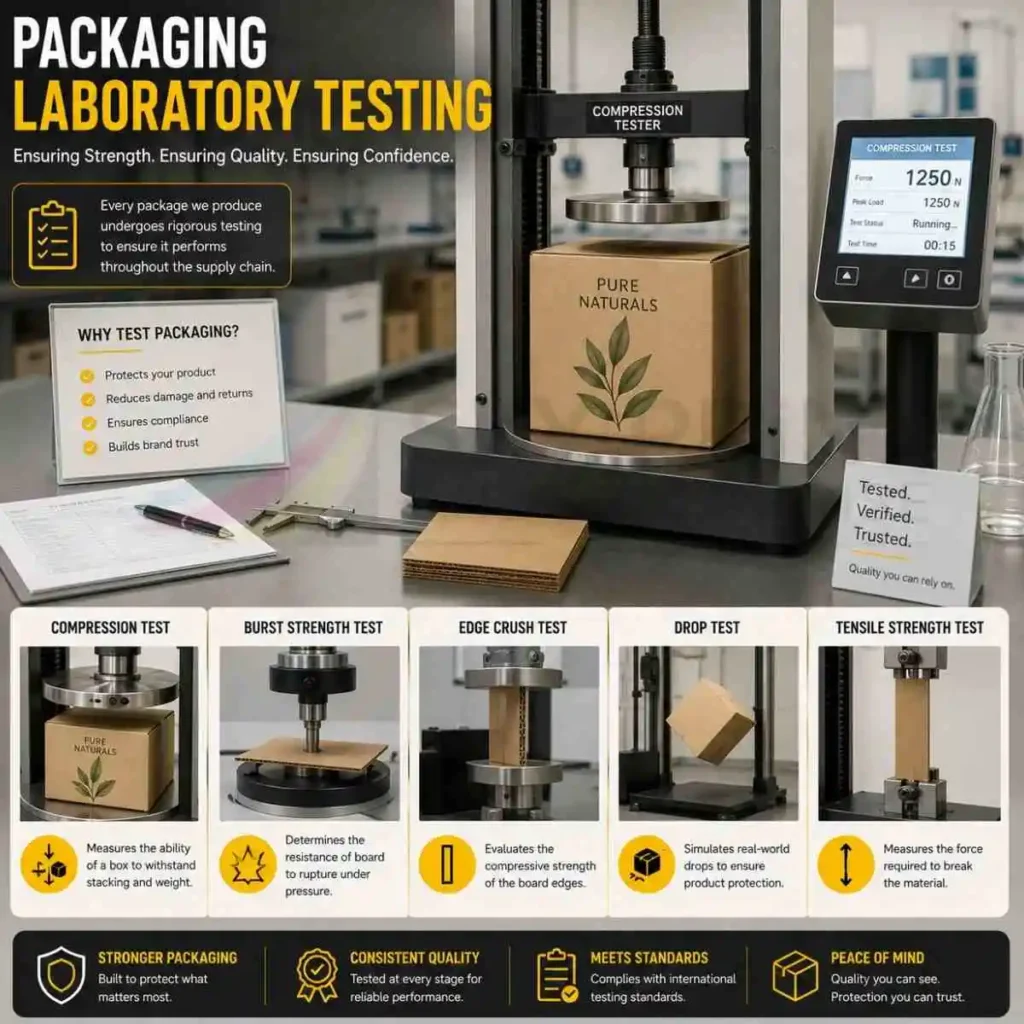
Laboratory testing provides measurable data on packaging material performance.
Packaging Quality Testing Guide: Performance Testing for Retail, E-commerce and Export Packaging
Packaging Quality Testing Guide concludes the technical testing section by evaluating packaging performance in real commercial environments. Although laboratory testing provides valuable data, packaging must ultimately perform where it matters most—in retail stores, fulfilment centres, courier networks and international supply chains. Therefore, manufacturers conduct performance testing that reflects the packaging’s intended application rather than relying solely on standard laboratory measurements. Consequently, businesses reduce damage, improve operational efficiency and deliver a better customer experience.
Retail packaging, e-commerce packaging and export packaging each face different challenges. For example, retail cartons prioritise shelf presentation, while e-commerce packaging must withstand repeated courier handling. Likewise, export packaging encounters extended storage periods, climate changes and multiple transport methods. Because of this, manufacturers tailor quality testing programmes to match the actual distribution environment.
Testing Packaging for Different Supply Chains
Professional manufacturers understand that one testing programme cannot suit every product. Therefore, they develop application-specific quality protocols based on distribution risks, product value and customer expectations. Moreover, packaging engineers often combine several testing methods into a single validation programme. As a result, businesses receive packaging that performs reliably throughout its intended lifecycle instead of simply meeting minimum laboratory requirements.
Similarly, procurement teams should consider how packaging will be stored, transported and displayed before approving final specifications. Consequently, quality testing becomes an integral part of packaging design rather than a final inspection activity.
- Excellent shelf appearance
- Consistent print quality
- Premium customer perception
- Easy product handling
- Reduced transit damage
- Reliable stacking strength
- Lower return rates
- Consistent customer deliveries
Packaging Quality Testing Guide: Continuous Quality Improvement
Quality testing should continue even after commercial production begins. Instead, manufacturers analyse customer feedback, logistics performance and production data to identify opportunities for improvement. Furthermore, periodic revalidation ensures packaging continues meeting performance requirements when materials, suppliers or manufacturing equipment change. Therefore, quality assurance becomes an ongoing process rather than a one-time approval.
For example, businesses supplying products in the Retail Packaging Boxes category often review customer handling feedback alongside laboratory results to refine future packaging designs and improve long-term performance.
| Packaging Type | Primary Performance Goal | Recommended Testing Focus |
|---|---|---|
| Retail Packaging | Presentation and usability | Print, finish and structural quality |
| E-commerce Packaging | Transit protection | Drop, compression and closure testing |
| Export Packaging | International durability | Environmental and logistics simulation |
| Luxury Packaging | Premium appearance | Finishing, abrasion and presentation testing |
- Match testing protocols to the intended distribution channel.
- Review laboratory data alongside real-world shipping results.
- Monitor customer feedback for recurring packaging issues.
- Revalidate packaging after material or supplier changes.
- Maintain documented quality records for every production revision.
- Use continuous improvement to optimise packaging performance over time.
Section Summary: The Packaging Quality Testing Guide demonstrates that effective quality assurance extends beyond laboratory testing into every stage of the product journey. Therefore, aligning testing programmes with retail, e-commerce and export requirements enables manufacturers to deliver packaging that protects products, strengthens brands and performs consistently across the entire supply chain. The next part of this guide will move beyond testing methods and cover quality standards, certifications, inspection systems and best-practice implementation for world-class packaging manufacturing.
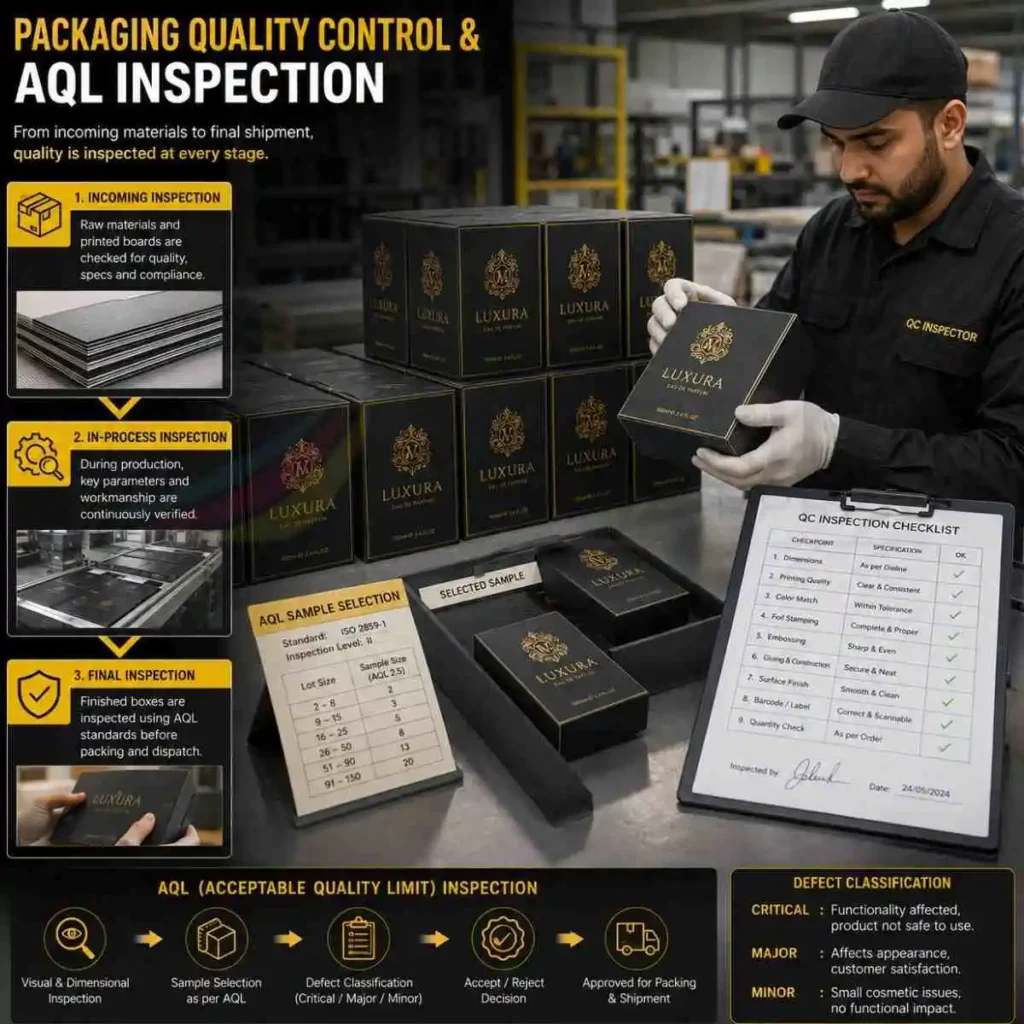
Structured quality control combines production inspection, sampling and documented testing.
Packaging Quality Testing Guide: International Quality Standards and Certifications
Packaging Quality Testing Guide would not be complete without understanding the international standards that govern packaging quality. Although individual manufacturers may develop their own inspection procedures, recognised standards provide a common framework for testing, reporting and continuous improvement. Therefore, businesses, procurement managers and brand owners should evaluate suppliers against internationally accepted requirements rather than relying solely on marketing claims. Consequently, standardised testing improves consistency, simplifies supplier comparisons and reduces quality risks throughout the supply chain.
Moreover, recognised certifications demonstrate that packaging has been evaluated using established technical methods instead of subjective judgement. As a result, customers gain greater confidence that products will perform reliably during manufacturing, transportation, storage and retail display.
Packaging Quality Testing Guide: The Most Recognised Packaging Standards
Different organisations publish standards for specific aspects of packaging quality. For example, some focus on material performance, while others concentrate on transportation testing, sustainability or barcode verification. Likewise, manufacturers often apply several standards simultaneously because no single certification covers every element of packaging quality. Consequently, understanding the purpose of each organisation helps businesses specify appropriate testing requirements during procurement.
Quality management systems, testing consistency and internationally recognised best practices.
Transit simulation procedures for shipping, handling and distribution performance.
Responsible sourcing and sustainable forest certification for paper-based packaging.
Packaging Quality Testing Guide: Selecting Standards for Different Packaging Projects
Choosing the correct quality standard depends on the packaging application. For example, export packaging generally requires comprehensive transit testing, whereas luxury retail packaging may place greater emphasis on visual quality and finishing consistency. Furthermore, food packaging often requires additional compliance with relevant food-contact regulations alongside traditional quality testing. Therefore, businesses should define performance objectives before selecting testing standards.
Similarly, material selection influences the standards that may apply during manufacturing. For example, companies sourcing cardboard packaging materials should confirm that material quality, structural performance and sustainability requirements align with their procurement specifications.
| Organisation | Primary Focus | Packaging Application |
|---|---|---|
| ISO | Quality management | Manufacturing systems and documentation |
| ISTA | Transit testing | Distribution and shipping validation |
| GS1 | Barcode standards | Retail identification and traceability |
| FSC / PEFC | Responsible sourcing | Paper and board certification |
| ASTM / TAPPI | Material testing methods | Laboratory evaluation of paper and packaging |
- Ask suppliers which recognised standards they follow.
- Request supporting test reports where appropriate.
- Confirm certifications remain current and independently verified.
- Match testing standards to the packaging’s intended application.
- Review standards regularly as regulations and technologies evolve.
Section Summary: The Packaging Quality Testing Guide shows that internationally recognised standards provide a reliable foundation for evaluating packaging quality. Therefore, selecting appropriate certifications and testing frameworks helps manufacturers demonstrate technical competence while giving buyers greater confidence in long-term packaging performance. In the next section, we’ll explore packaging quality inspection systems, including incoming material inspection, in-process quality control, final inspection and Acceptable Quality Limit (AQL) sampling.
Packaging Quality Testing Guide: Frequently Asked Questions
The following questions answer many of the issues businesses, procurement managers and brand owners regularly ask about the Packaging Quality Testing Guide. Moreover, these answers summarise the most important concepts covered throughout this guide while providing practical advice for selecting, testing and approving packaging for commercial production.
1. What is a Packaging Quality Testing Guide?
A Packaging Quality Testing Guide explains the procedures used to evaluate packaging materials, structural strength, print quality, durability and overall performance. Therefore, it helps manufacturers and buyers ensure packaging meets technical and commercial requirements before production begins.
2. Why is packaging quality testing important?
Quality testing reduces production defects, protects products during transport and improves customer satisfaction. Furthermore, it helps manufacturers identify potential issues before packaging reaches the market, reducing costly returns and replacements.
3. Which industries benefit from packaging quality testing?
Almost every industry benefits, including food, cosmetics, pharmaceuticals, electronics, apparel, luxury retail and e-commerce. Consequently, quality testing has become an essential part of modern packaging manufacturing.
4. What are the most common packaging quality tests?
The most common tests include compression testing, drop testing, burst testing, edge crush testing, vibration testing, barcode verification, dimensional inspection and print quality assessment. However, the exact testing programme depends on the packaging application.
5. How often should packaging be tested?
Packaging should be tested during development, before mass production and whenever materials, machinery or designs change. In addition, periodic verification helps maintain consistent quality throughout long production runs.
6. What is AQL in packaging quality inspection?
AQL, or Acceptable Quality Limit, is a statistical sampling method used to determine whether a production batch meets agreed quality standards. Therefore, inspectors evaluate selected samples instead of inspecting every individual package.
7. Can packaging quality testing reduce production costs?
Yes. Although testing requires time and resources, it often prevents expensive production failures, customer complaints and product recalls. As a result, businesses usually achieve lower long-term operating costs.
8. Which packaging materials require quality testing?
Paperboard, kraft board, corrugated board, rigid board, labels, adhesives, inks and protective coatings all require quality evaluation. Likewise, finished packaging should also undergo functional performance testing before approval.
9. Which international standards support packaging quality testing?
Several recognised organisations publish packaging standards, including ISO, ISTA, GS1, FSC, PEFC, ASTM, TAPPI and BSI. Consequently, manufacturers frequently use these frameworks to develop consistent quality procedures.
10. How do I choose a manufacturer with strong quality assurance?
Choose a manufacturer that provides documented inspection procedures, recognised quality systems, technical expertise and appropriate testing capabilities. Furthermore, ask for recent quality records and examples of continuous improvement initiatives before placing production orders.