
Packaging Manufacturing Guide: The Complete Guide to Modern Packaging Production
In this Packaging Manufacturing Guide, learn how custom packaging is manufactured—from structural design and material selection to printing, finishing, quality control and large-scale production.
Modern packaging does far more than protect products. In addition, it communicates your brand, improves customer experience, supports efficient logistics, and influences purchasing decisions. Therefore, whether you manufacture cosmetics, food products, retail goods, or luxury items, understanding the packaging manufacturing process helps you make informed decisions that improve quality while reducing production costs. To help businesses make better decisions, this Packaging Manufacturing Guide explains every stage of modern packaging production using practical manufacturing knowledge and industry best practices.
However, many businesses focus only on the finished box. In reality, successful packaging begins long before printing starts. For this reason, professional manufacturers, including Sky Print & Enterprise, carefully evaluate product dimensions, structural engineering, packaging materials, printing methods, finishing techniques, and quality control before mass production begins. Consequently, every decision made during development directly affects the appearance, durability, and overall performance of the finished packaging.
Furthermore, throughout this guide, you’ll discover how packaging manufacturers transform an initial concept into high-quality commercial packaging. First, we will explore structural design and dielines. Next, we’ll examine printing technologies, finishing processes, and production machinery. In addition, we’ll cover sustainable manufacturing practices and quality assurance procedures used across today’s packaging industry. Finally, you’ll gain practical insights into how Sky Print & Enterprise approaches professional packaging production.
📘 What You’ll Learn in This Packaging Manufacturing Guide
🏗️ Packaging Development
Understand how packaging moves from an idea to a production-ready design.
📦 Manufacturing Processes
Learn every major production stage used in commercial packaging manufacturing.
🎨 Printing & Finishing
Explore professional printing technologies and premium finishing techniques.
🛡️ Quality & Sustainability
Discover how manufacturers ensure consistent quality while reducing environmental impact.
What Is Packaging Manufacturing?
Packaging manufacturing is the complete industrial process of designing, producing and finishing packaging that protects, transports and presents products safely. Rather than simply printing boxes, manufacturers combine structural engineering, material science, commercial printing and precision converting to create packaging that performs reliably throughout the supply chain.
In addition, today’s packaging manufacturing industry serves almost every commercial sector. Food companies require hygienic packaging that preserves freshness, while cosmetic brands prioritise premium presentation. E-commerce businesses often focus on durability and efficient shipping, whereas luxury retailers seek exceptional finishing that enhances the customer experience. Although the objectives vary, every project follows a structured manufacturing workflow that begins with planning and ends with rigorous quality inspection.
Packaging Manufacturing Is More Than Box Production
Professional packaging manufacturers do far more than convert paperboard into boxes. They analyse product requirements, recommend suitable materials, develop structural designs, prepare production artwork, optimise manufacturing efficiency and monitor quality throughout the production process. Consequently, successful packaging combines engineering precision with creative design to deliver both functional performance and visual impact.
💡 Manufacturer’s Insight – Packaging Manufacturing Guide
One of the most common misconceptions is that packaging manufacturing starts with printing. In reality, successful production begins much earlier with accurate product measurements, structural engineering, material selection and prototype approval. Manufacturers who invest time in planning typically achieve better quality, lower production costs and fewer manufacturing delays.
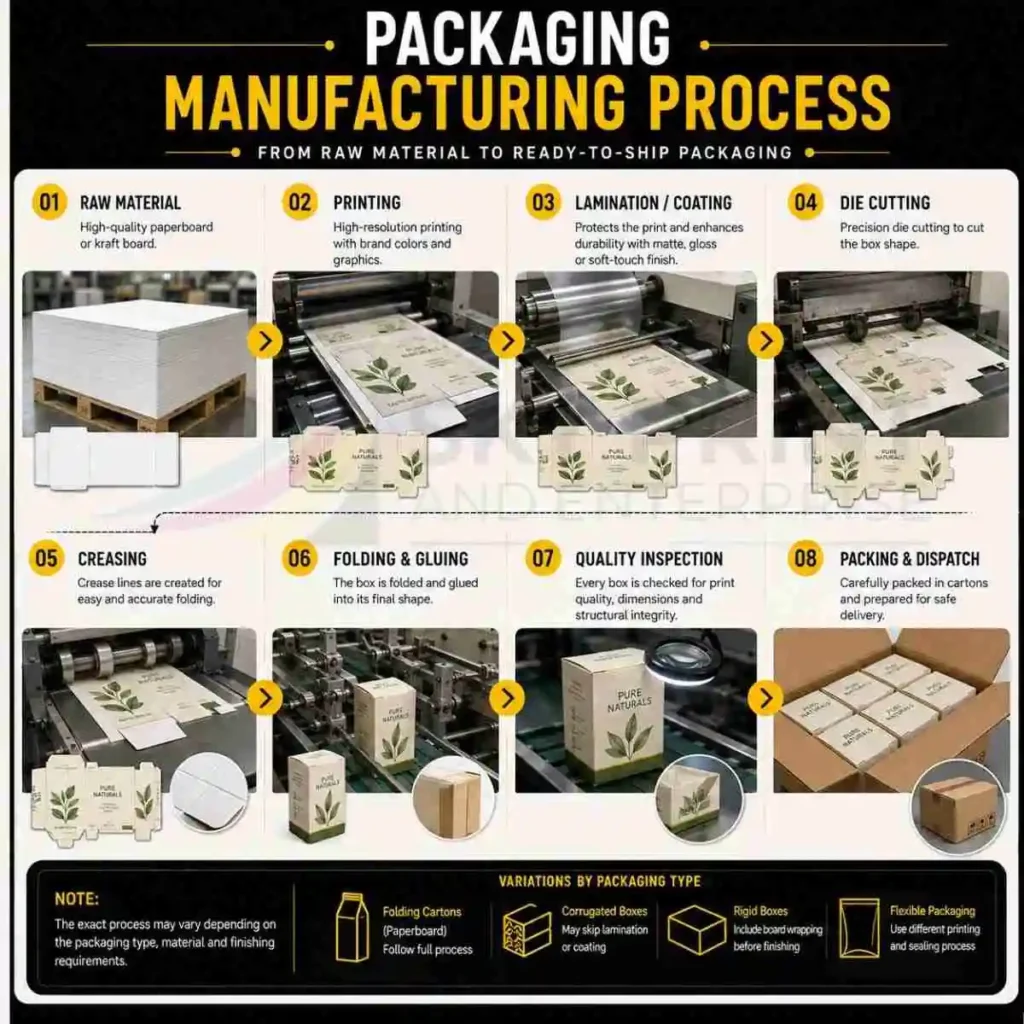
Commercial packaging passes through several manufacturing stages, from material preparation and printing to converting, finishing, quality control and packing.
Packaging Manufacturing Guide: The Complete Packaging Manufacturing Process
Every successful packaging project follows a carefully planned production workflow. Although different industries require different packaging solutions, professional manufacturers generally follow the same structured process to achieve consistent quality and efficient production. This systematic approach reduces costly mistakes, improves manufacturing efficiency and ensures that the finished packaging performs exactly as intended.
In addition, rather than treating each production stage as an isolated task, experienced manufacturers view packaging manufacturing as one continuous process. Every stage influences the next, meaning that decisions made during planning directly affect printing quality, finishing accuracy, assembly efficiency and overall production costs. Consequently, investing time in preparation almost always results in better packaging and fewer manufacturing issues.
🏭 Professional Packaging Manufacturing Workflow
Brief
Understand product requirements.
Structure
Design the packaging.
Materials
Choose suitable board.
Artwork
Prepare print-ready files.
Printing
Commercial production.
Finishing
Premium enhancements.
Converting
Die-cut & glue.
Inspection
Quality control.
Step 1 – Understanding the Customer Brief – Packaging Manufacturing Guide
Every packaging manufacturing project begins with gathering accurate information about the product and the customer’s objectives. Manufacturers assess product dimensions, weight, intended market, storage conditions, shipping requirements, branding goals and production quantities before recommending an appropriate packaging solution. Without this information, it becomes difficult to develop packaging that performs reliably throughout manufacturing and distribution.
At this stage, manufacturers also discuss budget expectations, production timelines, sustainability goals and premium finishing requirements. Establishing these requirements early prevents unnecessary revisions later in the project.
Step 2 – Structural Engineering and Packaging Design -Packaging Manufacturing Guide
Once the project requirements have been defined, structural designers begin creating the packaging. This stage determines how the packaging will fold, lock, protect the product and perform during transportation. Rather than focusing on appearance alone, structural engineering ensures that every panel, glue flap and locking mechanism functions correctly before artwork is added.
However, accurate engineering also minimises material waste, improves production efficiency and helps maintain consistent quality throughout large manufacturing runs. Consequently, structural design is one of the most important stages of the entire packaging manufacturing process.
📌 Why Professional Planning Matters – Packaging Manufacturing Guide
📉 Lower Production Costs
Efficient planning reduces unnecessary material waste and machine downtime.
⚡ Faster Manufacturing
Approved structures move smoothly through commercial production.
🛡 Better Product Protection
Accurate structural engineering reduces transport damage and customer complaints.
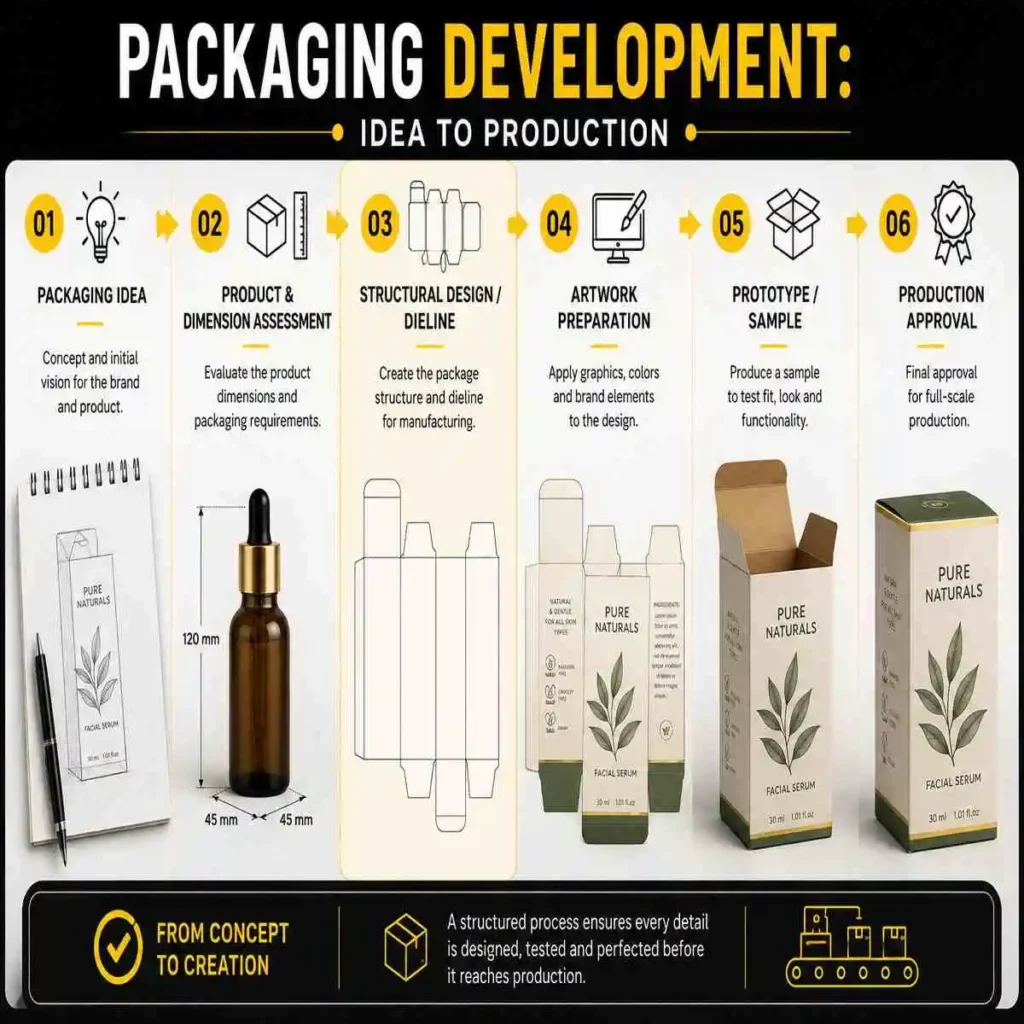
Packaging manufacturing begins with product requirements, structural design, artwork and prototyping before the final design enters production.
Packaging Manufacturing Guide: Packaging Development Before Production
Before commercial production begins, manufacturers complete several critical development stages that determine whether the packaging will perform successfully during printing, converting and assembly. These stages include creating the structural dieline, preparing production-ready artwork and selecting the most appropriate packaging material. Although these activities occur before the printing press starts, they largely determine the overall quality of the finished packaging.
Similarly, experienced packaging manufacturers understand that correcting design problems after production begins is considerably more expensive than identifying them during development. Therefore, every stage is reviewed carefully before approval is given for commercial manufacturing.
🏗 Manufacturing Principle
Professional manufacturers spend far more time planning than correcting mistakes. Careful preparation improves production efficiency, maintains consistent quality and significantly reduces manufacturing waste.
Step 3 – Packaging Dieline Development
Once the structural design has been approved, engineers create the packaging dieline. This technical drawing acts as the manufacturing blueprint for the entire project, showing cut lines, crease lines, glue flaps, folding panels, safety areas and bleed requirements. Every subsequent production stage depends on the accuracy of this drawing.
Meanwhile, professional dielines are developed with manufacturing tolerances in mind to ensure accurate die-cutting and efficient assembly. A well-designed dieline also improves machine performance, reduces material waste and helps achieve consistent results across large production runs.
Furthermore if you would like to understand this process in greater detail, our Packaging Dieline Guide explains every stage of professional structural packaging development.
📐 A Professional Dieline Includes
✂️ Cut Lines
Define where the finished packaging will be trimmed.
📏 Crease Lines
Ensure accurate folding during production.
🧴 Glue Areas
Identify bonding locations for assembly.
🎨 Artwork Safe Zones
Prevent important graphics from being trimmed.
Step 4 – Preparing Production Artwork
After the dieline has been approved, graphic designers prepare the production artwork. Unlike standard marketing graphics, packaging artwork must align precisely with the structural layout. Logos, product information, legal text, barcodes, nutritional information and decorative finishes must all be positioned accurately to ensure they print correctly after folding and assembly.
Nevertheless, commercial artwork files are carefully checked for colour accuracy, image resolution, bleed, trapping and font consistency before they are released for production. This detailed pre-press process helps prevent expensive printing errors and ensures that every package matches the approved design.
In addition, businesses producing premium Perfume Boxes, Face Wash Boxes, Beard Balm Boxes and Chocolate Packaging often invest additional time in artwork preparation because presentation plays a significant role in consumer purchasing decisions.
Step 5 – Selecting the Right Packaging Material –
Material selection is one of the most important decisions in the packaging manufacturing process. The chosen substrate influences structural strength, printing performance, finishing quality, sustainability and manufacturing cost. Selecting the wrong material can reduce durability, increase waste and negatively affect the overall appearance of the finished packaging.
Similarly, professional manufacturers evaluate several factors before recommending a material, including product weight, moisture resistance, storage conditions, transportation requirements and desired presentation. Consequently, packaging materials are always selected according to the specific needs of the product rather than applying a one-size-fits-all approach.
📦 Choosing the Right Packaging Material
| Material | Best Application | Learn More |
|---|---|---|
| Cardboard | Retail cartons & folding boxes | Cardboard Packaging Material |
| Kraft Board | Eco-friendly packaging | Kraft Packaging Material |
| Corrugated Board | Shipping & e-commerce | Corrugated Material |
| Rigid Board | Luxury packaging | Rigid Box Material |
✅ Production Approval Checklist
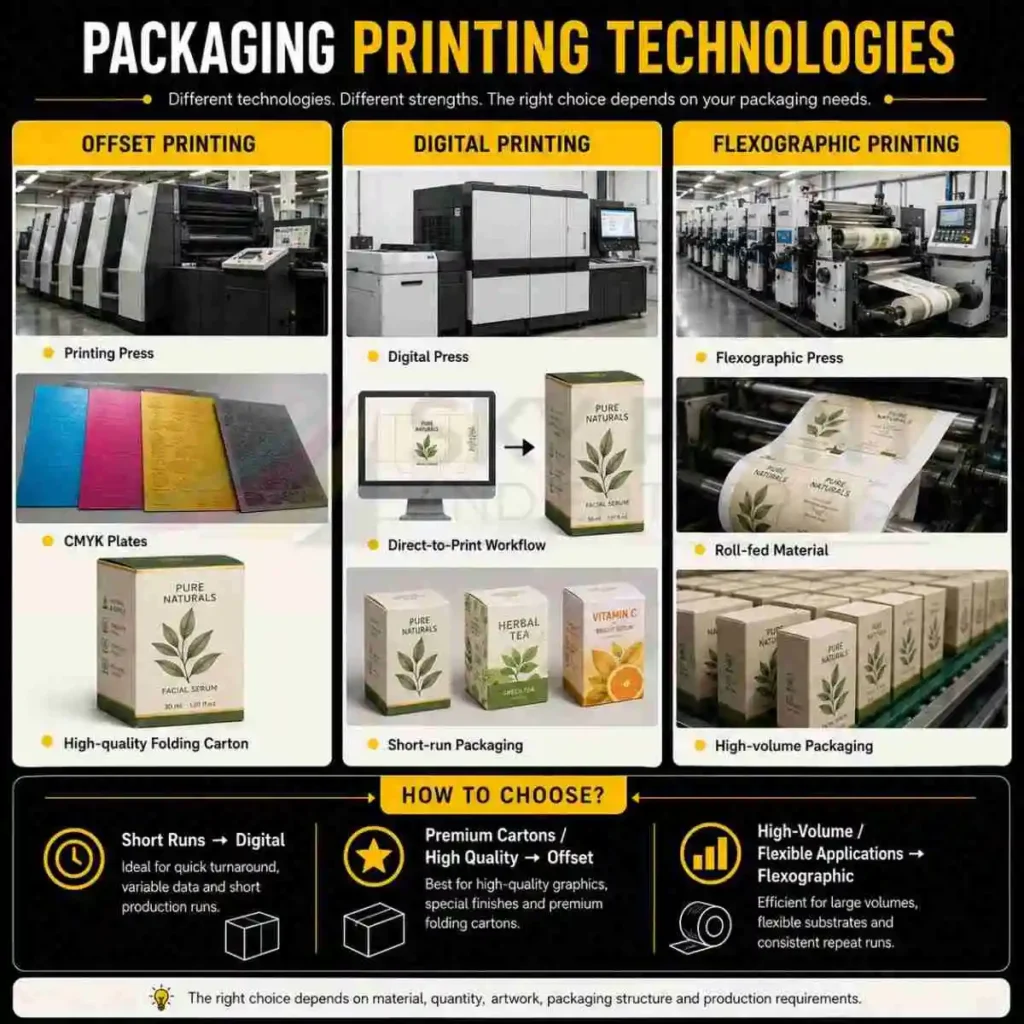
Different printing technologies are selected according to packaging material, volume, artwork requirements and production objectives.
Packaging Manufacturing Guide: Commercial Printing Technologies
Commercial printing transforms approved artwork into high-quality packaging ready for converting and finishing. The selected printing technology influences colour consistency, production speed, manufacturing costs and the overall appearance of the finished packaging. Consequently, choosing the right printing process is one of the most important decisions during packaging manufacturing. Professional manufacturers evaluate order quantity, packaging material, finishing requirements and budget before recommending the most suitable printing solution.
Modern packaging manufacturers use highly specialised printing equipment capable of producing millions of cartons with exceptional colour accuracy. Whether manufacturing folding cartons, luxury rigid boxes, corrugated packaging or retail cartons, selecting the appropriate printing technology ensures consistent quality throughout the production run.
🖨 Commercial Printing Workflow
Artwork
Approved files
Colour Setup
Calibration
Press Setup
Machine preparation
Printing
Production run
Inspection
Colour verification
Offset Lithographic Printing
Offset lithographic printing remains the industry’s preferred solution for premium packaging production. This process delivers exceptional image quality, consistent colour reproduction and outstanding printing precision across large production volumes. For businesses manufacturing retail packaging, cosmetics, pharmaceuticals and luxury cartons, offset printing provides excellent value while maintaining outstanding visual quality.
Offset presses can efficiently print on a wide range of paperboard materials before the sheets move to subsequent manufacturing stages such as lamination, die-cutting and folder-gluing. Once the press has been prepared, production speeds are extremely high, making offset printing highly economical for medium and large orders.
Digital Printing
Digital printing has transformed short-run packaging manufacturing by eliminating the need for traditional printing plates. Artwork is transferred directly to the press, allowing manufacturers to produce prototypes, personalised packaging and smaller production runs with significantly shorter lead times.
This technology is particularly suitable for product launches, seasonal campaigns, promotional packaging and businesses requiring multiple artwork variations. Although unit costs are generally higher for large quantities, digital printing provides exceptional flexibility for lower-volume projects.
📊 Printing Technology Comparison
| Printing Method | Best For | Production Volume |
|---|---|---|
| Offset Lithography | Premium cartons | Medium to high |
| Digital Printing | Short runs & prototypes | Low to medium |
| Flexographic Printing | Corrugated packaging | High volume |
Flexographic Printing
Flexographic printing is widely used for corrugated packaging, shipping cartons and large-volume industrial packaging. Flexible printing plates and fast production speeds make this process highly efficient for long manufacturing runs. Advances in flexographic technology have also significantly improved print quality, making it suitable for many retail applications.
Manufacturers producing heavy-duty shipping cartons often combine flexographic printing with Corrugated Cardboard Material to achieve durable, cost-effective packaging suitable for transportation and warehouse distribution.
💡 Manufacturer’s Recommendation
🏆 Offset Printing
Choose this for premium retail packaging, luxury cartons and high-volume production where colour consistency is essential.
🚀 Digital Printing
Ideal for prototypes, short production runs, product testing and personalised packaging campaigns.
📦 Flexographic Printing
Recommended for corrugated shipping cartons and large-scale industrial packaging production.
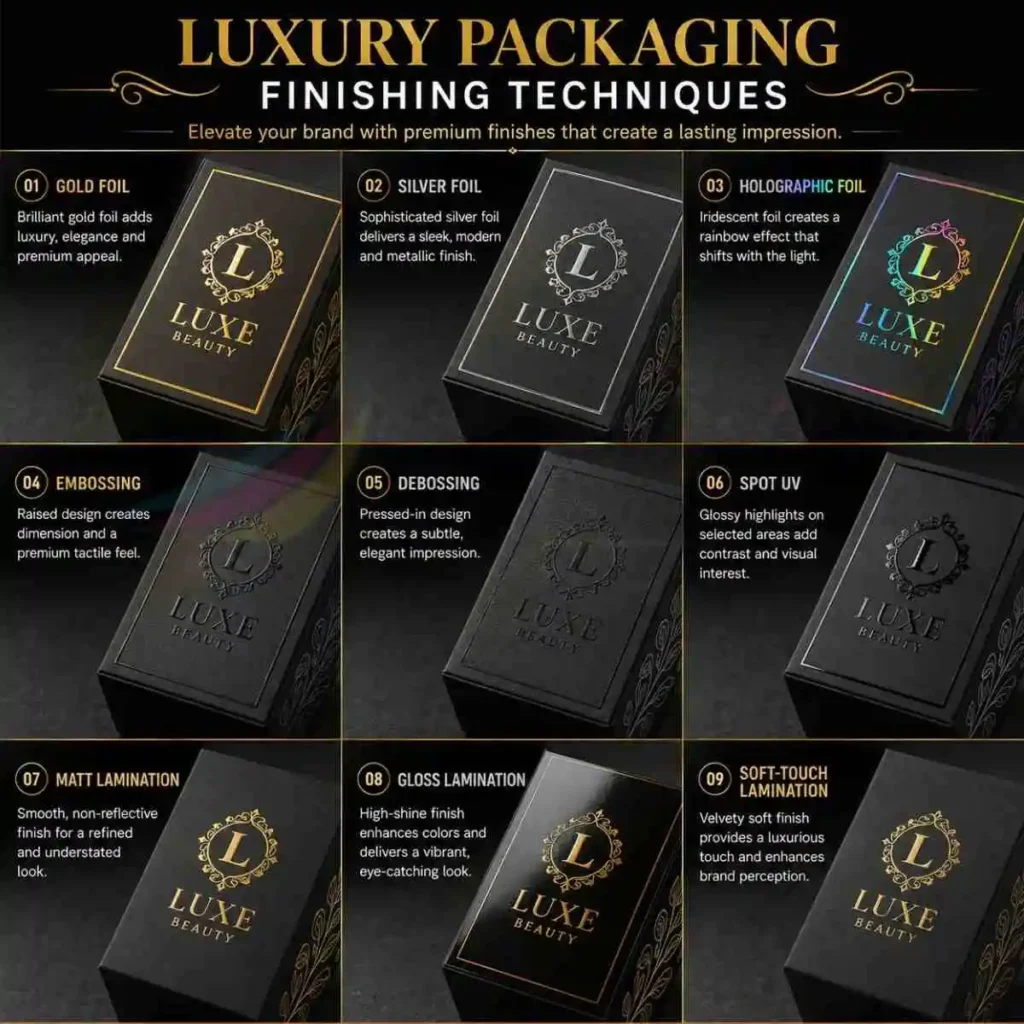
Premium finishing techniques can add texture, contrast, shine and tactile appeal to printed packaging.
Packaging Manufacturing Guide: Premium Packaging Finishing Techniques
Printing creates the visual identity of packaging, but professional finishing transforms ordinary printed sheets into premium packaging that attracts attention and strengthens brand perception. Finishing techniques enhance appearance, improve durability, create tactile experiences and help products stand out in competitive retail environments. Consequently, many successful brands invest in specialist finishing because it directly influences customer perception and purchasing decisions.
Modern packaging manufacturers combine several finishing processes to produce luxury packaging for cosmetics, confectionery, electronics, jewellery and premium retail products. Each finish serves a different purpose, so selecting the right combination depends on the product, brand positioning and target market.
✨ Premium Finishing Workflow
Printing
Base graphics
Lamination
Surface protection
Decoration
Luxury finishes
Die Cutting
Shape creation
Assembly
Finished packaging
Lamination
Lamination applies a protective film to the printed surface, improving durability while enhancing visual appearance. It protects packaging from scratches, moisture, fingerprints and everyday handling throughout the supply chain. Most commercial packaging uses either matt or gloss lamination depending on the desired presentation.
🛡 Choosing the Right Lamination
✨ Gloss Lamination
Produces vibrant colours with a reflective finish, making it ideal for food packaging, retail cartons and promotional packaging.
🖤 Matt Lamination
Creates an elegant, premium appearance with reduced glare. Widely used for cosmetics, luxury packaging and presentation boxes.
🤲 Soft-Touch Lamination
Provides a smooth velvet-like texture that enhances the perceived quality of premium packaging.
Foil Stamping
Foil stamping transfers metallic foil onto selected artwork using heat and pressure. Gold, silver, copper and holographic foils create premium visual effects without using metallic inks. Luxury cosmetic brands, jewellery manufacturers and premium gift packaging frequently incorporate foil stamping to increase shelf impact.
Spot UV Coating
Spot UV applies a high-gloss coating to selected design elements while leaving the remaining surface matt. The contrast between gloss and matt creates an eye-catching visual effect that immediately draws attention to logos, product names or decorative graphics.
📊 Popular Packaging Finishes – Packaging Manufacturing Guide
| Finish | Primary Benefit | Common Industries |
|---|---|---|
| Matt Lamination | Elegant appearance | Cosmetics • Luxury • Retail |
| Gloss Lamination | Colour enhancement | Food • FMCG • Retail |
| Foil Stamping | Luxury branding | Jewellery • Perfume • Gifts |
| Spot UV | Premium contrast | Retail • Cosmetics |
| Emboss / Deboss | Luxury texture | Premium Packaging |
Embossing and Debossing
Embossing raises selected artwork above the surface, whereas debossing presses it below the surface. Both techniques add depth and texture without relying solely on colour. These finishes create a sophisticated tactile experience and are commonly combined with foil stamping for luxury packaging.
Premium Perfume Boxes, Jewellery Packaging, Cosmetic Packaging and Presentation Folders frequently use embossing or debossing to reinforce brand identity and elevate the customer experience.
🏆 Manufacturer’s Best Practice
✨ Luxury Packaging
Matt Lamination + Gold Foil + Embossing
🍫 Food Packaging
Gloss Lamination + Spot UV
📦 E-commerce Packaging
Matt Lamination with durable protective coating
Packaging Manufacturing Guide: Machinery Used in Packaging Production
Modern packaging manufacturing depends on highly specialised machinery that delivers precision, efficiency and consistent quality. Every machine performs a dedicated task within the production process, from printing and die-cutting to folding, gluing and final inspection. Together, these machines enable manufacturers to produce thousands of high-quality packaging units every hour while maintaining strict quality standards.
Professional packaging facilities carefully coordinate each stage of production to minimise waste, improve efficiency and maintain colour consistency throughout large manufacturing runs. Consequently, understanding how these machines work provides valuable insight into why professionally manufactured packaging consistently outperforms manually produced alternatives.
🏭 Complete Manufacturing Line
Printing
Finishing
Die Cutting
Folding
Gluing
Inspection
Packing
Offset Printing Presses
Offset presses are responsible for transferring artwork onto paperboard with exceptional precision. Modern multi-colour presses print several colours simultaneously, ensuring outstanding colour consistency and production efficiency. These presses are widely used to manufacture premium retail packaging, luxury cartons and branded product boxes requiring sharp graphics and vibrant colour reproduction.
Die-Cutting Machines
After printing, large sheets move to die-cutting machines where precision cutting tools create the final packaging shape. These machines accurately cut outer profiles while simultaneously producing fold lines, locking tabs, windows and glue flaps. High-quality die-cutting ensures accurate folding and efficient assembly during later production stages.
⚙️ Engineering Blueprint – What Happens During Die Cutting?
Printed Sheet
Large printed board enters the machine.
Steel Rule Die
Cuts the packaging profile precisely.
Creasing
Creates fold lines for accurate assembly.
Finished Blank
Ready for folding and gluing.
Folder-Gluers
Folder-gluers automatically fold packaging along pre-creased lines before applying adhesive to designated glue flaps. These highly efficient machines assemble thousands of cartons every hour while maintaining precise alignment throughout production. Automated folding significantly improves consistency compared with manual assembly and helps reduce manufacturing costs on larger orders.
Rigid Box Manufacturing Machines
Luxury rigid boxes require dedicated machinery that wraps printed paper around thick greyboard before forming the finished box structure. These machines produce exceptionally strong and visually impressive packaging commonly used for premium cosmetics, electronics, jewellery, watches and luxury gifts.
Manufacturers producing premium Jewellery Packaging, Perfume Boxes and luxury presentation packaging frequently use rigid box manufacturing equipment to achieve outstanding structural strength and premium presentation.
📊 Packaging Manufacturing Equipment Comparison
| Machine | Purpose | Production Stage |
|---|---|---|
| Offset Press | Commercial printing | Printing |
| Die Cutter | Cutting & creasing | Converting |
| Folder Gluer | Assembly | Finishing |
| Rigid Box Machine | Luxury box production | Assembly |
| Inspection System | Quality verification | Final inspection |
💡 Expert Manufacturing Tip – Packaging Manufacturing Guide
The most advanced packaging facilities don’t rely on a single machine to guarantee quality. Instead, they integrate automated inspection systems throughout production to monitor colour consistency, registration accuracy, cutting precision and structural integrity. Continuous quality checks reduce waste, improve efficiency and ensure every finished package meets the required manufacturing standard.
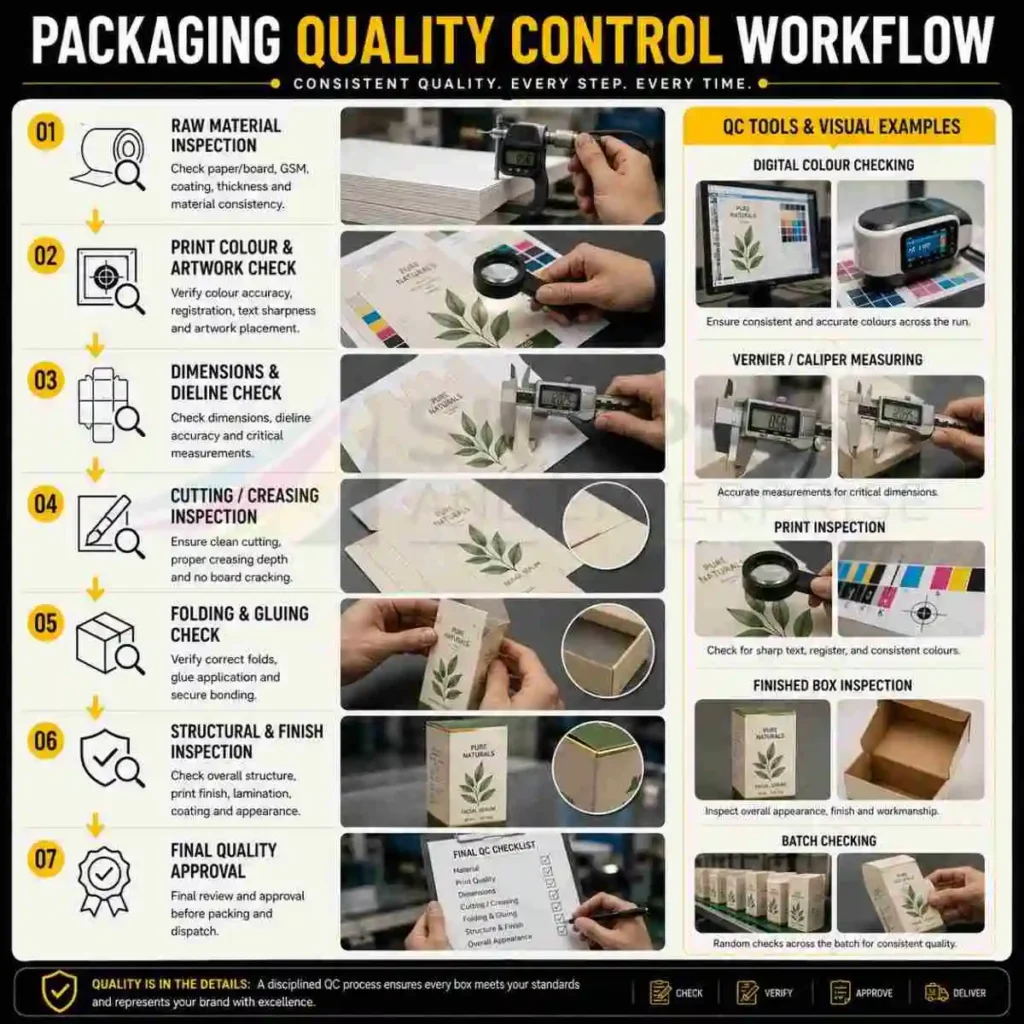
Quality control checks help ensure that packaging meets the agreed material, print, dimensional, structural and finishing specifications.
Packaging Manufacturing Guide: Quality Control and Inspection
Exceptional packaging is not achieved by printing alone. Every professionally manufactured package passes through multiple quality control checkpoints before it reaches the customer. These inspections verify structural accuracy, printing consistency, colour reproduction, finishing quality and assembly precision. As a result, manufacturers can identify potential defects early, reduce production waste and ensure every packaging unit meets the approved specification.
Modern packaging manufacturers combine skilled operators with automated inspection systems to monitor production continuously. Instead of checking only the first and last sheets, quality is verified throughout the manufacturing process to maintain consistency across thousands—or even millions—of packaging units.
🔍 Quality Control Workflow
Artwork Check
File verification
Colour Check
Print approval
Die-Cut Check
Accuracy inspection
Assembly Check
Glue & folding
Final Inspection
Ready for dispatch
Colour Consistency Inspection
Maintaining consistent colour throughout an entire production run is one of the greatest challenges in commercial printing. Even slight colour variations can affect brand recognition and create noticeable differences between production batches. Professional manufacturers therefore monitor colour density, registration and ink balance continuously using calibrated equipment and standardised colour management systems.
Furthermore, this level of control is particularly important for premium products such as Perfume Boxes, Face Wash Boxes and Chocolate Packaging, where brand colours must remain consistent across every package.
Structural Accuracy Testing
Quality inspectors verify that every die-cut blank matches the approved structural drawing. Fold lines, locking tabs, glue flaps and panel dimensions are measured carefully to ensure smooth assembly and reliable product protection. Even a small dimensional error can affect automated packing lines or reduce the overall strength of the finished packaging.
📋 Professional Quality Inspection Checklist
📏 Dimensions
Verify length, width, height and manufacturing tolerances.
🎨 Print Quality
Inspect colour accuracy, registration and image sharpness.
🧴 Glue Strength
Confirm secure bonding without adhesive overflow.
✨ Finishing
Check lamination, foil, embossing and Spot UV quality.
📦 Assembly
Ensure cartons fold correctly and lock securely.
🚛 Shipping Readiness
Verify packaging is suitable for storage and transport.
Performance Testing
Many packaging products undergo additional performance testing before commercial release. Depending on the application, manufacturers may perform compression testing, drop testing, stacking tests, moisture resistance evaluation and transportation simulations. These procedures confirm that the packaging protects the product throughout warehousing, shipping and retail handling.
In addition, corrugated packaging designed for e-commerce or wholesale distribution often requires more rigorous testing than luxury retail cartons because it must withstand significantly greater handling during transportation.
🏆 Manufacturer’s Best Practice – Packaging Manufacturing Guide
Leading packaging manufacturers don’t wait until production is complete to inspect quality. Instead, they monitor every stage of the manufacturing process using scheduled inspections and automated quality control systems. This proactive approach reduces waste, improves production efficiency and delivers consistently high-quality packaging.
Lower Waste
Higher Efficiency
Consistent Quality
Greater Customer Satisfaction
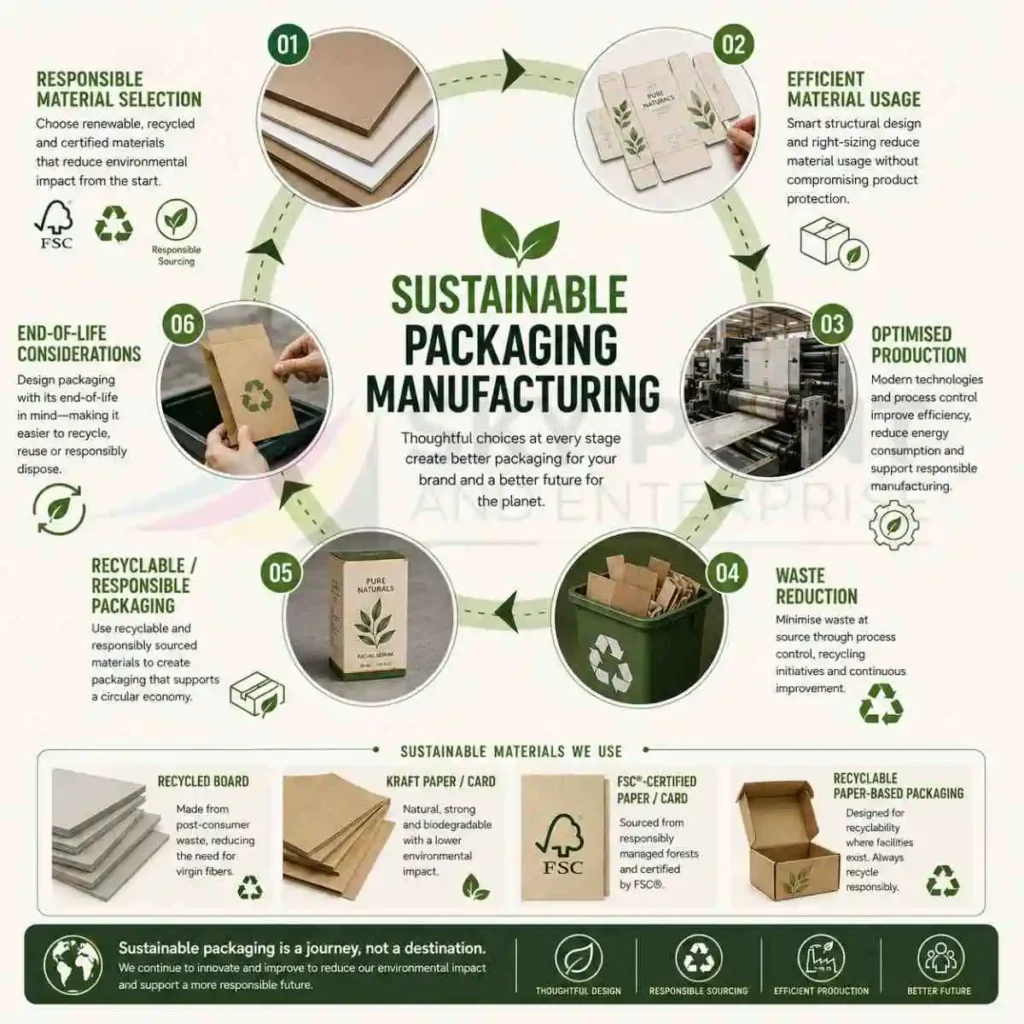
More sustainable packaging manufacturing considers material selection, efficient production, waste reduction and end-of-life recyclability.
Packaging Manufacturing Guide: Sustainable Packaging Manufacturing
Sustainability has become one of the most influential factors in modern packaging manufacturing. Businesses, retailers and consumers increasingly expect environmentally responsible packaging that reduces waste without compromising product protection or brand presentation. As a result, manufacturers continuously improve production methods, adopt recyclable materials and optimise manufacturing processes to reduce environmental impact while maintaining commercial efficiency.
Sustainable packaging manufacturing involves far more than simply using recycled materials. Professional manufacturers evaluate every stage of production, including material sourcing, printing methods, energy consumption, waste reduction and transportation efficiency. Together, these improvements help create packaging that performs well throughout its lifecycle while supporting long-term environmental objectives.
🌱 Sustainable Manufacturing Cycle
Responsible Sourcing
Efficient Production
Waste Reduction
Optimised Logistics
Recycling
Selecting Sustainable Packaging Materials
Material selection plays a significant role in sustainable manufacturing. Modern paperboard, kraft board, corrugated materials and rigid board can all contribute to environmentally responsible packaging when sourced from certified suppliers and used efficiently. Manufacturers carefully balance durability, recyclability, production efficiency and cost before recommending the most suitable substrate for each project.
Businesses looking for environmentally responsible solutions can explore materials such as Kraft Packaging Material, Cardboard Packaging Material, Corrugated Cardboard Material and Rigid Box Material, each offering different performance characteristics depending on the application.
🌿 Sustainable Material Comparison – Packaging Manufacturing Guide
| Material | Key Benefit | Typical Applications |
|---|---|---|
| Kraft Board | Natural appearance | Food, retail & eco packaging |
| Cardboard | Versatile & recyclable | Retail cartons |
| Corrugated Board | High strength | Shipping & e-commerce |
| Rigid Board | Reusable premium packaging | Luxury products |
Reducing Manufacturing Waste
Professional manufacturers continually optimise production layouts to reduce offcuts, minimise material consumption and improve machine efficiency. Advanced nesting software, accurate dieline engineering and automated quality control help reduce unnecessary waste before production begins. Consequently, efficient planning benefits both the environment and overall manufacturing costs.
Additionally, waste reduction also includes recycling paper trimmings, reusing production materials where appropriate and continuously monitoring manufacturing efficiency to identify further improvements.
🏭 Inside the Factory – Packaging Manufacturing Guide
Efficient packaging manufacturers rarely throw usable material away. During production, paperboard offcuts are collected automatically, sorted and recycled instead of entering general waste. Machine operators also monitor sheet layouts carefully to maximise material usage, while production planners arrange multiple packaging designs on the same sheet whenever possible. These small improvements significantly reduce waste across thousands of production runs each year.
Environmentally Responsible Printing
Sustainability extends beyond packaging materials. Modern printing facilities increasingly use low-emission inks, efficient drying systems and advanced colour management technologies that reduce waste during press setup. By producing accurate colours more quickly, manufacturers minimise the number of rejected sheets while improving production efficiency.
However, many manufacturers also optimise production schedules to reduce machine downtime and energy consumption, helping lower their overall environmental footprint without affecting product quality.
💡 Sustainable Manufacturing Best Practices
🌳 Choose Certified Materials
Source responsibly produced paperboard whenever possible.
📐 Optimise Dielines
Reduce material waste through efficient structural design.
♻️ Recycle Production Waste
Recover offcuts and paper waste for recycling wherever practical.
⚡ Improve Efficiency
Reduce setup times, energy use and unnecessary production waste.
Packaging Manufacturing Guide: What Affects Packaging Manufacturing Costs?
One of the most common questions businesses ask is why two packaging projects with similar dimensions can have significantly different manufacturing costs. In reality, packaging pricing depends on dozens of technical variables rather than a single factor. Material selection, production quantity, printing technology, finishing options, structural complexity and logistics all contribute to the final manufacturing cost.
Moreover, professional manufacturers evaluate these variables together rather than individually. Consequently, a small change to one specification—such as increasing board thickness or adding foil stamping—can influence several stages of production simultaneously. Understanding these relationships allows businesses to make informed decisions without compromising packaging quality or functionality.
💷 Cost Breakdown Blueprint
Material
Board grade, GSM & thickness
Printing
Colours & press setup
Finishing
Foil, UV & lamination
Manufacturing
Assembly & machinery time
Delivery
Packing & transport
Production Quantity
Order volume has one of the greatest influences on unit cost. Commercial printing requires machine setup, calibration and production preparation before manufacturing begins. These fixed setup costs are distributed across the total production quantity. Therefore, larger production runs usually achieve a lower unit price than smaller orders because the setup costs are shared across more packaging units.
📈 Expert Insight – Packaging Manufacturing Guide
Many businesses focus exclusively on the lowest quotation rather than the overall manufacturing value. An experienced packaging manufacturer evaluates production efficiency, material optimisation and finishing compatibility to reduce long-term costs while maintaining quality. In many cases, slightly adjusting the packaging specification can produce meaningful savings without affecting the customer experience.
Material Selection
Different materials require different manufacturing processes, machine settings and finishing techniques. Lightweight folding cartons generally cost less to manufacture than luxury rigid boxes because rigid construction involves additional wrapping, assembly and quality inspection stages. Similarly, corrugated packaging requires different converting equipment compared with standard paperboard cartons.
Furthermore, businesses comparing material options can explore our Packaging Materials resource, which explains the characteristics and commercial applications of different packaging substrates.
📊 Cost Impact Decision Matrix – Packaging Manufacturing Guide
| Manufacturing Factor | Impact on Cost | Impact on Quality |
|---|---|---|
| Higher GSM Board | ⬆ Moderate | ⭐⭐⭐⭐⭐ |
| Premium Finishes | ⬆ High | ⭐⭐⭐⭐⭐ |
| Larger Production Run | ⬇ Lower Unit Cost | ⭐⭐⭐⭐⭐ |
| Digital Printing | Best for Short Runs | ⭐⭐⭐⭐ |
⚠ Manufacturing Mistakes to Avoid
Packaging Manufacturing Guide: How to Choose the Right Packaging Manufacturer
Selecting the right packaging manufacturer is one of the most important decisions a business can make. An experienced manufacturing partner does far more than produce boxes. They provide technical guidance, optimise packaging structures, recommend suitable materials, maintain quality standards and ensure reliable production schedules. Consequently, choosing a capable manufacturer can improve product presentation, reduce long-term costs and minimise production risks.
Before requesting quotations, businesses should evaluate a manufacturer’s capabilities, production capacity, technical expertise and quality assurance processes. Comparing prices alone rarely provides the complete picture because manufacturing quality, consistency and customer support contribute significantly to the overall value of a packaging project.
🏭 Packaging Manufacturer Evaluation Roadmap
Portfolio
Review previous projects
Manufacturing
Production capability
Artwork Support
Prepress expertise
Quality Control
Inspection systems
Delivery
Reliable logistics
Evaluate Manufacturing Experience
Every packaging project has different technical requirements. Luxury rigid boxes, corrugated shipping cartons, retail packaging and food packaging each require specialised manufacturing knowledge. Therefore, businesses should work with manufacturers who regularly produce packaging within their industry and understand the relevant production methods, finishing techniques and material requirements.
Experienced manufacturers also identify potential production challenges before manufacturing begins. Their technical recommendations can improve structural performance, reduce waste and simplify assembly without compromising the appearance of the finished packaging.
🏆 Expert Insight
A quotation should never be evaluated solely on price. Ask how the packaging will be manufactured, which materials will be used, what quality inspections are performed and whether structural recommendations are included. Manufacturers who ask detailed technical questions usually deliver better packaging because they understand the complete production process rather than simply calculating a price.
Assess Production Capabilities
Manufacturing capability determines the complexity, consistency and scalability of packaging production. Businesses should confirm whether the manufacturer offers commercial printing, die-cutting, luxury finishing, rigid box production, corrugated packaging and automated folding and gluing. Working with one manufacturer throughout the production process often improves efficiency and quality consistency.
If your project requires multiple packaging formats, it is also beneficial to choose a manufacturer capable of producing everything from Custom Mailer Boxes and Cake Boxes to Catalog Printing and Presentation Folders under one production workflow.
📊 Manufacturer Comparison Matrix
| Evaluation Criteria | Why It Matters | Business Impact |
|---|---|---|
| Manufacturing Experience | Improves production reliability | ★★★★★ |
| Quality Control | Reduces manufacturing defects | ★★★★★ |
| Material Knowledge | Optimises packaging performance | ★★★★★ |
| Finishing Capability | Enhances brand presentation | ★★★★☆ |
| Technical Support | Improves project efficiency | ★★★★★ |
🏭 Inside the Factory
Professional packaging manufacturers begin every project with a production planning meeting. Designers, prepress technicians, production supervisors and quality inspectors review the artwork, structural drawings, material specifications and manufacturing schedule before the first sheet enters the printing press. This collaborative approach reduces production delays, improves quality and ensures every department understands the project requirements before manufacturing begins.
⚠ Common Mistakes When Choosing a Packaging Manufacturer
Packaging Manufacturing Guide: Industry-Specific Packaging Manufacturing
Every industry has unique packaging requirements. Although the manufacturing process follows the same fundamental principles, the choice of materials, structural design, printing methods and finishing techniques varies considerably depending on the product being packaged. A packaging manufacturer must therefore understand both manufacturing technology and the commercial demands of each industry before recommending the most suitable packaging solution.
Professional manufacturers rarely offer a one-size-fits-all approach. Instead, they customise every stage of production to ensure the finished packaging protects the product, supports branding and performs efficiently throughout storage, transportation and retail display.
🏭 Manufacturing Solutions by Industry
Food
Cosmetics
Jewellery
Apparel
Electronics
Retail
🍫 Food Packaging Manufacturing
Food packaging must balance attractive presentation with structural integrity and efficient production. Manufacturers carefully select food-safe materials, suitable coatings and durable box constructions that protect products throughout handling and transportation. Production planning also considers moisture resistance, grease protection and stacking performance to ensure packaging performs reliably in retail environments.
Businesses manufacturing bakery products, confectionery and takeaway meals often require specialised packaging such as Custom Cake Boxes, Pizza Boxes, Fish & Chip Boxes, Sandwich Boxes, Burger Boxes, Chocolate Packaging, Sugared Almond Boxes, Honey Packaging and Indian Mithai Boxes.
🏭 Industry Spotlight — Food Manufacturing
Food packaging production focuses on efficiency, hygiene and product protection. Manufacturers minimise handling during production, use food-compatible materials and design structures that assemble quickly on automated packing lines. These improvements increase productivity while maintaining consistent packaging quality.
💄 Cosmetic Packaging Manufacturing
Cosmetic packaging places greater emphasis on presentation than almost any other industry. Luxury finishes, accurate colour reproduction and premium structural design all contribute to customer perception. Manufacturers frequently combine matt lamination, foil stamping, embossing and Spot UV to produce elegant packaging that reflects premium brand positioning.
Popular cosmetic products include Beard Balm Boxes, Face Wash Boxes and Perfume Boxes. Many brands also explore the wider Cosmetic Packaging range for coordinated product collections.
💍 Jewellery & Luxury Packaging Manufacturing
Luxury packaging requires exceptionally accurate manufacturing. Thick rigid boards, precision wrapping, magnetic closures and decorative finishes combine to create premium presentation while protecting delicate products. Even small manufacturing inconsistencies become noticeable on luxury packaging, making quality control particularly important.
Manufacturers producing Jewellery Packaging frequently combine rigid board construction with foil stamping and embossing to create packaging that reflects the premium value of the product inside.
📊 Industry Manufacturing Comparison
| Industry | Manufacturing Priority | Typical Materials |
|---|---|---|
| Food | Protection & hygiene | Cardboard, Kraft |
| Cosmetics | Luxury appearance | Premium paperboard |
| Jewellery | Premium presentation | Rigid board |
| Electronics | Protection & precision | Corrugated + inserts |
| Retail | Brand visibility | Paperboard |
📱 Electronics, Apparel and Retail Packaging
Electronics packaging prioritises structural protection, while apparel packaging focuses on premium presentation and consistent branding. Retail packaging often combines both objectives by balancing visual appeal with manufacturing efficiency. Consequently, manufacturers customise structural engineering, board grades and finishing techniques according to the intended retail environment.
Businesses can explore dedicated solutions for Electronic Packaging, Apparel Boxes, Retail Packaging and Sports Packaging, each designed to meet different commercial requirements.
🎯 Manufacturer’s Recommendation
The best packaging solution is rarely determined by appearance alone. Professional manufacturers evaluate product weight, storage conditions, transport requirements, retail display, sustainability goals and production efficiency before recommending the final packaging specification. This integrated approach delivers packaging that performs effectively throughout the entire supply chain while supporting long-term brand growth.
Packaging Manufacturing Guide: Complete Packaging Manufacturing Process
Every successful packaging project follows a carefully planned manufacturing workflow. Although the exact production stages vary depending on the packaging style, materials and finishing requirements, professional manufacturers follow a structured process to ensure accuracy, efficiency and consistent quality. Understanding this workflow helps businesses appreciate how technical planning influences the final packaging product.
From the initial enquiry through to final delivery, each department contributes specialist expertise. Designers prepare production-ready artwork, structural engineers optimise dielines, press operators manage colour consistency, finishing specialists enhance presentation and quality inspectors verify every production stage before dispatch.
🏭 Factory Journey — From Concept to Delivery
Consultation
Structural Design
Artwork
Prototype
Printing
Finishing
Assembly
Delivery
1. Consultation and Project Planning
Every manufacturing project begins with understanding the customer’s product, target market and commercial objectives. Packaging specialists discuss dimensions, product weight, branding, transportation requirements, sustainability goals and budget before recommending the most appropriate manufacturing solution. Early planning prevents costly production changes later in the project and ensures every technical requirement is considered from the outset.
2. Structural Design and Engineering
Packaging engineers develop the structural layout using CAD software before creating a precise dieline for production. During this stage they optimise material usage, verify folding sequences and ensure the finished packaging can be manufactured efficiently without compromising strength or appearance.
Projects involving unique retail displays or premium presentation often require bespoke structural engineering. Manufacturers also evaluate whether cardboard, corrugated board, kraft board or rigid board offers the most suitable balance between performance and cost.
🔬 Engineering Explained
Professional manufacturers rarely begin printing immediately after receiving artwork. Structural engineers first confirm that fold lines, locking tabs, glue flaps and panel sizes will function correctly on production machinery. Correcting these details before manufacturing saves significant time, reduces waste and improves assembly efficiency.
3. Artwork Preparation and Prepress
After approving the packaging structure, prepress technicians prepare production-ready artwork. They verify image resolution, colour profiles, bleed, safety margins, trapping, overprint settings and barcode readability before generating printing plates or digital production files. This stage eliminates common production errors and ensures accurate colour reproduction.
If artwork requires adjustments, designers collaborate with the customer before manufacturing begins. Businesses looking to understand artwork preparation in greater detail should also review our dedicated Packaging Artwork Guide once published.
4. Prototype and Sample Approval
Before mass production, manufacturers often produce physical prototypes or short-run samples for approval. These prototypes allow customers to assess dimensions, structural performance, graphics, colours and finishing techniques under real-world conditions. Sampling reduces risk and provides confidence before committing to large production quantities.
💡 Manufacturer’s Recommendation
Never skip the sampling stage for a new packaging project. A prototype confirms structural performance, colour accuracy and overall presentation before full production begins. Identifying small issues during sampling is considerably faster and more cost-effective than correcting them after thousands of units have been manufactured.
5. Commercial Production
Once approved, production begins using commercial printing presses, die-cutting equipment, folder-gluers and finishing machinery. Operators monitor colour consistency, registration accuracy and machine performance continuously throughout the production run. Automated inspection systems support manual quality checks to maintain consistent standards across every packaging unit.
🏭 Inside the Factory
As production progresses, operators regularly remove sample sheets for inspection. Colour density, cutting precision, folding accuracy and finishing quality are measured against the approved production standard. Rather than waiting until the end of manufacturing, adjustments are made immediately whenever small variations are detected. This continuous monitoring helps maintain consistent quality throughout the entire production run.
Packaging Manufacturing Guide: Future Trends in Packaging Manufacturing
The packaging manufacturing industry continues to evolve as brands demand faster production, greater sustainability, improved personalisation and higher quality standards. New technologies are transforming traditional manufacturing methods, allowing packaging manufacturers to produce more efficiently while reducing waste and improving customer experiences.
The future of packaging manufacturing will not depend on a single technology. Instead, the industry is moving towards connected production systems where automation, artificial intelligence, sustainable materials and advanced printing technologies work together to create smarter and more efficient packaging solutions.
🚀 Future Manufacturing Roadmap
Automation
Smarter production
Artificial Intelligence
Better decisions
Sustainability
Lower impact
Digital Printing
Flexible production
Data Systems
Quality control
Artificial Intelligence in Packaging Manufacturing
Artificial intelligence is becoming increasingly important throughout the packaging production process. Manufacturers are using AI-powered systems to analyse production data, identify potential errors and improve machine efficiency. These technologies help reduce downtime, minimise waste and support faster decision-making during complex manufacturing projects.
AI can also support artwork inspection by identifying potential printing issues before production begins. Automated systems can detect colour variations, missing design elements, registration problems and image quality concerns, helping manufacturers maintain consistent results across large production runs.
🔬 Technology Explained: Smart Packaging Factories
A smart packaging factory connects machinery, software and quality systems through digital networks. Instead of operating independently, machines communicate production information in real time. This allows manufacturers to monitor performance, predict maintenance requirements and optimise production schedules.
⚙️ Connected Machines
Real-time production monitoring.
📈 Data Analysis
Improved efficiency and planning.
🔍 Automated Inspection
Faster quality verification.
Growth of Digital Printing
Digital printing continues to transform packaging manufacturing by making short-run production, personalised packaging and rapid product launches more practical. Unlike traditional printing methods that require extensive setup, digital printing allows manufacturers to produce smaller quantities efficiently while maintaining high-quality graphics.
This technology benefits businesses testing new products, launching seasonal collections or requiring multiple packaging designs within one production order. It also supports greater creativity because brands can experiment with different designs without committing to extremely large quantities.
💡 Expert Insight
The future of packaging manufacturing is not only about producing more boxes faster. Successful manufacturers will combine technology with human expertise. Automated systems can improve efficiency, but experienced packaging specialists remain essential for structural design, material selection, finishing recommendations and creative problem-solving.
Sustainable Manufacturing Innovations
Environmental responsibility will continue to influence packaging manufacturing decisions. Future developments will focus on improved recyclable materials, reduced material consumption, renewable resources and more efficient production methods.
Manufacturers will increasingly use advanced design software to optimise packaging structures, reducing unnecessary material while maintaining strength and product protection. Lightweight designs, improved recycling systems and responsible sourcing will become standard expectations rather than optional features.
Personalised Packaging Production
Consumers increasingly value unique brand experiences, creating demand for personalised packaging. Modern manufacturing technologies allow brands to create limited editions, regional designs and customised packaging campaigns without traditional production limitations.
Personalised packaging will become particularly valuable for industries such as cosmetics, food, luxury products and subscription businesses where differentiation plays an important role in customer engagement.
🏭 Inside the Factory: The Future Production Floor
Future packaging factories will combine skilled professionals with intelligent automation. Operators will monitor connected production systems, designers will use advanced software for faster development, and quality teams will analyse real-time production data to maintain consistent standards.
📌 Future Packaging Manufacturing Checklist
- ✔ Sustainable materials and responsible sourcing
- ✔ Automated quality inspection systems
- ✔ Digital production management
- ✔ Flexible manufacturing capabilities
- ✔ Reduced production waste
- ✔ Faster product development cycles
- ✔ Improved customer personalisation options
Packaging Manufacturing Guide: Ultimate Checklist Before Choosing a Packaging Manufacturer
Choosing the right packaging manufacturer requires more than comparing prices. A reliable manufacturing partner influences packaging quality, production efficiency, delivery reliability and the overall success of your product launch. Before placing an order, businesses should evaluate technical capabilities, quality standards, communication processes and manufacturing experience.
This checklist helps businesses assess packaging manufacturers before starting production. Whether you need retail packaging, food boxes, cosmetic cartons, luxury rigid boxes or e-commerce packaging, these evaluation points can help you select a supplier that delivers consistent quality and long-term value.
✅ Packaging Manufacturer Evaluation Checklist
Capability
Can they manufacture your product?
Engineering
Do they offer design support?
Printing
Can they achieve your branding?
Quality
Do they inspect production?
Delivery
Can they meet deadlines?
1. Manufacturing Capability Assessment
The first step is confirming whether the manufacturer has the capability to produce your required packaging style. Different packaging formats require different machinery, materials and production expertise. A manufacturer specialising only in standard cartons may not have the equipment required for premium rigid boxes, complex structures or luxury finishes.
Before selecting a supplier, review their previous projects and confirm whether they manufacture similar products. Experience within your industry can significantly improve production results because the manufacturer understands the specific challenges associated with your packaging requirements.
📋 Capability Questions To Ask
- ✔ Do you manufacture this packaging style regularly?
- ✔ What materials can you produce with?
- ✔ Can you handle both small and bulk production?
- ✔ Do you offer structural design support?
- ✔ Can you provide production samples?
2. Review Material Knowledge
A professional packaging manufacturer should understand how different materials affect strength, appearance, cost and sustainability. The cheapest material is not always the most suitable choice because packaging must protect products while representing the brand effectively.
Manufacturers should be able to explain the advantages of different options, including Cardboard Packaging Material, Kraft Packaging Material, Corrugated Cardboard Material and Rigid Box Material.
💡 Expert Manufacturing Advice
The best packaging material depends on the product, not simply the budget. For example, luxury products may require rigid construction, while shipping products may benefit from corrugated strength. An experienced manufacturer recommends materials based on performance requirements rather than only focusing on reducing initial costs.
3. Check Artwork and Design Support
Packaging manufacturing begins before the printing machine starts. Artwork preparation and structural design directly influence the final quality of the finished packaging. A manufacturer with experienced designers and prepress specialists can identify potential problems before production, reducing delays and unnecessary costs.
Businesses should confirm whether the manufacturer provides dieline support, artwork checking, colour guidance and technical recommendations. This support is especially valuable for businesses creating packaging for the first time.
4. Confirm Quality Control Procedures
Quality control separates professional manufacturers from basic suppliers. Before choosing a packaging partner, ask how they inspect materials, printing accuracy, cutting precision, finishing quality and final assembly.
🔍 Quality Control Checklist
5. Evaluate Communication and Project Management
Successful packaging projects require clear communication between the customer and manufacturer. Delays often occur when specifications, artwork approvals or production requirements are unclear. A reliable manufacturer provides regular updates and keeps customers informed throughout the manufacturing process.
Good communication includes clear quotations, realistic production timelines, sample approvals and transparent delivery information. These factors are just as important as manufacturing capability because they directly affect the overall project experience.
🏆 Final Manufacturer Selection Scorecard
| Category | Priority |
|---|---|
| Production Capability | ★★★★★ |
| Material Expertise | ★★★★★ |
| Quality Control | ★★★★★ |
| Design Support | ★★★★☆ |
| Communication | ★★★★★ |
Packaging Manufacturing Guide: Quality Control Process in Packaging Manufacturing
Quality control is one of the most important stages in professional packaging manufacturing. A packaging manufacturer does not simply produce boxes and dispatch them. Every production stage requires inspection, testing and monitoring to ensure the final packaging meets the approved specifications.
Consistent quality is especially important for businesses selling products in competitive markets. Packaging represents the brand before customers experience the product itself. Poor printing, inaccurate dimensions or weak construction can negatively affect customer perception and create unnecessary costs.
🔍 Packaging Quality Control Journey
Material Check
Before production
Print Inspection
Colour accuracy
Cutting Check
Structural precision
Assembly Check
Folding & glue
Final Approval
Ready for delivery
Incoming Material Inspection
Quality control begins before manufacturing starts. Professional packaging manufacturers inspect incoming materials to confirm that the board grade, thickness, colour, texture and finish match the approved specification.
Material consistency is essential because variations in paperboard, kraft or corrugated materials can affect printing performance, structural strength and the overall appearance of the finished packaging.
📋 Material Inspection Checklist
Printing Quality Inspection
Printing accuracy directly affects brand presentation. Packaging manufacturers monitor colour reproduction, registration accuracy and print consistency throughout production. Even small variations can become noticeable when thousands of packaging units are displayed together.
Professional printing processes include regular checks for ink density, alignment, sharpness and image quality. These inspections help ensure that logos, product information and brand colours appear exactly as approved.
💡 Expert Manufacturing Insight
Colour accuracy is not achieved only through good printing equipment. It requires correct artwork preparation, suitable colour profiles, experienced operators and continuous monitoring during production. This is why professional packaging manufacturers review colour standards before mass production begins.
Die-Cutting and Structural Accuracy Checks
After printing, packaging sheets move to the die-cutting stage where the final shape, folding lines and locking features are created. Precision during this stage is critical because incorrect cutting can affect assembly, product fitting and overall appearance.
Manufacturers inspect cut lines, crease positions, window cut-outs, glue flaps and structural components to ensure every packaging unit performs correctly during assembly.
📐 Structural Quality Testing
| Test Area | Purpose |
|---|---|
| Dimensions | Ensures product fitting accuracy |
| Folding Lines | Ensures smooth assembly |
| Glue Points | Ensures packaging strength |
| Locking Features | Improves usability |
Assembly and Finishing Inspection
Premium packaging often includes additional finishing processes such as lamination, foil stamping, embossing and Spot UV. Each finishing technique requires careful inspection to maintain a professional appearance.
During assembly, quality teams check folding accuracy, adhesive strength, surface cleanliness and overall presentation. This stage is particularly important for luxury packaging where customers expect a premium unboxing experience.
Final Packaging Inspection Before Delivery
Before products leave the manufacturing facility, final inspections confirm that the completed packaging matches the approved sample and production requirements. Random samples are selected from finished batches and checked against quality standards.
🏆 Final Quality Approval Checklist
- ✔ Correct packaging dimensions
- ✔ Approved colours and artwork
- ✔ Strong structural performance
- ✔ Accurate finishing application
- ✔ Clean assembly quality
- ✔ Correct quantity verification
- ✔ Secure packaging before dispatch
Why Quality Control Matters
A packaging manufacturer with strong quality control processes protects businesses from production issues, customer complaints and unnecessary replacement costs. Consistent quality builds brand confidence and ensures that every product reaches customers with professional presentation.
Packaging Manufacturing Guide: Lead Times, Production Planning and Delivery Management
Understanding packaging manufacturing lead times helps businesses plan product launches, stock requirements and marketing campaigns more effectively. While production schedules vary depending on packaging type, quantity, materials and finishing requirements, professional manufacturers follow a structured workflow to ensure projects move efficiently from concept to delivery.
Many production delays do not occur because of manufacturing limitations. They often happen due to incomplete artwork, late approvals, incorrect specifications or poor planning between the customer and supplier. A clear manufacturing timeline helps businesses avoid unexpected delays and ensures packaging arrives when required.
⏱️ Typical Packaging Manufacturing Timeline
Brief
Requirements confirmed
Artwork
Design approval
Sampling
Prototype review
Production
Manufacturing stage
Delivery
Dispatch planning
Factors That Influence Packaging Manufacturing Lead Times
No two packaging projects have exactly the same production timeline. A simple folding carton may require less preparation than a complex rigid box with multiple finishing processes. Manufacturers evaluate several factors before confirming a realistic delivery schedule.
📋 Main Lead Time Factors
📦 Packaging Style
Complex structures require more preparation.
🎨 Artwork Approval
Delays occur when designs are not finalised.
✨ Finishing Options
Luxury finishes add production stages.
📊 Order Quantity
Large orders require additional planning.
🚚 Delivery Location
Logistics affects final timelines.
Artwork Approval and Its Impact on Production
Artwork approval is one of the most important stages in packaging manufacturing. Production cannot begin until the manufacturer receives final approved artwork because printing, cutting and finishing depend on accurate design files.
Businesses can reduce delays by preparing artwork correctly before production begins. This includes confirming dimensions, colours, logos, product information, regulatory details and finishing requirements.
💡 Planning Tip
Businesses launching new products should complete packaging planning earlier than the product launch date. Allowing additional time for artwork approval, samples and manufacturing creates flexibility and reduces pressure during the final stages.
The Importance of Packaging Samples Before Production
Sampling provides an opportunity to review packaging before full production begins. A physical sample confirms the dimensions, material selection, structural design and finishing quality. It allows businesses to identify improvements before committing to the complete production quantity.
Although sampling adds an additional stage to the process, it often saves significant time and cost by preventing large-scale production mistakes.
🏭 Production Planning Checklist
How Manufacturers Improve Production Efficiency
Experienced packaging manufacturers improve efficiency through careful scheduling, organised production workflows and technical expertise. They combine automated machinery with skilled operators to maintain quality while completing projects within agreed timelines.
Efficient manufacturers also maintain relationships with material suppliers, allowing them to source suitable boards, papers and finishing materials more reliably. This reduces unexpected delays caused by material availability issues.
📊 Lead Time Management Summary
| Stage | Customer Action | Impact |
|---|---|---|
| Specification | Provide accurate requirements | Faster quotation |
| Artwork | Approve designs quickly | Earlier production start |
| Sampling | Review carefully | Reduced production risk |
| Production | Maintain communication | Smooth completion |
Final Manufacturing Advice
The most successful packaging projects begin with proper planning. Businesses that provide accurate specifications, approve artwork promptly and communicate clearly with manufacturers experience smoother production, better quality results and more reliable delivery schedules.
Packaging Manufacturing Guide: Common Packaging Manufacturing Mistakes to Avoid
Successful packaging projects require careful planning, technical knowledge, and clear communication between businesses and manufacturers. However, many packaging problems do not happen during production; instead, they occur earlier because of incorrect specifications, poor planning, or choosing the wrong manufacturing partner.
Therefore, understanding common packaging manufacturing mistakes allows businesses to make better decisions and reduce unnecessary costs. In addition, it helps ensure that packaging performs correctly from the first production run. For example, whether you are developing retail packaging, food boxes, cosmetic cartons, or luxury packaging, avoiding these mistakes can significantly improve your results. As a result, businesses can achieve better packaging quality, smoother production, and more reliable outcomes.
⚠️ Packaging Manufacturing Mistake Prevention Guide
Design Errors
Poor planning
Material Choice
Wrong specification
Artwork Issues
Production delays
Supplier Selection
Quality risks
Quantity Planning
Cost problems
1. Choosing a Packaging Manufacturer Based Only on Price
Price is an important factor; however, selecting a packaging manufacturer simply because they offer the lowest quotation can create problems later. In fact, extremely low pricing may indicate compromises in material quality, production standards, finishing options, or quality control procedures.
Therefore, a professional manufacturer evaluates the complete project requirements rather than offering a simple price per box. Instead, they consider material performance, production efficiency, finishing requirements, and delivery expectations before recommending the most suitable packaging solution. As a result, you can achieve better quality, consistent production, and reliable delivery while maintaining overall cost efficiency.
💡 Expert Manufacturing Advice
The cheapest packaging option is not always the most economical choice. Poor-quality packaging can increase replacement costs, damage products during shipping and negatively affect customer perception. Businesses should evaluate overall value rather than focusing only on initial pricing.
2. Selecting the Wrong Packaging Material
Choosing the correct material is one of the most important decisions in packaging manufacturing. Moreover, different materials provide varying levels of strength, protection, appearance, and sustainability.
For example, luxury products may require rigid construction to create a premium experience, whereas shipping products may need corrugated strength for better transportation protection. Similarly, food products may require suitable coatings and food-safe materials, while retail packaging may focus more on visual presentation. Therefore, selecting the right material depends on the product type, protection requirements, brand positioning, and intended use.
📦 Material Selection Questions
| Question | Why It Matters |
|---|---|
| What product weight will the packaging hold? | Determines structural strength |
| Will the packaging be shipped or displayed? | Influences material selection |
| Is premium appearance important? | Determines finishing options |
| Are sustainability goals required? | Guides material choices |
3. Ignoring Structural Design and Functionality
Many businesses focus heavily on graphics while overlooking the structural performance of their packaging. Attractive artwork cannot compensate for packaging that does not protect the product or function correctly.
Packaging engineers consider dimensions, product weight, assembly method, storage requirements and transportation conditions before finalising the structure. This approach ensures the packaging looks impressive while performing effectively.
📐 Structural Design Checklist
4. Not Approving Samples Before Mass Production
Skipping the sampling stage can create unnecessary risks. Digital artwork previews cannot always show the real behaviour of packaging materials, colours and structures.
Physical samples allow businesses to check the actual size, feel, strength and appearance before committing to a full production run. This is especially important for custom packaging with special structures or premium finishes.
5. Providing Incorrect Product Information
Accurate product information is essential for successful packaging manufacturing. Incorrect dimensions, product weights or usage requirements can lead to packaging that does not perform as expected.
Before production begins, businesses should provide complete details including product measurements, quantity requirements, storage conditions, shipping expectations and branding requirements.
🏆 Final Mistake Prevention Checklist
- ✔ Do not select a supplier only because of price
- ✔ Choose materials based on product requirements
- ✔ Invest time in structural planning
- ✔ Approve samples before bulk production
- ✔ Prepare accurate artwork files
- ✔ Confirm quantities before manufacturing
- ✔ Discuss delivery requirements early
- ✔ Work with an experienced packaging manufacturer
Building Better Packaging Projects
The strongest packaging projects combine creative design, technical manufacturing knowledge and careful planning. By avoiding common mistakes and working with an experienced packaging partner, businesses can achieve packaging that protects products, strengthens branding and delivers long-term value.
Packaging Manufacturing Industry Resources
Professional packaging manufacturers follow recognised industry standards, environmental guidance and best practices. The following organisations provide useful information about sustainable packaging, responsible sourcing, packaging regulations and print quality.
- WRAP UK – Guidance on sustainable packaging and recycling.
- British Printing Industries Federation (BPIF) – Printing industry standards and technical resources.
- Forest Stewardship Council (FSC) – Responsible forest certification.
- International Organization for Standardization (ISO) – International manufacturing and quality standards.
Packaging Manufacturing Guide FAQs
Below are answers to some of the most common questions about packaging manufacturing. Whether you are ordering custom packaging for the first time or improving an existing product, this Packaging Manufacturing Guide will help you make informed decisions.
1. What is packaging manufacturing?
Packaging manufacturing is the complete process of designing, printing, converting and assembling packaging products. Overall, it includes material selection, structural engineering, commercial printing, finishing, quality control and delivery.
2. Why is a Packaging Manufacturing Guide important?
A Packaging Manufacturing Guide explains every stage of production. Therefore, businesses can understand materials, costs, lead times and quality standards before placing an order.
3. Which materials are commonly used in packaging manufacturing?
Generally, manufacturers use cardboard, kraft board, corrugated board and rigid board. However, the most suitable material depends on the product, budget and shipping requirements.
4. How long does packaging manufacturing take?
Production time varies according to the packaging style and quantity. Typically, projects take several working days after artwork approval. However, luxury packaging and specialist finishes may require additional production time.
5. What affects packaging manufacturing costs?
Material type, dimensions, quantity, printing method and finishing all influence pricing. In addition, custom inserts, premium finishes and complex structures can increase manufacturing costs.
6. Why should I request a sample before production?
A sample allows you to inspect dimensions, colours and structural performance. Consequently, potential issues can be corrected before full production begins.
7. What printing methods are used in packaging manufacturing?
Offset printing and digital printing are the most common options. Meanwhile, flexographic printing is widely used for corrugated packaging and large-volume production.
8. What is the difference between offset and digital printing?
Offset printing is ideal for larger quantities. On the other hand, digital printing provides excellent flexibility for smaller production runs and personalised packaging.
9. Why is quality control important in packaging manufacturing?
Quality control ensures every packaging unit meets the approved specifications. Furthermore, it reduces waste, prevents production errors and protects brand reputation.
10. Can packaging manufacturing be environmentally friendly?
Yes. Today, many manufacturers offer recyclable, biodegradable and responsibly sourced materials. Additionally, efficient production methods help reduce material waste.
11. What is a dieline?
A dieline is the structural template used to manufacture packaging. Essentially, it shows cut lines, fold lines, glue areas and safety margins.
12. Which finishing options are available?
Common finishing options include matt lamination, gloss lamination, Spot UV, embossing, debossing and foil stamping. As a result, packaging achieves a more premium appearance.
13. What industries use custom packaging manufacturing?
Packaging manufacturing supports food, cosmetics, retail, electronics, jewellery, healthcare, fashion and e-commerce businesses. Likewise, subscription box companies rely heavily on custom packaging.
14. What information should I provide before requesting a quotation?
You should provide product dimensions, quantity, artwork, material preferences and finishing requirements. This allows manufacturers to prepare an accurate quotation.
15. How can I reduce packaging manufacturing costs?
Ordering appropriate quantities, selecting suitable materials and finalising artwork before production can reduce costs. Moreover, efficient structural design minimises material waste.
16. Why is structural design important?
Structural design ensures packaging protects the product while remaining easy to assemble. Without proper engineering, packaging may fail during transportation.
17. Can packaging manufacturers help with artwork?
Yes. Most professional packaging manufacturers provide artwork checking, prepress support and structural design assistance before production begins.
18. What is MOQ in packaging manufacturing?
MOQ means Minimum Order Quantity. However, minimum quantities vary depending on packaging style, material and production method.
19. Why are lead times different for every project?
Lead times depend on materials, production schedules, finishing techniques and delivery location. Consequently, every project should be planned individually.
20. How do I choose the right packaging manufacturer?
Choose a manufacturer with proven experience, strong quality control and excellent communication. Above all, review previous work before placing an order.
21. Can packaging manufacturing improve my brand?
Absolutely. High-quality packaging manufacturing creates a professional first impression. Furthermore, premium packaging increases customer confidence and strengthens brand recognition.
22. Is sustainable packaging more expensive?
Not always. Although some eco-friendly materials cost more, efficient manufacturing often offsets these differences through reduced waste.
23. How important is colour consistency?
Colour consistency is essential for brand identity. Therefore, professional manufacturers monitor colour accuracy throughout the entire production process.
24. What should I avoid during packaging manufacturing?
Avoid incomplete artwork, incorrect dimensions and selecting suppliers based only on price. Instead, focus on quality, technical expertise and long-term value.
25. Where can I order professional custom packaging?
If you need custom packaging manufactured in the UK, choose a supplier with expertise in structural design, commercial printing, quality control and sustainable materials. Ultimately, an experienced packaging manufacturer delivers better results and a smoother production experience.